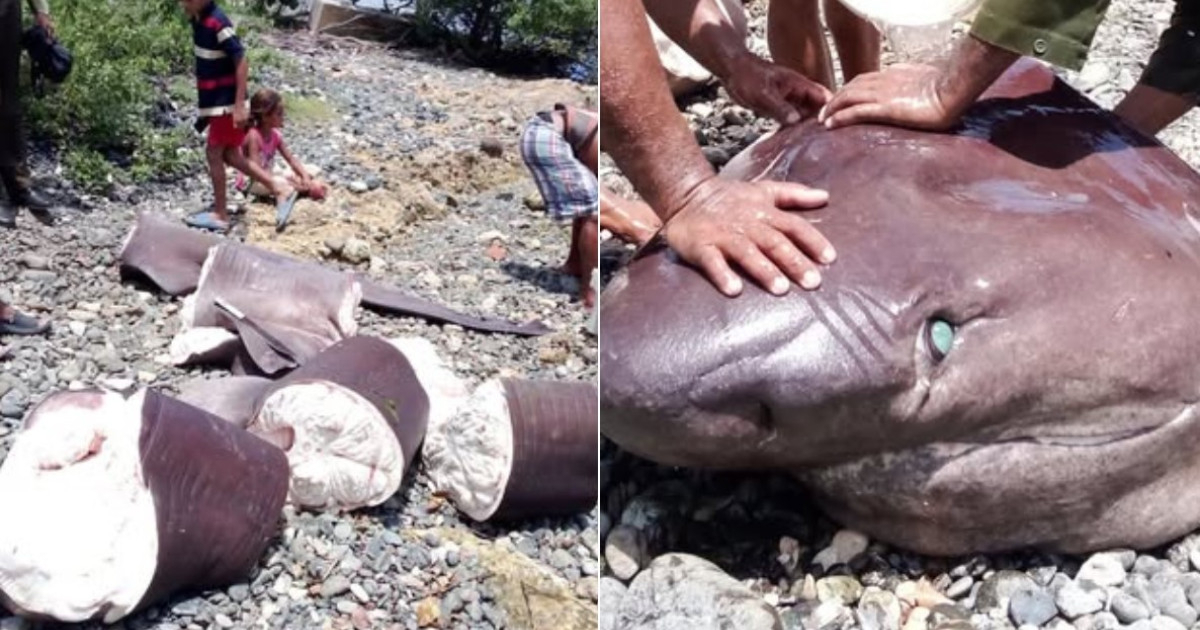
The Association of Divers of Santiago de Cuba issued an alert this Monday regarding the recent captures and deaths of sharks reported at various locations across the Island, and warned about the potential consequences for the marine ecosystem resulting from the disappearance of these predators, while acknowledging that the severe economic and food crisis influences many of these practices.
"They are killing sharks in Santiago... and it's not just their problem," noted the organization in a Facebook post, in which it reviewed several recent incidents that occurred on Cuba's coasts.
The association mentioned among those cases a shark weighing over 500 kilograms that was dismembered in Baracoa, a hammerhead shark transported through the streets of Varadero, and other specimens caught in recent weeks.
These are not isolated stories. They are a pattern. And we cannot remain silent, the group of divers expressed.
Its members, who dive in the waters where these animals live, also rejected the perception of sharks solely as a threat to humans.
"Sharks are not the danger. The danger is losing them," they stated.
The organization highlighted the role these predators play in the balance of marine ecosystems, referring to them as the "doctors of the ocean" due to their function in controlling other populations.
According to divers, a recent study conducted by Cuban scientists identified 83 species of sharks and rays in the waters around the Island, several of which are critically endangered.
"When we kill a shark, we are not 'eliminating a threat'. We are weakening the entire ecosystem that we depend on for fishing, for tourism, for living," they warned.
However, the association avoided reducing the captures to just a problem of lack of environmental awareness and acknowledged the impact that the current economic situation has on the decisions of many Cuban families.
The economic crisis is real. Hunger is real. And in moments of desperation, people seek to survive as best they can, he pointed out.
The divers insisted, however, that the protection of these species is also necessary in the long term and stated that there are Cuban laws to protect sharks.
"It's not about pointing fingers. It's about educating," they emphasized.
Several episodes involving sharks have drawn attention on social media in recent months, while also reflecting the hunger and desperation that, according to divers in Santiago de Cuba, lie behind many of these captures.
One of the most notable occurrences happened in May, when a shark weighing over 500 kilograms was captured in the coastal area of Yumurí, in Baracoa.
The viral images showed the huge animal already cut and processed into sections on the shore.
Another case occurred in July, when a large shark was captured off 50th Street in Varadero.
The author of the post that documented the incident later stated that the animal "ended up filleted."
Just days later, a hammerhead shark was transported on a motorcycle through the streets of Varadero, in a scene where the animal's tail brushed against the pavement as the vehicle moved forward.
Related videos:
Filed under: