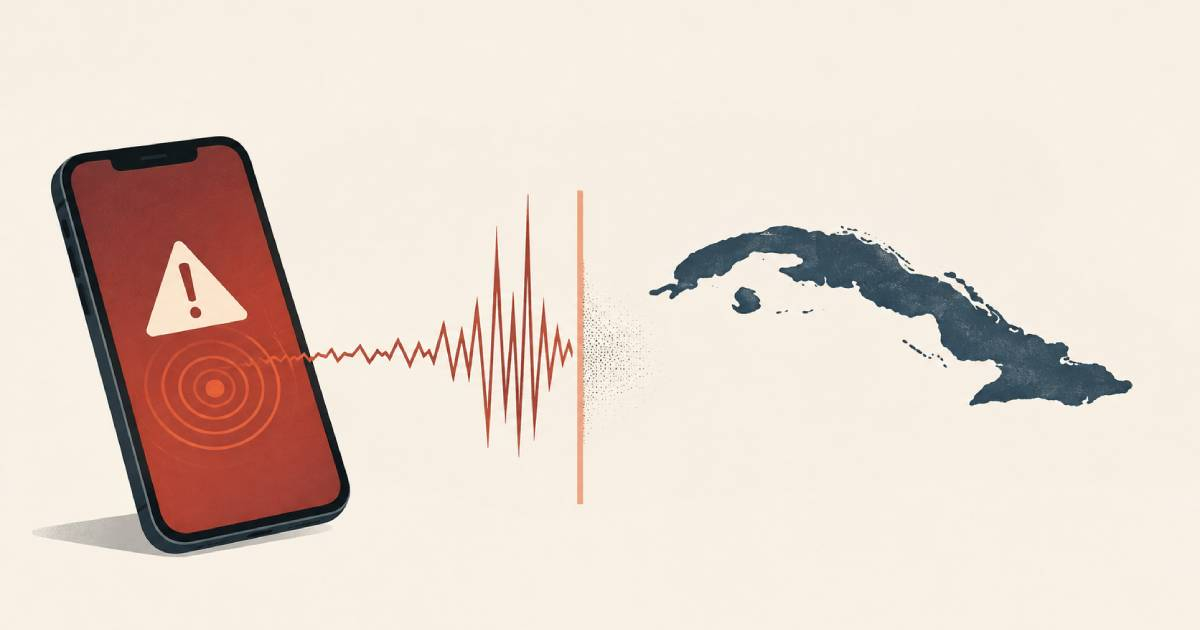
An earthquake alert that appeared this Tuesday on Android phones and tablets caused moments of panic in several provinces of Cuba, prompting many people to leave their homes, workplaces, and other buildings out of fear that a strong earthquake was about to occur.
The warning turned out to be a false seismic alert transmitted through mobile devices, as clarified shortly afterward by specialists and Cuban authorities.
Dr. Enrique Diego Arango Arias, head of the National Seismological Service of Cuba and technical deputy director of the National Center for Seismological Research (CENAIS), reacted swiftly to the confusion generated on the island.
"False earthquake alarm in Cuba is transmitted via phones," he wrote on his social media.
Subsequently, Arango Arias provided a more detailed explanation, circulated by the newspaper Sierra Maestra, in which he clarified that the alert received on mobile devices in various locations across the country was not supported by any official notification.
"The earthquake alarm that reached mobile devices in many parts of the country is not based on any officially issued alert notice," the specialist clarified.
The head of the National Seismological Service added that the country's network of stations had not detected any significant seismic activity that would warrant such a warning.
“The specialist emphasized that the network of stations from the Service has not detected any significant seismic activity, thus the information that has also been spread on social media and cell phones is completely false,” stated Sierra Maestra.
The official newspaper Girón also denied that an earthquake of the magnitude detected by the devices was occurring. The newspaper quoted Mario Sabines Lorenzo, the first secretary of the Communist Party in Matanzas, who stated that he had contacted the National Civil Defense Headquarters to verify the situation.
"It is false about the earthquake tremor and the earthquake alert," he stated.
However, hours later, the CENAIS clarified an element that could have contributed to the confusion: this Tuesday there was indeed an earthquake in Cuba, although its location and characteristics did not match the alert received by many users.
Its epicenter was located in Ciego de Ávila, at the coordinates of 21.52 degrees north latitude and 78.72 degrees west longitude. Authorities reported no material damage or casualties related to this seismic event.
"Everyone is in the streets."
The alert reached users in at least nine provinces: Mayabeque, Granma, Holguín, Matanzas, Havana, Ciego de Ávila, Camagüey, Las Tunas, and Santiago de Cuba.
Not all phones reacted in the same way. Some users claimed they did not receive any warning. Two residents of El Vedado, in Havana, for example, said that their devices did not display the notification.
For those who did receive it, the reaction in some areas was immediate. "In the center of Camagüey, everyone is in the streets," reported a witness.
From Campechuela, in Granma, Jenny Yero stated that "people are very worried," while Norge Luis Fernández Ardevol mentioned that they had also left their homes: "We also went out to open areas."
In Santiago de Cuba, where seismic movements are part of the recent memory of its residents, the warning generated particular unease.
"People rushed into the streets. In Santiago, we remember the occurrence of several earthquakes," recounted a resident. "Many of us were scared," summarized Teresa Ramos, another of those caught off guard by the alarm.
The seismic notifications on Android devices are part of the Google Android Earthquake Alerts System, a technology that uses the sensors of the devices themselves to detect movements consistent with an earthquake and to complement information from seismological systems.
According to Google, alerts can be sent for nearby earthquakes of magnitude 4.5 or higher, provided that certain functions, such as location services, are enabled. The company itself warns that not all earthquakes can be detected and that the estimates of magnitude and intensity may contain errors.
At this time, it has not been officially reported what caused the warning to reach user devices located in different parts of Cuba.
A population particularly vulnerable to earthquakes
The incident takes place at a time of heightened attention to seismic activity in the Caribbean. Throughout 2026, several perceptible tremors have been reported in the region, some of considerable magnitude, which has raised concerns among the population.
The reaction this Tuesday also recalls what happened in Baracoa in June 2021, when a false rumor about the arrival of a tsunami caused around a thousand people to seek refuge in elevated areas. Some later required medical attention.
On this occasion, there were no reported victims or damages associated with the alert, but for several minutes, thousands of Cubans had to face the uncertainty of not knowing whether the notification that had just appeared on their phones was anticipating a real earthquake.
People venturing into open spaces across various parts of the country demonstrated the extent to which concern over seismic phenomena remains alive in Cuba and how an alert received directly on their cell phones can trigger an immediate reaction when the population feels their safety is at risk.
Related videos:
Filed under: