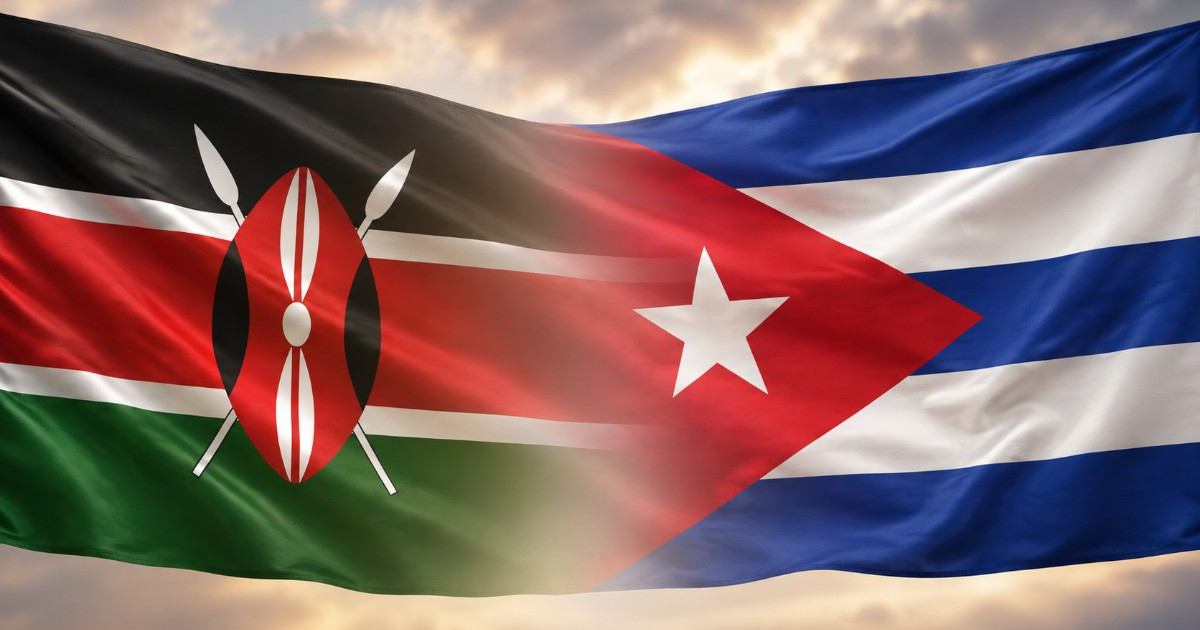
Kenia closed its embassy in Havana and moved its center of diplomatic operations in the Caribbean to Kingston, Jamaica, marking the end of a decade in which Cuba served as Nairobi's main base in the region. The change, however, does not signify the breaking of diplomatic relations between the two nations.
The closure was reported this Monday by Kenyan Foreign Policy, which stated that the representation in Havana was closed and its operations were moved to Jamaica.
For its part, the Ministry of Foreign Affairs of Kenya had confirmed in July a "transition" of its diplomatic operations from Havana to Kingston.
The new High Commission of Kenya in Jamaica officially began operations in July. Karisa Mwenda, who previously served as the Kenyan representative in Havana, relocated to Kingston to take on the role of the first resident high commissioner of the African country in Jamaica.
The Kenyan government presented the opening of the mission as a commitment to deepen its political and economic relations with Jamaica and to expand its commercial, investment, cultural, and consular activities in the Caribbean. Kingston is also viewed by Nairobi as a gateway to the Caribbean Community (CARICOM) market.
The Ministry of Foreign Affairs thanked the diplomatic staff for ensuring what it described as a "smooth" transition of operations from Havana to Kingston, a formulation that made it clear that the new Jamaican headquarters would effectively replace the regional role that the Cuban mission had played for years.
The Kenyan embassy in Cuba opened in 2016 and became the first diplomatic mission of the African country in the Caribbean. From Havana, Kenya also managed relations with several countries in the Caribbean, Central America, and South America.
The closure of the embassy does not mean that Nairobi has severed relations with Havana. Cuba maintains its embassy in the Kenyan capital, and Kenya will continue to have diplomatic representation before the Cuban government through a non-resident ambassador based in Kingston, according to Kenyan Foreign Policy.
The realignment marks the end of a phase in the relations between the two governments, during which health cooperation played a significant role.
In 2018, 100 Cuban medical specialists were sent to Kenya under an agreement aimed at addressing staff shortages in healthcare facilities across various counties. The program ended in 2023.
That collaboration was also marked by one of the most serious incidents related to Cuban medical missions abroad.
The doctors Landy Rodríguez Hernández and Assel Herrera Correa were kidnapped on April 12, 2019 in Mandera, northeastern Kenya, while they were being escorted to the hospital where they worked. The attack was attributed to the Islamist group Al-Shabaab and resulted in the death of a Kenyan police officer.
Al-Shabaab claimed in 2024 that the two doctors had died during a U.S. airstrike in Somalia, but that version was never independently confirmed. Seven years after the kidnapping, Cuban authorities still had not provided a definitive confirmation regarding their fate.
Kenia and Cuba have recently been linked, albeit separately, to another international phenomenon: the recruitment of foreign citizens to fight alongside Russia in Ukraine.
Kenyan authorities acknowledged cases among their nationals, repatriated dozens of people, and closed more than 600 recruitment agencies, while in Cuba, no updated official figures have been disclosed regarding how many citizens have ended up being incorporated into Russian forces.
Related videos:
Filed under: