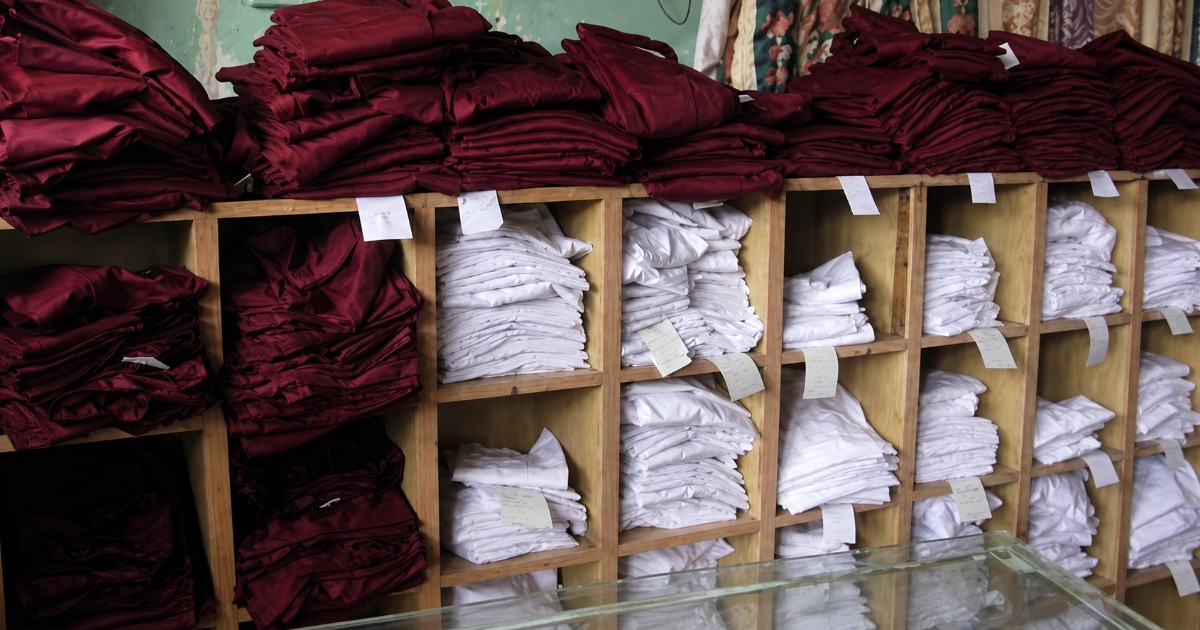
The authorities of Ciego de Ávila acknowledged that the demand for school uniforms can only be prioritized for preschool, fifth, and seventh grades, which means that students in continuing years will not be included in this coverage, a decision that has provoked numerous criticisms from parents and family members: "What about the other children, don't they exist?"
The situation was reported this Wednesday by the state newspaper Invasor, which provided information about a meeting to prepare for the 2026-2027 school year led by Party and Government officials in that province, where logistical, financial, material, organizational, and transportation difficulties were analyzed.
Executives of the Base Business Unit Confecciones Trébol reported that there are still about 2,700 garments left to be made, primarily for primary education and mainly related to shorts.
The official forecast is to complete that production next week, just a few days before the start of the school year, scheduled for September 1.
However, the official information itself clarified that the demand for school clothing will be met "only as a priority" for the mentioned grades, and not for the continuing years.
In the province, there are also garments brought from Sancti Spíritus, including shirts, and the authorities are coordinating with trade entities to make them available for sale to the public as soon as possible.
The news raised immediate questions about what will happen to the children whose uniforms from previous years no longer fit them.
"Tremendous achievement. Do the children in the continuing groups not grow or is the uniform stretchy?" someone joked.
A mother explained that her son will start second grade with clothing received from preschool: "They gave him a pair of shorts and two shirts. Those pieces no longer fit him. Of course, children grow and stretch. How long do we have to reinvent ourselves?"
Another woman indicated that she would not resort to the informal market to solve the problem: "I'm not going to buy uniforms online, so mine will be in civilian clothes."
Many questions also arose about the students entering tenth grade. "I can't understand why the students who are about to start tenth grade aren't prioritized as well. Since seventh grade, they have been given a uniform, they have grown, and they are in the midst of development," stated one person.
"And what uniform will the children starting tenth grade wear to school?" asked another.
Some parents demanded that schools not penalize students who must attend in casual clothing due to the lack of uniforms.
"I hope that when the continuing students go out in civilian clothing, the teachers don't want to take disciplinary action or punish them," warned a user.
Another reaction questioned the proximity of the start of classes in light of a production that is still incomplete: "So how can they say that all the conditions are in place for the new school year if, at this point, the making of the uniforms has not been completed, and then there’s the distribution and sale?"
The difficulties for the start of the school year in Ciego de Ávila go beyond clothing. During the meeting, the delays in salary payments to education workers were also addressed, which according to the authorities themselves have caused "great tensions" over the past four or five months.
The director general of Education in the province, Luis Enrique Calderón Piñeiro, also proposed the possibility of installing photovoltaic solar kits in residential centers and homes for children without parental care to ensure certain nighttime activities in light of energy challenges.
The deficiencies in transportation and fuel will also necessitate a reorganization of higher education.
The teaching activities of various programs will be moved to the Manuel Ascunce Domenech campus in the city of Ciego de Ávila, due to the challenges in traveling to the central campus of the Máximo Gómez Báez University, located in the Modesto Reyes community.
The issue of uniforms adds to another growing concern for Cuban families as they return to school: how to ensure the daily meals of students.
A mother questioned what snacks children will be able to take to school due to the rising cost of basic products. She cited examples such as oil, which she found for 4,000 pesos, and sausages for 1,200 pesos.
The economic concern was also reflected in a personal calculation that estimated 10,160 pesos per month as the expenditure needed to cover 30 breakfasts and 30 snacks for a child, excluding lunches, meals, transportation, medications, shoes, clothing, notebooks, and backpack.
Incomplete uniforms, difficulties with food supply, transportation issues, fuel shortages, delays in salary payments, and continuous blackouts are all part of the situation that Ciego de Ávila is facing as it attempts to start the new school year.
Related videos:
Filed under: