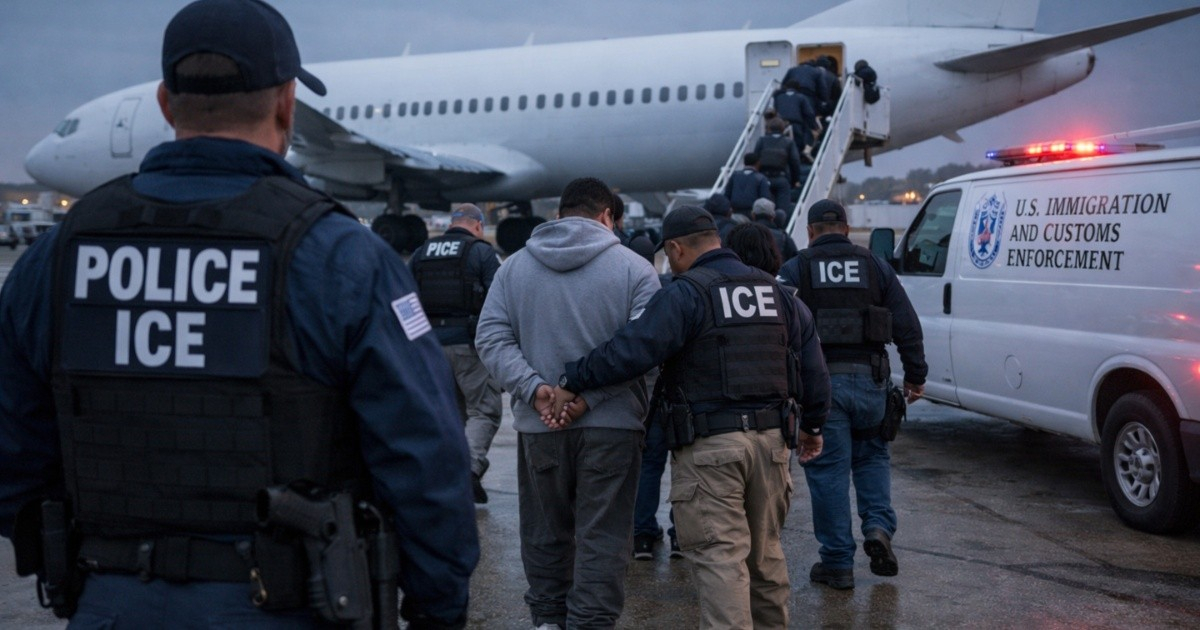
The first 20 migrants deported by the United States to Liberia arrived this Thursday at Roberts International Airport, located outside Monrovia, marking the beginning of an agreement under which the African country has agreed to accept up to 1,200 foreigners within a 12-month period, according to the Associated Press.
The plane landed just before 1:00 PM local time, and the deportees were transferred by bus from the airport.
Personnel from the Liberian Commission for Repatriation, Resettlement, and Reintegration were responsible for attending to them; the journalists from AFP present at the scene were kept at a distance and were unable to speak with any of the arrivals.
The agreement was announced on Tuesday by the Liberian government and is among the largest deportation operations to third countries initiated by the administration of Donald Trump.
The Minister of Information of Liberia, Jerolinmek Piah, specified that the group of 1,200 will not be limited to African citizens: "Among the 1,200 deported, there will be citizens from Africa, as well as from North America, South America, and the Caribbean."
The Liberian Minister of Justice, Natu Oswald Tweh, explained at a press conference that the government reviewed the list of migrants before their arrival and that most had committed immigration-related infractions or offenses. Tweh added that the deported individuals could request asylum in Liberia or leave whenever they wish.
The Liberian government also clarified that "it has not demanded or received any compensation or promise of rewards in exchange for its consent to participate in the program," although it will receive support to manage the scheme and strengthen its migration system.
Under a series of frequently secret agreements, the Trump administration has deported thousands of migrants to nearly two dozen countries different from their countries of origin. About 10 of those countries are located in Africa.
A specialized tracker estimated that, at the beginning of August, approximately 22,000 people would have been sent to at least 26 countries under this scheme.
Liberia is thus joining an African network that already includes Eswatini, the Democratic Republic of the Congo, Rwanda, Ghana, Uganda, Equatorial Guinea, Sierra Leone, and Cameroon. Cubans expelled from the U.S. were among the first to arrive in Eswatini under similar agreements in 2025.
Immigration lawyers have warned that Washington is using these deportations as a legal loophole to indirectly force asylum seekers to return to their countries of origin, as the U.S. argues that it is legally only prohibited from sending them directly back to the countries they fled from.
In many cases, migrants are moved to countries where they have never been or where they face risks to their safety.
In February of last year, a federal judge in Massachusetts ruled the policy of deporting individuals to third countries without prior notice or the opportunity to contest the transfer illegal, although the enforcement of the ruling was temporarily suspended.
The agreement with Liberia is also related to the case of Salvadoran migrant Kilmar Ábrego García, who has become a symbol of mass deportations after being mistakenly sent to El Salvador.
According to The New York Times, the Trump administration has sought to deport him to Liberia, and a federal judge pressed the Department of Justice about that plan, which was still in litigation as of August.
Related videos:
Filed under: