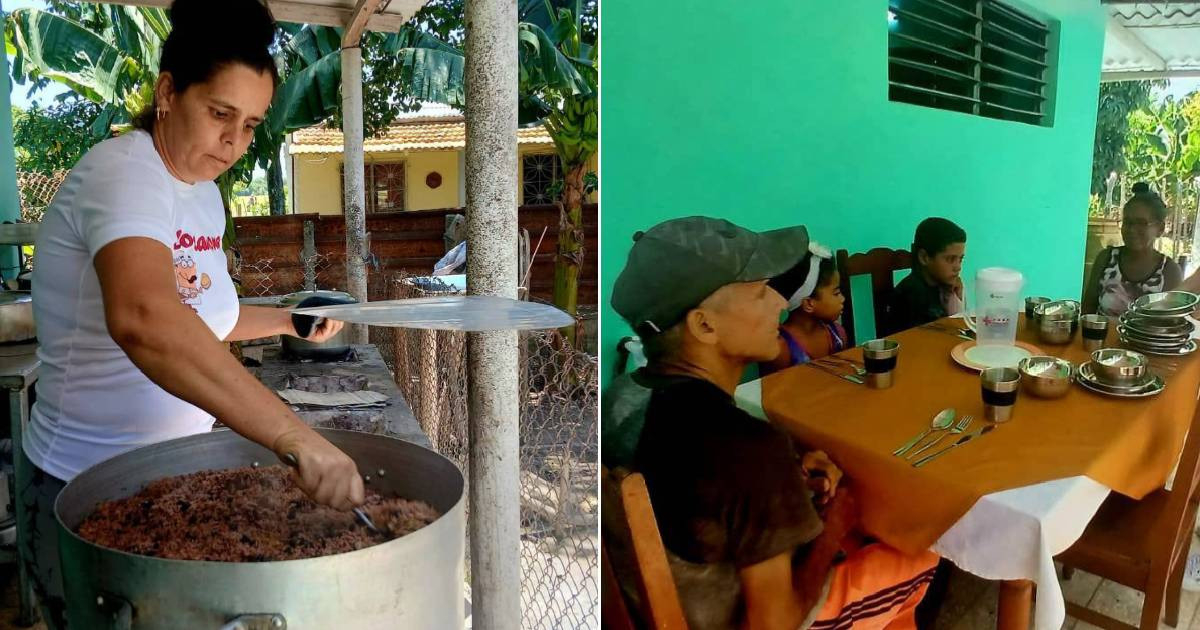
The first Community Food Home in Ciego de Ávila opened its doors this Friday in the Zaragoza Community, district 49 of the main municipality, notably managed by a private worker rather than by the State.
The space is managed by the self-employed workers project Los Ramones, linked to the Commerce sector, and will serve 10 individuals in vulnerable situations, five of whom are bedridden and will receive food through a home delivery service.
The inaugural event was attended by Bárbara Guerra Pérez, a member of the Provincial Bureau of the Communist Party of Cuba, along with provincial government officials and representatives of the Business Group of Commerce, who described the opening as "a work of infinite love," highlighted on his Facebook profile by Fidel Cruz Pérez, director of the Business Group of Commerce of Ciego de Ávila.
During the ceremony, a kitchen module from China was received as a donation, along with a refrigerator and thermos for food preservation, provided by self-employed workers from the Commerce sector, the source indicated.
This first home marks the beginning of a provincial plan that includes the opening of 16 similar spaces in Ciego de Ávila; three in the central municipality and the others in Ciro Redondo, Chambas, Majagua, Florencia, Venezuela, and Morón, it was announced.
The initiative is part of the opening of the Family Care System (SAF) to the non-state sector, enabled by Agreement 10418 of the Council of Ministers and the , published on August 4 in the Extraordinary Official Gazette No. 85.
This regulation allows small and medium-sized enterprises, self-employed workers, state entities with worker cafeterias, and non-profit institutions to manage SAF establishments, and explicitly includes community feeding homes for rural or hard-to-reach areas.
The measure is part of a package of 176 economic measures announced in June, some of which aim to shift activities historically reserved for the state to the private sector due to the government's fiscal inability to sustain them.
The backdrop is a food crisis of alarming proportions. In May, the Food Monitor Program indicated that nearly 97% of the Cuban population lacks adequate access to food, while about 34% of households had a member who went to bed hungry.
The situation is particularly severe among older adults, the main group served by the SAF, as 55.6% of those over 60 reported having completely lost access to food.
The government itself acknowledged in March that it does not have a sufficient budget to assist all the applicants for the program, which increased from about 59,000 individuals in 2023 to approximately 67,000 by mid-2025.
The Minister of Domestic Trade, Betsy Díaz Velázquez, justified the shift towards private management by stating that "even if the management is non-state, those benefiting from the system will be defined locally by social policy groups."
Related videos:
Filed under: