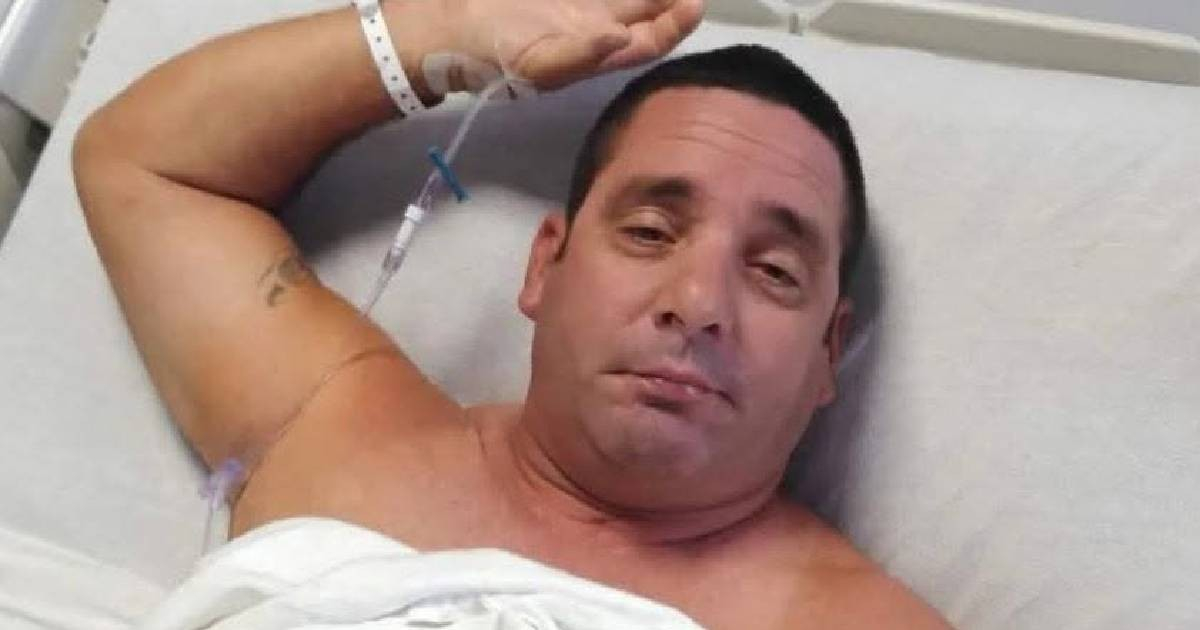
Leonardo Sánchez, a legally residing Cuban permanent resident in the United States with a large ventral hernia, was deported by the Immigration and Customs Enforcement (ICE) on August 20 and ended up in Equatorial Guinea, without guaranteed medical care and with no authorities taking responsibility for his health condition.
A report from the Spanish newspaper El País explains that the deportation flight took off from Alexandria Airport in Louisiana, initially headed to Liberia.
Upon arrival, Sánchez and four other Cubans —Carlos Rodríguez López, Emilio Destrade Correoso, and Darwin Hernández Calvo— refused to disembark from the plane and were taken without prior notice to Malabo, the capital of Equatorial Guinea.
The journey lasted more than 36 hours. The deportees were handcuffed at their feet and hands, received only sandwiches and water, and were not allowed to go to the bathroom. "I urinated in my pants three times," Sánchez recounted in a video call to journalist Carla Colomé from the aforementioned Spanish newspaper.
The physical condition of Sánchez particularly exacerbates the case. Almost ten years ago, in Hialeah, he was the victim of multiple stabbings that affected his intestines and left him 40 days in a coma.
Her sister Dorty Sánchez explained that "the skin was left open, and they had to perform a graft and place the colon beside it." Since then, he has undergone nine surgeries and had a tenth intervention scheduled at Jackson Memorial Hospital in Miami.
He now lives with a severe ventral hernia, which prevents him from lifting more than 20 pounds, makes it difficult for him to find employment, and causes him unbearable pain, as detailed by the newspaper.
Upon arriving in Equatorial Guinea, he was accommodated at the Bamy hotel in Malabo, owned by the family of President Teodoro Obiang Nguema Mbasogo, who has been in power for almost half a century.
The facility operates as a de facto detention center under an agreement between the Trump administration and the government of Malabo valued at 7.5 million dollars. The deportees are monitored by armed personnel and cannot exit.
When the authorities took him to a local hospital, the doctors refused to treat him. "At the hospital, they said that if I didn't have documents, the doctors wouldn’t take responsibility for me. They asked the officer who brought me if he was responsible, and he said no, that he was just following orders," Sánchez recounted.
He stated that he was only given paracetamol. Four days after his arrival, he was still wearing the same clothes he left the United States in, without a toothbrush, toothpaste, or a change of clothes.
"I'm not worth a dime," he said from the Bamy hotel.
His family, based in Lehigh Acres, Florida, learned of his whereabouts through a video on Facebook posted by another deportee.
"He said there was a boy with an open belly named Leonardo Sánchez. And if he has an open belly and is called Leonardo, that's my brother, there’s no one else," Dorty recounted.
The family had hired a lawyer from the firm Wannamaker to try to have him released on medical grounds, but they claim that the lawyer scammed them.
The case adds to a growing trend of deportations of Cubans to third countries in Africa.
Savi Arvey, Director of Refugee and Immigrant Rights Policy at Human Rights First, warned that they are "deeply concerned" about the situation in Equatorial Guinea. "The individuals confined in the hotel are deprived of access to essential medical care and subjected to conditions that further endanger their health and well-being, while also suffering physical abuse at the hands of the guards," she stressed.
A federal judge in Massachusetts declared this policy of deportations to third countries illegal in February 2026 for violating due process, although the ruling was temporarily suspended while litigation continues.
Related videos:
Filed under: