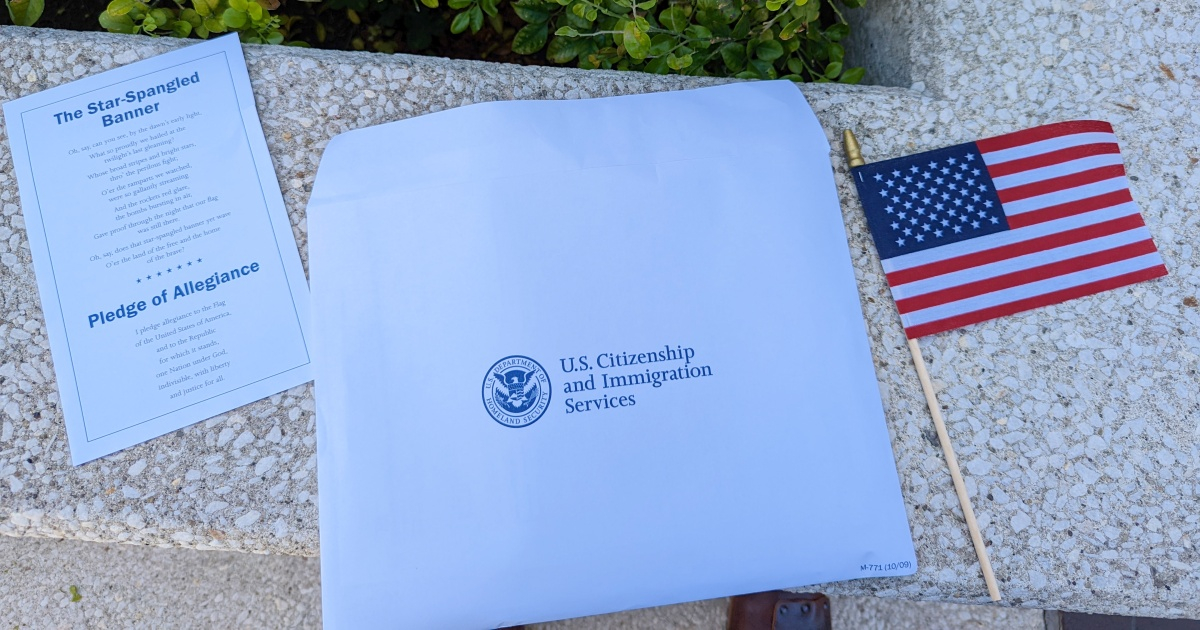
The U.S. Citizenship and Immigration Services (USCIS) formalized a policy on August 25 that authorizes its officials to interview neighbors, employers, and coworkers of those applying for naturalization.
The measure, contained in the Policy Alert PA-2026-10, went into effect immediately and applies to both pending applications and those submitted from that date onward.
The so-called "neighborhood investigations" were authorized since 1952 by section 335(a) of the Immigration and Nationality Act, but the predecessor of USCIS abandoned them in 1991 due to their inefficiency.
Since then, the government verified backgrounds exclusively through biometric checks and FBI criminal databases.
The new alert consolidates in the Policy Manual a process that had begun a year earlier, when the agency director, Joseph Edlow, issued a memorandum ordering its resumption.
What can USCIS investigate about you?
Under the new directive, officials are authorized to gather information that goes far beyond criminal records.
Verifications may include family situation —including marriages and divorces— social activities, associations, and habits, in addition to credibility, sincerity, and loyalty to constitutional principles. Changes in USCIS processes may affect your path to citizenship.
The decision to conduct or waive an investigation is not automatic: the Fraud Detection and National Security Directorate will evaluate each case individually.
If the file contains sufficient evidence, the agency may choose not to conduct the investigation.
How to protect yourself?: Reference letters.
The very policy alert opens a way to reduce the risk of being investigated
Applicants “may voluntarily submit testimonials or personal reference letters, preferably from U.S. citizens who are not relatives,” that attest to eligibility, character, loyalty to the United States, and adherence to the Constitution.
USCIS will take those letters into account when deciding whether to exempt the applicant from the investigation.
Anyone who does not provide supporting evidence may face a more thorough verification, which could include visits to their neighborhood or workplace.
Employers should also be prepared: the agency may contact them to confirm employment dates, position, and character of the worker.
Concern among lawyers and the community
"I am concerned that people's privacy no longer exists if you want to apply for citizenship. Now you are going to give the government all your information, which is actually not necessary to determine whether you are eligible for citizenship or not," stated a lawyer interviewed by Univision.
Another lawyer warned about the waiting times: "What delays are there going to be for each application? Nowadays, it takes more than a year for an application to be processed. If these investigations we are talking about are involved, it's going to be one year, two years..."
Erik Finch, a former USCIS official, noted that "without clear standards, two applicants with nearly identical cases could face very different levels of scrutiny."
Doris Meissner, former INS commissioner under Clinton, warned that the measure could create “a more intimidating atmosphere that discourages people from seeking naturalization.”
The context of migration hardening
The PA-2026-10 falls within Executive Orders 14159 and 14161 of President Donald Trump, which demand strict enforcement of immigration laws and uniform verification standards for any foreign national applying for an immigration benefit.
This formalization adds to other recent restrictions: in August, USCIS also tightened the initial evidence requirements, allowing them to deny applications without first issuing a Request for Evidence.
In July, the interviews for status adjustment became more stringent.
For the Cuban community, one of the most active in naturalization processes, these changes are particularly significant, especially following the resumption of citizenship processes for Cubans confirmed in July.
Edlow defended the measure: "Americans should feel reassured knowing that USCIS takes its responsibility seriously to ensure that foreign nationals possess good moral character, adhere to the principles of the United States Constitution, and are well-disposed towards the good order and happiness of the United States."
The lawyers, however, do not rule out the possibility that the policy may be challenged in court.
Stay updated on all the news regarding procedures, requirements, and immigration policies in our section on
Related videos:
Filed under: