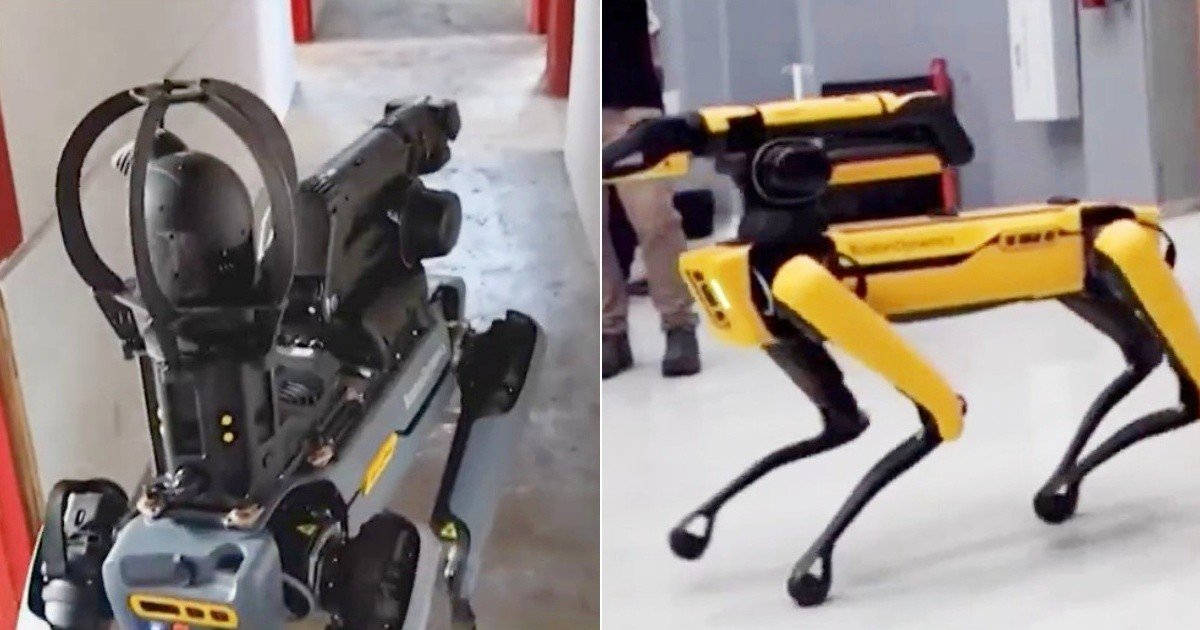
The United States Immigration and Customs Enforcement (ICE) plans to allocate up to two million dollars for the purchase of robotic dogs to support its immigration enforcement operations, according to a procurement notice published by the Department of Homeland Security in its official purchasing planning system.
The document outlines an investment of between one and two million dollars in the four-legged robot SPOT, manufactured by Boston Dynamics.
A senior official from the department confirmed the plans to NBC News and specified that the robots will not be used to make arrests.
What can these robots do?
SPOT devices are equipped with 360-degree cameras and sensors capable of detecting vibrations, gas, and radiation, as well as having extendable arms, although they cannot attack like a conventional police dog.
According to the official announcement, the robots will "support public safety operations and law enforcement by providing remotely operated robotic capabilities for inspection, situational awareness, and hazard assessment in environments that may pose risks to personnel."
The notice also states that the technology "helps to enhance the safety of agents, supports informed operational decision-making, and improves the Department of Homeland Security's ability to respond to incidents in hazardous, confined, unstable, or hard-to-reach areas."
A technology already tested by other agencies
The SPOT robot is not a new development in the field of U.S. security. The Secret Service used it to patrol President Donald Trump's Mar-a-Lago residence in 2024.
The New York Police Department began testing it in 2020, nicknaming it "Digidog." It canceled the contract in 2021 due to public pressure and reintegrated it in 2023 for high-risk situations, such as bomb threats and hostage situations.
Boston Dynamics maintains an explicit ethical statement: “We will not authorize or associate with anyone who wishes to use our robots as weapons or autonomous attack systems”, and adds that it will take action if its products are used to cause harm.
Electric gloves and rising criticism
The purchase of robot dogs comes amidst controversy over ICE's equipment. In mid-August, the Department of Homeland Security approved spending up to 20 million dollars on electric shock gloves for field agents, capable of delivering up to 380 volts directly to the skin.
That decision sparked backlash from civil rights organizations and a group of 16 Democratic senators who sent a letter to the acting director of ICE, David Venturella, demanding the cancellation of the contract and to "invest in de-escalation tools, training, and accountability."
The border czar of the White House, Tom Homan, spoke in defense of the gloves:
"It's another device to help someone follow through when they're not doing it. You can't just go from 0 to 100 and have your first resort be lethal force."
The criticisms are set against a backdrop of documented escalation: the use of force in ICE detention centers increased by 37% in 2025 compared to the previous year, with at least 780 documented incidents and over 1,300 individuals affected.
Kica Matos, president of the National Immigration Law Center, described ICE as "an out-of-control agency with a discretionary fund of $80 billion that allows them to invent and finance new ways to inflict cruelty on our communities."
The agency, which exceeded 10,000 arrests in just five days in July, has also invested more than 1.4 billion dollars in technological contracts for facial recognition and social media monitoring, significantly expanding its surveillance apparatus under the Trump administration.
El uso de tecnología robótica en las operaciones de ICE es solo uno de los muchos cambios que están transformando la política migratoria en Estados Unidos. Sigue todos los detalles en nuestra sección de
Related videos:
Filed under: