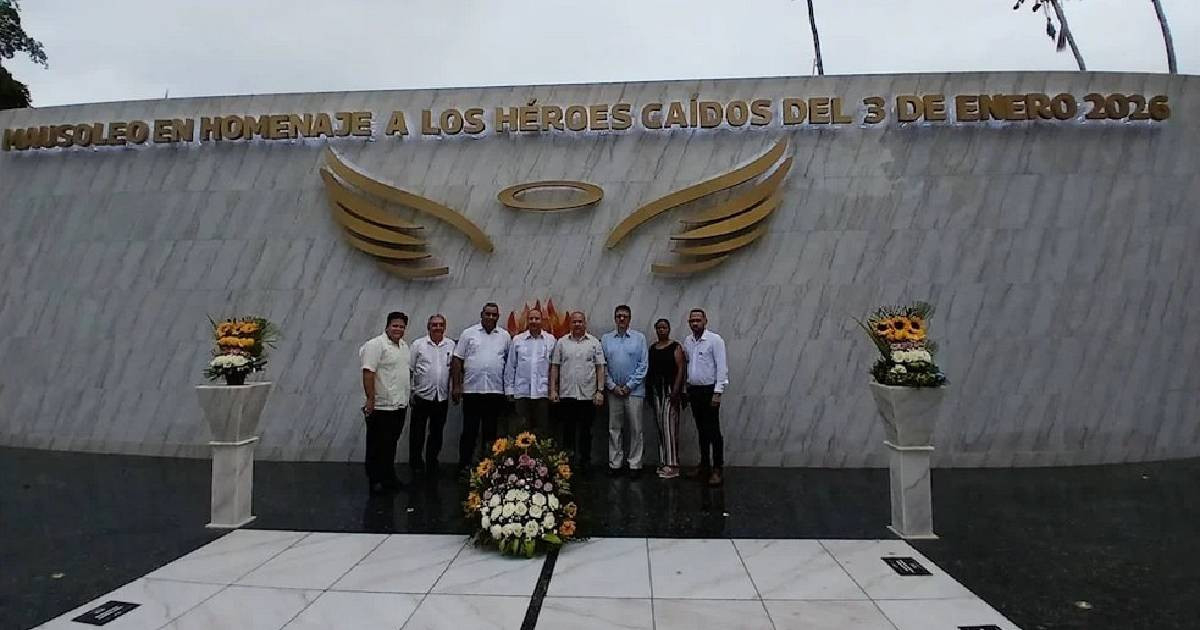
Months after the Cuban regime paid State honors to the 32 military personnel and agents of the FAR and MININT who died during the capture of Nicolás Maduro, an investigation by elToque presents hypotheses that challenge the official version: several journalists, activists, and sources close to the case claim that some of those Cubans did not die at the hands of U.S. forces, but were eliminated by agents of the Chavista regime itself.
The operation that culminated in the arrest of Maduro and his wife Cilia Flores was carried out on January 3, 2026 in Caracas, primarily at the military complex Fuerte Tiuna. The 32 Cubans were part of the personal security detail for the then Venezuelan president. Twelve days later, a plane landed in Havana with the urns containing their ashes, and the dictatorship presented them as heroes who "resisted" the attack.
However, from Venezuela, allegations have emerged that contradict that narrative. Journalist and human rights advocate Luis Carlos Díaz was straightforward about it: "You and we have a duty to ask what happened to the Cuban agents who were responsible for Nicolás Maduro's security, because we have a strong suspicion that they did not fall in a confrontation with U.S. soldiers. Very likely, they were eliminated by Venezuelan agents during the operation."
In the same vein, the sociologist Rafael Uzcátegui, director of the NGO Laboratorio de Paz, posted in April on the social network X: "According to private sources, there are chilling hypotheses about the execution of Cuban security officials. And not by U.S. forces. Only an independent investigation will reveal the truth about what happened that day."
What supports these suspicions is a chain of documented events. During the last week of January 2026, the Venezuelan Directorate General of Military Counterintelligence (DGCIM) arrested several active officials and former members of the Corps of Scientific, Penal and Criminal Investigations (CICPC) for refusing to falsify forensic reports from January 3 at Fuerte Tiuna.
César Batiz, director of the independent Venezuelan outlet El Pitazo, reported that the pressure on those officials had a specific purpose: "to alter bullet trajectories, modify photographic expertise, and eliminate evidence that could demonstrate internal responsibilities in the events that occurred at Fuerte Tiuna."
The Venezuelan media Runrun.es reported that those detained were tortured. A protected source described the case of one of the agents: "he was tortured when they caught him... he has always been extremely ethical, has 26 years of service, and is irreproachable. He refused to sign some documents from January 3."
In March 2026, the United Nations Independent International Fact-Finding Mission on Venezuela brought the matter before the Human Rights Council. The expert María Eloísa Quintero stated that "around 30 people from the CICPC and their relatives were detained after officials allegedly refused to falsify evidence related to the military attack of January 3." The director of CICPC, Douglas Rico, denied that number but did not deny the reason for the detentions.
Among those identified as prisoners is the chief forensic photography inspector Joharlinn Enrique Luzardo Noria. His sister, Kiolis Luzardo, recounted this Saturday in an interview that he was summoned on January 3 to Fuerte Tiuna, spent five days there conducting expert evaluations, submitted his report, and on January 23 was called to a meeting from which he did not return: the DGCIM took him into custody.
Regarding what happened afterward, Kiolis was emphatic: "They hung him by his hands with a chain, for days, off the ground, suffering from the cold, they applied electric shocks and gave him one meal a day."
From prison, Luzardo himself conveyed his perplexity to his sister: "I have to fulfill my duties, I already submitted the report of everything observed there on January 3, I have no reason to invent anything, I don't understand why I'm here."
The Cuban regime, which published the identities of the 32 fallen in the state newspaper Granma and inaugurated a monument in Caracas in their honor in June, has not responded to any of these hypotheses nor has it opened any investigation into the true circumstances of the deaths.
Related videos:
Filed under: