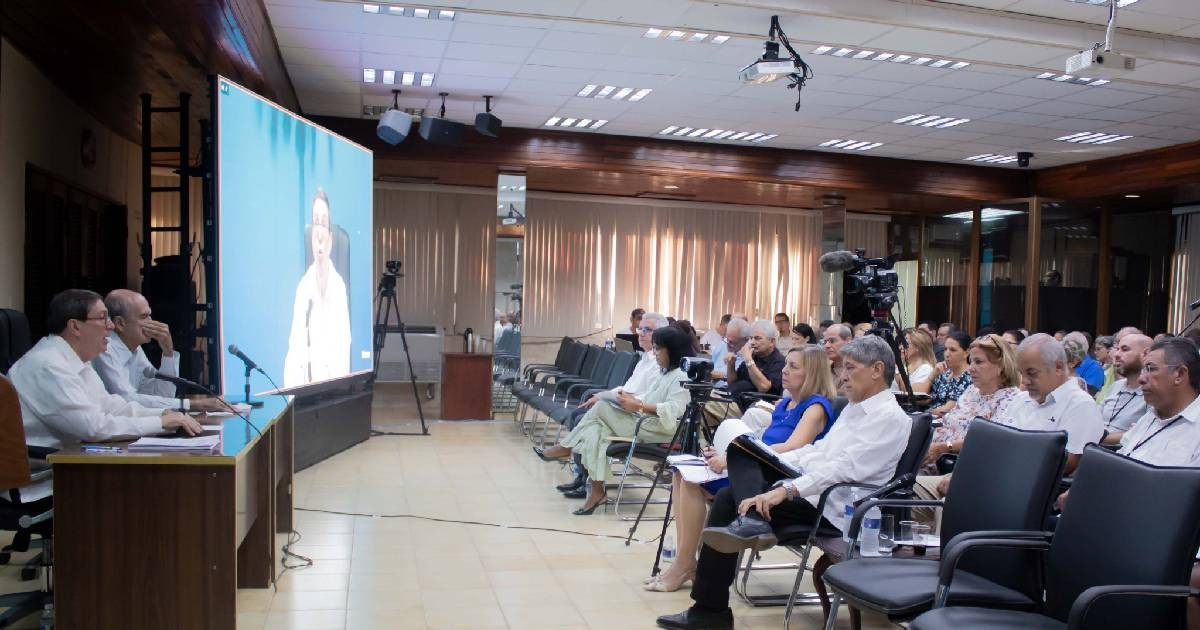
The Cuban foreign minister Bruno Rodríguez Parrilla chaired a virtual meeting this Wednesday with heads of Cuba's diplomatic missions abroad, during which he defended the role of the regime's diplomacy and blamed the U.S. embargo and Washington's secondary sanctions for the crisis facing the island, according to a post on his X account.
The meeting, held via videoconference in a hybrid format—with both in-person and remote participants—was intended to communicate to the representatives of Cuba around the world the official version regarding the country's situation and to establish priorities for the remainder of 2026 and the year 2027.
Rodríguez Parrilla stated that the meeting shared details about the country's current situation, caused by the energy siege, the intensification of the blockade, and the secondary sanctions imposed by the US government.
The chancellor used the term "energy blockade," a part of the regime's official discourse to attribute the severe electrical crisis that Cuba is experiencing to external factors, characterized by prolonged blackouts, fuel shortages, and the deterioration of the generation infrastructure.
What the regime overlooks is that this crisis also stems from decades of mismanagement, lack of investment, and structural dependence on imports, which the Cuban economic model itself has exacerbated over 67 years of dictatorship.
This type of meeting of mission chiefs is a common mechanism used by the Cuban Ministry of Foreign Affairs to align its representatives abroad with the government's political directives and to coordinate diplomatic action in response to international pressures.
In the current period, the regime's diplomacy combines denunciation of the embargo in multilateral forums with the pursuit of allies in Latin America, Africa, Asia, and Europe to maintain trade and cooperation relations despite U.S. sanctions, which affect banks, companies, and third countries that do business with sanctioned Cuban entities.
The image published by Rodríguez Parrilla shows an institutional hall with attendees seated in rows, a large LED screen with an active broadcast, and a speakers' table, along with the presence of a professional video camera indicating that the event was recorded or broadcasted.
While the chancellor reaffirmed the commitment of diplomacy to "the well-being of the Cuban people," that same people continues to endure one of the worst energy crises in the recent history of the island, with diplomatic missions abroad failing to reverse the collapse of the national electrical system.
Related videos:
Filed under: