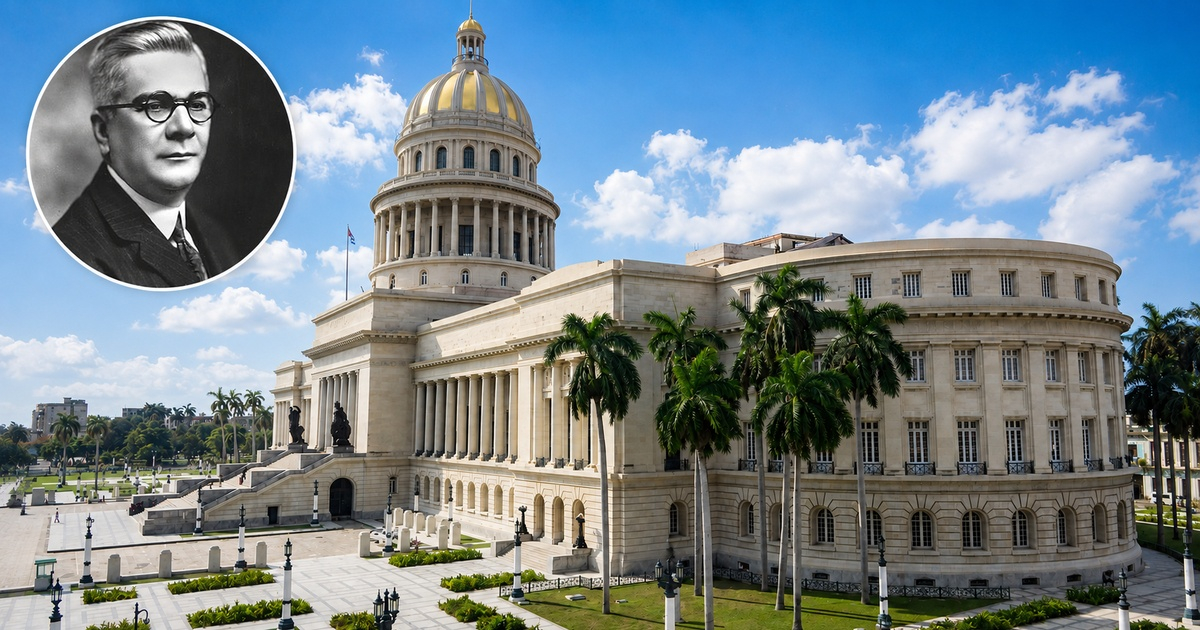
It was undoubtedly a government that increasingly took on a dictatorial nature. This is acknowledged by the Congressional Research Service, which states that Gerardo Machado «became more and more dictatorial». Based on this observation, and following the perspective of academic Rolando Gallardo, we will examine this thesis to avoid simplifications and distortions of our history.
Rolando Gallardo's perspective on Gerardo Machado deserves to be taken seriously. Not because it forces us to accept each of his conclusions, but because it brings to light an issue that has been difficult to address with calm for decades: how much of what we think we know about Machado comes from the facts, and how much comes from the subsequent interpretation constructed by revolutionary historiography?
Gallardo points out something that cannot be overlooked. The historiography produced after 1959 subjected the Republic to a profound ideological reinterpretation. Machado was turned into one of the great symbols of that narrative: the dictator, the repressor, the embodiment of an essentially corrupt Republic that would have made the revolution inevitable. This historical construction undoubtedly deserves to be revisited.
But reviewing the Castroist interpretation does not necessarily mean reversing it.
There is a precision that I consider indispensable. The image of Machado as an authoritarian ruler did not originate with Fidel Castro or with Marxism-Leninism. It already existed during his own government and is documented in contemporary sources. The opposition to Machado was not solely communist. It included students, intellectuals, traditional political sectors, nationalist organizations, and various revolutionary groups. Therefore, criticism of his government cannot be retrospectively reduced to a fabrication of Castroism.
Here lies the true historical complexity.
Machado came to the presidency in 1925 through constitutional means and initially had considerable political support. His government promoted public works and certain modernization initiatives that are also part of his legacy. It would be just as unreasonable to deny these elements as it would be to turn them into an absolution of his later actions.
The problem arises when we observe the evolution of his government.
The constitutional reform of 1928, the extension of his hold on power, the gradual reduction of spaces for opposition, censorship, political persecution, and the use of the state's coercive mechanisms are all facts that must be examined independently of how they were later utilized by revolutionary propaganda.
For this reason, I find it perfectly legitimate to use the term dictatorship to describe the final stage of the Machado regime, as long as that word is understood as a historical conclusion and not as an ideological label.
And here is, perhaps, the contribution that can be made to Gallardo's approach: we do not need to choose between the demonized Machado of Castro's historiography and a completely rehabilitated Machado. There is a third way: to study the historical Machado.
That Machado was a constitutionally elected president who, over the years, concentrated power, restricted freedoms, and ultimately found himself at odds with a considerable part of Cuban society. However, he was also a politician of his time, with real support, a particular vision of the state, and achievements that do not vanish simply because his government ended in a deep political crisis.
The story must be able to support those truths simultaneously.
The context must also be examined. The international economic crisis of 1929, the deterioration of social conditions, labor conflicts, political violence, and the actions of an opposition that was not free of violent methods contributed to turning those years into one of the most turbulent periods of the Republic.
Reducing everything to "Machado against the people" would be an oversimplification. However, reducing it, in the opposite sense, to a communist conspiracy to destroy the image of a legitimate president would be equally inadequate.
Historiography should neither absolve nor condemn in advance: it should explain.
And explaining the machadato requires carefully separating two things that have been intertwined for too long: what actually happened and what was subsequently said to have happened.
The Castro revolution deeply manipulated the memory of the Republic and used Machado to construct its own legitimizing narrative. This needs to be studied and denounced when appropriate. However, the historian should not make the opposite mistake of dismissing everything claimed by Castroite historiography as false. Some of its conclusions may be propagandistic; certain facts, however, remain documented regardless of who later used them.
Perhaps that is where the true importance of Rolando Gallardo's intervention lies. More than just closing the case on Machado, it opens the necessity to study it again. And that task does not require defending or condemning him. It requires returning to the sources, contrasting testimonies, reviewing the press of the time, consulting documents from before 1959, and comparing the various subsequent interpretations.
Only then can we separate the historical Machado from the Machado turned political figure. The history of Cuba needs just that: fewer legends and more documents; fewer slogans and more research.
Related videos:
Filed under:
Opinion article: Las declaraciones y opiniones expresadas en este artículo son de exclusiva responsabilidad de su autor y no representan necesariamente el punto de vista de CiberCuba.