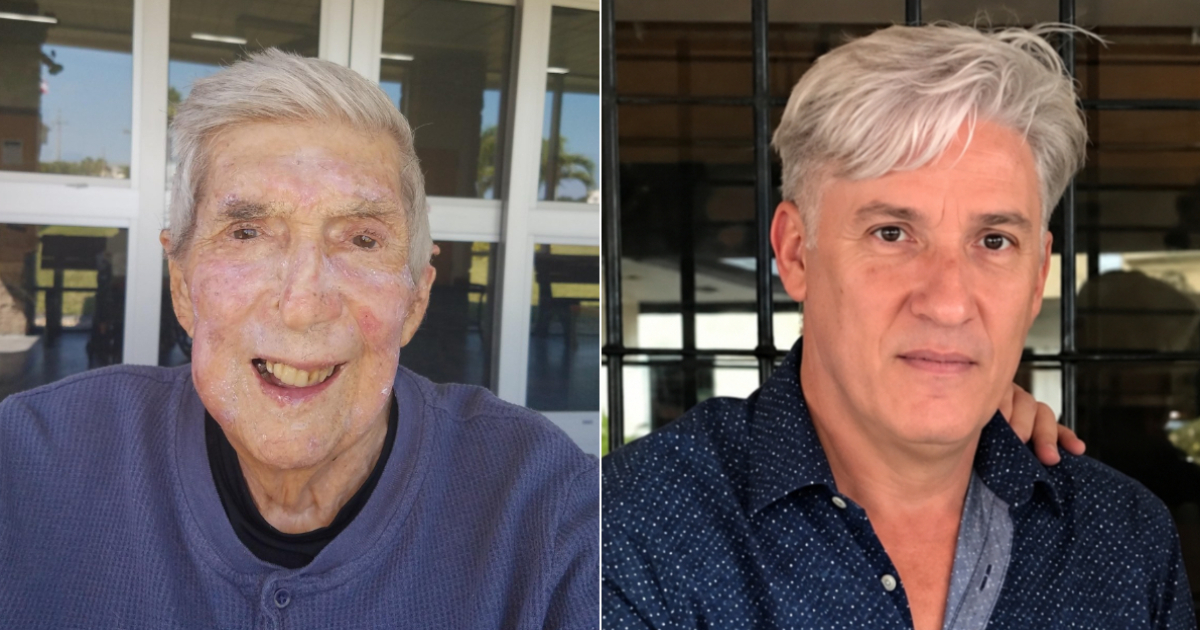
Fernando Armando Valdés Pérez, the Cuban-Guatemalan recently deported by the United States after being identified by authorities as an asset of the Cuban regime's intelligence, managed to penetrate deep into the inner circle of Luis Posada Carriles.
For years, he was his companion, caregiver, and such a close figure that one of Posada's friends went so far as to describe him as his "devoted son".
An investigation by journalist Nora Gámez Torres, published this Saturday by the Miami Herald, reveals new details about the relationship that Valdés Pérez had with Posada and the extraordinary level of access he achieved to one of the main enemies of the Havana regime.
Valdés Pérez, 61 years old and a longtime resident of Kendall, was deported to Guatemala on August 7. The Immigration and Customs Enforcement (ICE) claims that he was an active member of Cuban intelligence tasked, since at least the 1990s, with infiltrating exile organizations.
The information available so far indicated that he had managed to infiltrate Posada Carriles' circle. The testimonies gathered by Gámez Torres reveal that that relationship was much deeper.
Orlando González, a close friend of Posada and director of Rescate Jurídico, an organization in Hialeah that supports Cuban political prisoners, shared that Valdés Pérez became practically inseparable from the anti-Castro activist.
He took him to medical appointments and activities, managed his medications, and acted practically as his personal representative. González described him as Posada's "devoted son" and affirmed that those who wanted to see him practically had to make an appointment through Valdés Pérez.
Santiago Álvarez, a businessman from Miami and benefactor of Posada, also recalled Valdés Pérez's ease in winning over those around him. He described him as a charismatic, bold man who was always willing to solve problems, to the point of seeming "too perfect".
He hid it for over a year in Guatemala
One of the episodes that best reflects the level of trust between the two occurred after the then Panamanian president Mireya Moscoso granted clemency to Posada in August 2004.
After leaving Panama and passing through Honduras, Posada had to find another place to hide due to information that his life was in danger.
He ended up taking refuge for over a year in Guatemala in a house owned by Valdés, precisely the man whom U.S. authorities would publicly identify two decades later as an asset of Cuban intelligence.
There is another particularly striking detail: according to the Miami Herald, Posada remained hidden about 200 yards —around 183 meters— from the Cuban consulate in Guatemala City.
Ernesto Abreu, another member of Posada's inner circle, retrospectively described that situation as being "like sleeping with the enemy".
Valdés Pérez's attention to Posada was constant. Abreu recalled that he prepared breakfast for him and personally attended to his daily routines.
Posada refused to abandon him
The level of trust achieved by Valdés Pérez became even clearer when preparations began for Posada's departure from Guatemala to Mexico.
Santiago Álvarez was organizing the operation with his vessel Santrina and, due to the suspicions that some members of the group already had about Valdés Pérez, he had given instructions for him not to accompany Posada.
But Posada refused.
According to Álvarez's account to the Miami Herald, he made it clear that if Valdés Pérez did not travel with him, he would not leave either.
Finally, Valdés accompanied him.
The episode showcases how far he had managed to earn the trust of a man who for decades was among the top priorities of Havana's intelligence apparatus.
Posada Carriles died in 2018 at the age of 90. A photograph from the celebration of his last birthday is now a particularly symbolic image of that relationship.
In front of a huge cake for her 89th birthday stands Posada. Next to her, standing, is just one person: Fernando Armando Valdés Pérez.
Related videos:
Filed under: