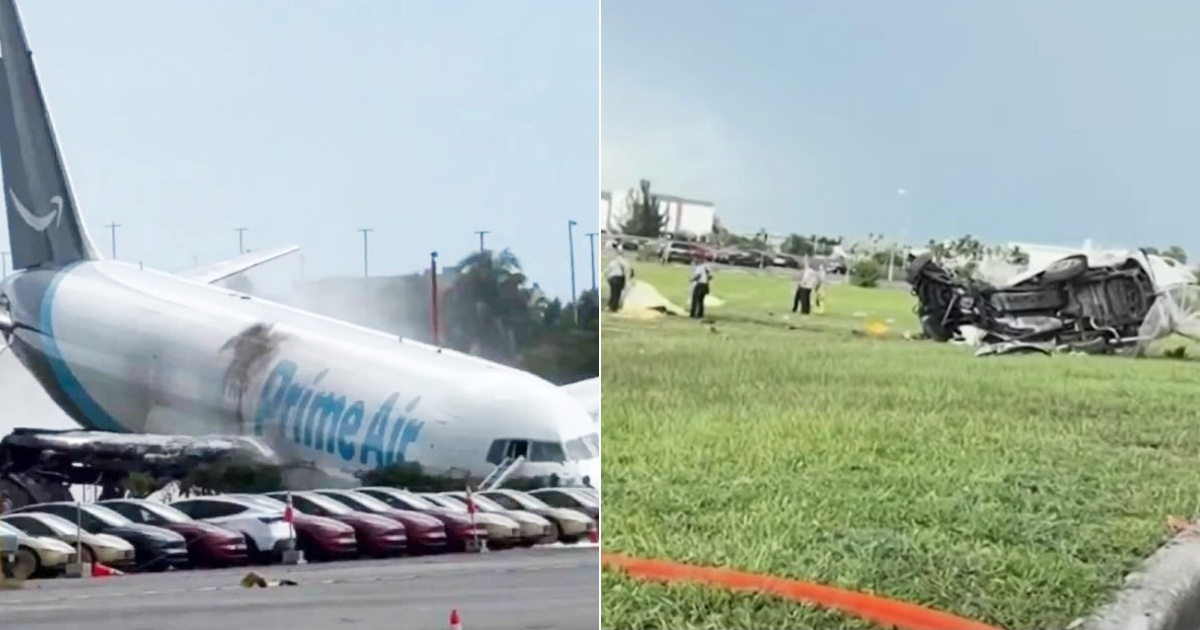
A Boeing 767-300 cargo aircraft operated by 21 Air for Amazon Prime Air veered off the runway at Miami International Airport this Sunday and collided with several vehicles on an access road, resulting in at least five fatalities and five injuries, three of which are in critical condition.
The aircraft had departed from Luis Muñoz Marín International Airport in San Juan, Puerto Rico, and overran the end of runway 30 around two in the afternoon, crossing a perimeter road and striking vehicles in the vicinity of Northwest 42nd Avenue.
FlightRadar24 data indicates that the plane was traveling at 112 knots (207 km/h) when it left the usable runway.
More than 200 personnel from the Miami-Dade Fire and Rescue Department responded to the scene and found the aircraft engulfed in flames, with a complex fire in the engine area and an active fuel leak.
The fire chief, Ray Jadallah, reported that the pilot and co-pilot were trapped in the cockpit, as were several occupants of the vehicles. The teams also freed one person who was underneath one of the vehicles.
A truck driver who witnessed the accident recounted the moment of impact:
"Since we work next to the airport, one is always accustomed to seeing planes flying at a low altitude. Apparently, this one flew too low, and the moment you realized it, you heard the explosion, the tremor, the smoke, and the fire."
The microburst, main hypothesis
The expert in air accidents Luis Irizarry, consulted by Univision, pointed to the meteorological phenomenon known as microburst as a possible cause of the disaster.
"What we have been observing and assessing is that at the entrance of Miami airport, there was a storm, there were adverse weather conditions. There are certain effects from this type of storm called a microburst; these are downbursts of air that come from the cloud, which greatly affect either the approach or the landing of the planes," he explained.
Irizarry explained that these descending currents collide with the runway and bounce back, causing a sudden increase in speed during the final phase of landing.
"In the videos we took from FlightAware, it can be seen that the plane, as it was approaching, reduced speed and then suddenly increased its speed over the runway, and that's the effect this causes; if it doesn't have enough runway, if it hasn't controlled the plane with this gust of wind, the plane will go off the runway," he stated.
In response to the question of what would have happened if it had been a passenger plane, Irizarry was direct: “I wouldn't want to speculate, but based on what we could see there, there would have been many more fatalities.”
Prolonged gliding and tailwind
The pilot and former chief inspector of the Department of Transportation Mary Schiavo noted, according to a report by the AP agency, that a video shows the plane floating over the runway for an extended period without raising its nose to force the main landing gear to touch down.
“A tailwind would undoubtedly worsen your problems if you have already given up a good portion of the runway by not touching down and landing immediately,” Schiavo warned.
The aviation security expert Steve Arroyo added that if the plane exceeded the designated landing zone —the first 3,000 feet (914 meters) of runway— the pilots should have aborted the landing and gone around.
At the time of the accident, it was not raining directly on the runway, but there were light storms and gusty winds in the surrounding area.
A 32-year-old plane and an airport without braking systems
The crashed Boeing 767-300 was 32 years old and was converted into a cargo aircraft in 2015 after operating for several passenger airlines.
Schiavo indicated that the National Transportation Safety Board (NTSB) will review its maintenance history, particularly due to its foreign ownership background, including that of a Russian company.
An additional factor that researchers will consider is that the Miami airport does not have EMAS systems — beds of crushable material at the end of runways designed to stop aircraft that veer off the runway—.
The Federal Aviation Administration (FAA) estimates that these systems, installed in more than 120 airports across the country, have saved at least 497 lives.
Operational chaos and official response
The accident halted airport operations for hours during one of the busiest weekends of the year.
More than 160 flights were canceled and nearly 325 were delayed, according to FlightAware. Some flights were diverted to Orlando International Airport, over 320 km to the north.
Amazon expressed its dismay in a statement:
"We are devastated to learn that five people lost their lives in today's incident at Miami International Airport. Our deepest condolences go out to the families, loved ones, and all those affected by this devastating loss."
The NTSB opened a formal investigation, and its chair, Jennifer Homendy, held a press conference this Monday.
Authorities warned that determining the official cause could take months, while the aircraft remains at the accident site under federal custody.
Related videos:
Filed under: