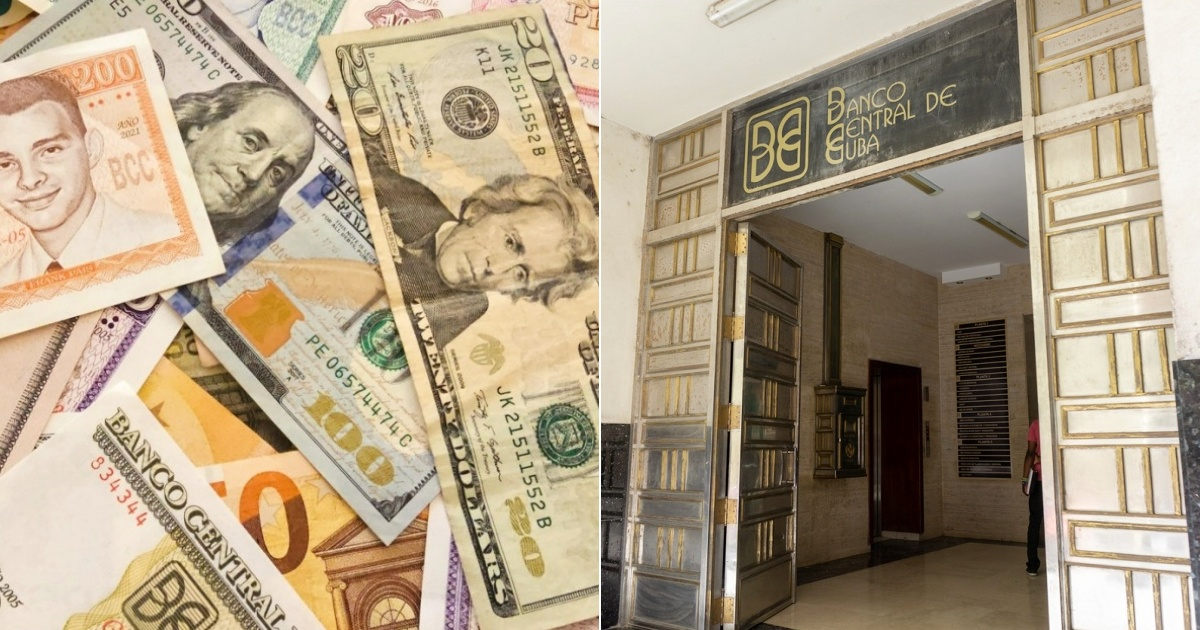
The Cuban regime has established new rules to determine what portion of certain foreign currency earnings economic actors can retain and what proportion must be sold to the state, within a system that expressly acknowledges the "partial dollarization" of the economy.
The , signed on August 31 and published this Thursday in the , establishes the general framework for the management, control, and allocation of foreign currency in the national economy.
The regulation replaces the from the same ministry and is based on the Decree-Law 113/2025, which authorized the Minister of Economy and Planning to approve transactions in foreign currency within the Cuban economy.
One of the central points of the new regulation is the establishment of different percentages for foreign currency retention based on the economic agent and, particularly, on the source of those revenues.
For economic actors who do not have an approved retention coefficient as part of the national economic plan, the Resolution establishes an 80% withholding on certain sources of income.
These include exports, e-commerce, sales to the Special Development Zone of Mariel, foreign investment modalities, and entities authorized to trade in foreign currency, as well as certain intercompany transactions, wholesale commercial operations, and other lawful sources that are available.
The remaining 20% is contributed to the central fund and does not remain in foreign currency in the hands of the economic actor. According to the regulation, that portion is credited in national currency at the exchange rate applicable at the time.
The Resolution also specifies that the foreign currency not retained is sold to the Central Bank of Cuba, which transfers the corresponding national currency to the economic actor's account by applying the exchange rate of the segment in which it operates.
Therefore, the 80/20 scheme does not apply indiscriminately to all foreign currency income or to all economic actors, but rather to the cases and sources specifically established by the regulations.
State entities that already have a specific retention coefficient approved by the Minister of Economy and Planning maintain that percentage and make their contributions to the central fund based on their income and the corresponding contribution plan.
Income that can be retained in full
The new regulation also includes sources where economic actors can retain 100% of their income in foreign currency.
These include financing received from abroad or pre-financing; contributions from foreign investors to the share capital or to the common fund of international economic association contracts, as well as dividends from the parties; donations from abroad; and external revenues allocated for international cooperation projects.
The forms of foreign investment, including the contracts that generate profits, also retain 100% of their earnings in foreign currency.
However, when the Cuban party receives dividends or profits in foreign currency, it must contribute the total amount of that currency to the central treasury and, in return, receives national currency at the exchange rate at which it operates.
The regulation also dedicates a section to agricultural producers. As a principle, the percentages outlined in the 80/20 framework apply to them, but if they are part of approved export or import substitution mechanisms, they receive what is specifically established in those schemes.
More space to operate directly in dollars and other currencies
The regulation is part of a broader process of expanding foreign currency operations that the government itself defines as "partial dollarization."
The resolution allows intercompany and wholesale commercial operations within Cuba to be conducted in both national currency and foreign currency, as agreed upon by the parties.
In retail, it establishes as a principle that transactions must be conducted in the national currency, although the Ministry of Economy and Planning can authorize sales in foreign currency when it deems there is "national interest."
For non-state economic actors, another provision of special importance is introduced: they will be able to accept cash payments in foreign currency at the customer's discretion and deposit those earnings in their tax accounts in foreign currency or convert them into the national currency at the current exchange rate in the segment in which they operate.
The measure had been anticipated in June, when the government announced before the National Assembly that small and medium-sized enterprises, cooperatives, and other non-state actors could deposit cash in foreign currency into bank accounts and withdraw it in the same currency, as part of a broad package of economic transformations. The plan also includes the opening of foreign currency accounts without prior administrative authorization.
Resolution 103 now incorporates some of those measures into the legal framework and establishes that economic actors can open foreign currency accounts both within Cuba and abroad without prior authorization. In the case of accounts opened outside the country, they must notify the Central Bank of Cuba and the National Tax Administration Office (ONAT).
The Gaceta also includes a provision for professionals who export services through state entities, allowing them to receive foreign currency directly in their accounts according to the contract signed between the parties.
A foreign exchange market that had already started to open up to the private sector
The reform is part of the currency redesign initiated at the end of 2025. In January of this year, Banco Metropolitano enabled the purchase of foreign currencies for SMEs and cooperatives, under the conditions of the so-called Segment III of the currency market.
Purchases were subject to limits and the current rate of that segment, which operates under a managed floating system.
The new resolution maintains that segmented logic: when a certain amount of foreign currency needs to be converted to local currency, it does not set a specific rate, but rather instructs the application of the exchange rate of the segment in which each actor operates.
Two resolutions, but different effective dates
In the same Official Gazette No. 76, Resolution 102/2026 from the Central Bank of Cuba was published, which regulates the operation of bank accounts in foreign currencies.
Among other provisions, it establishes that the accounts of non-state economic actors can receive income from exports, e-commerce, transfers from abroad, and cash deposits in the currencies accepted by the Central Bank, provided that they come from lawful sources.
The two regulations, however, do not come into effect simultaneously.
Resolution 103/2026 of the Ministry of Economy and Planning came into effect this Thursday, September 10, from its publication in the Official Gazette, and expressly revokes Resolution 140/2025.
In contrast, Resolution 102/2026 of the Central Bank states that it will take effect seven days after its publication.
The new package thus deepens a model in which the regime allows companies, producers, and workers to manage an increasing portion of their operations in foreign currency, while maintaining mechanisms for retention, conversion, and centralized allocation of foreign exchange, and legally consolidates the partial dollarization of an economy where the Cuban peso remains the official currency.
Related videos:
Filed under: