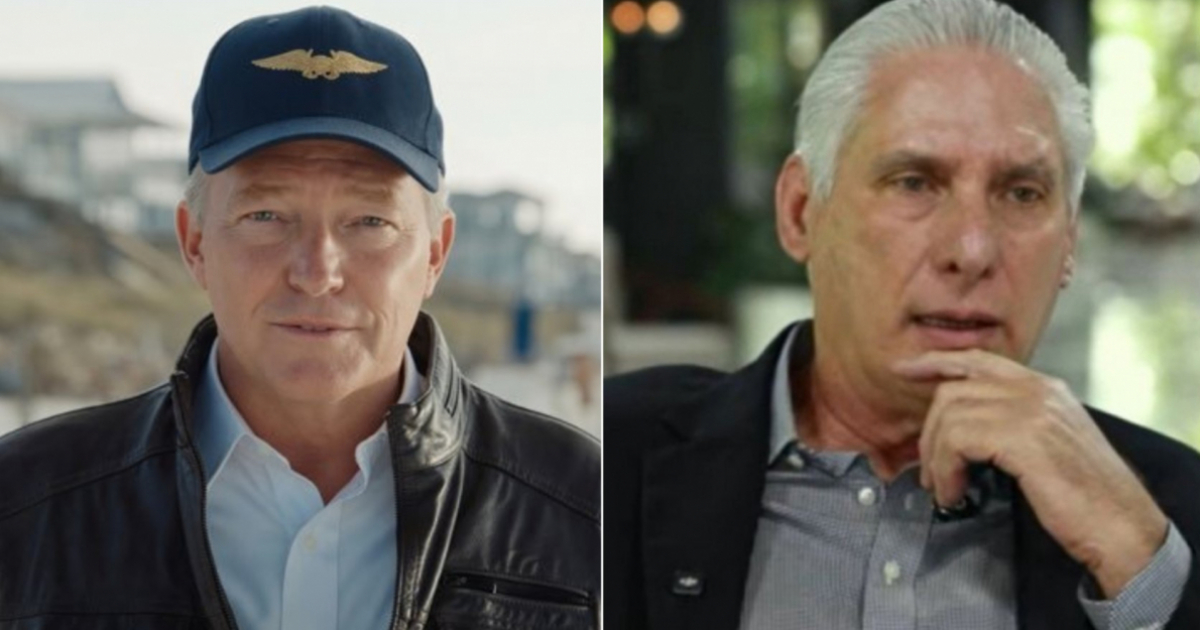
Phil Ehr, a retired U.S. Navy commander with 26 years of service and the current Democratic candidate for Congress in Florida, harshly responded to the statements made by Miguel Díaz-Canel, who claimed that Cuba would resist a possible invasion "to the last drop of blood."
The Cuban leader issued that warning in a recorded message sent to the 50th Avante Festival of the Portuguese Communist Party, held in Amora, Portugal. The message was released by the Presidency of Cuba on September 7 and prompted an immediate response from Ehr just a few hours later.
"Díaz-Canel is as arrogant and overbearing as Maduro. They pretend to be strong, but they are small and cowardly men who only survive by draining their own people," wrote the former military officer on his account on X.
Ehr directly pointed out the hypocrisy in the regime's rhetoric: “'Until the last drop of blood'? Of course: they never talk about their own blood or that of their families. They talk about the blood of the Cuban people, whom they have been using as a human shield to maintain power for almost seven decades.”
The former commander closed his message with a direct warning to the Cuban ruler: "If Díaz-Canel thinks his threats intimidate us, he is mistaken. I served 26 years in the Navy and know the difference between a hero and a communist charlatan. We will defend the Cuban people, protect civilians, and will never allow the dictatorship to decide how many Cubans should die to remain in power."
Díaz-Canel has repeated variations of that phrase multiple times throughout this year, including a warning in May that a military aggression by the U.S. “will provoke a bloodbath with incalculable consequences,” and another in July in direct response to President Trump, stating that his country is willing to “fight to the last drop of blood” to defend its sovereignty.
Ehr, the Democratic candidate for Congress in Florida's 28th District—which has one of the largest Cuban-American electorates in the country—has progressively hardened his stance on Cuba over the course of this year.
At the beginning of September, a demand was made for the U.S. government to accuse, arrest, and prosecute Díaz-Canel, partly driven by the criminal charges brought in May by the Department of Justice against Raúl Castro for the downing of Brothers to the Rescue planes in 1996.
In August, the Democratic candidate presented a six-point plan for the freedom of Cuba that includes the possibility of military action authorized by Congress, with conditions that involve the protection of civilians, the release of political prisoners, and the dismantling of the repressive apparatus.
Ehr also warned that a negotiated exit that leaves the Communist Party, the Revolutionary Armed Forces, and GAESA in control of the country would not represent a real change: "We've already seen that movie in Venezuela," he noted, referring to the process that followed the seizure of Nicolás Maduro by U.S. forces on January 3.
Related videos:
Filed under: