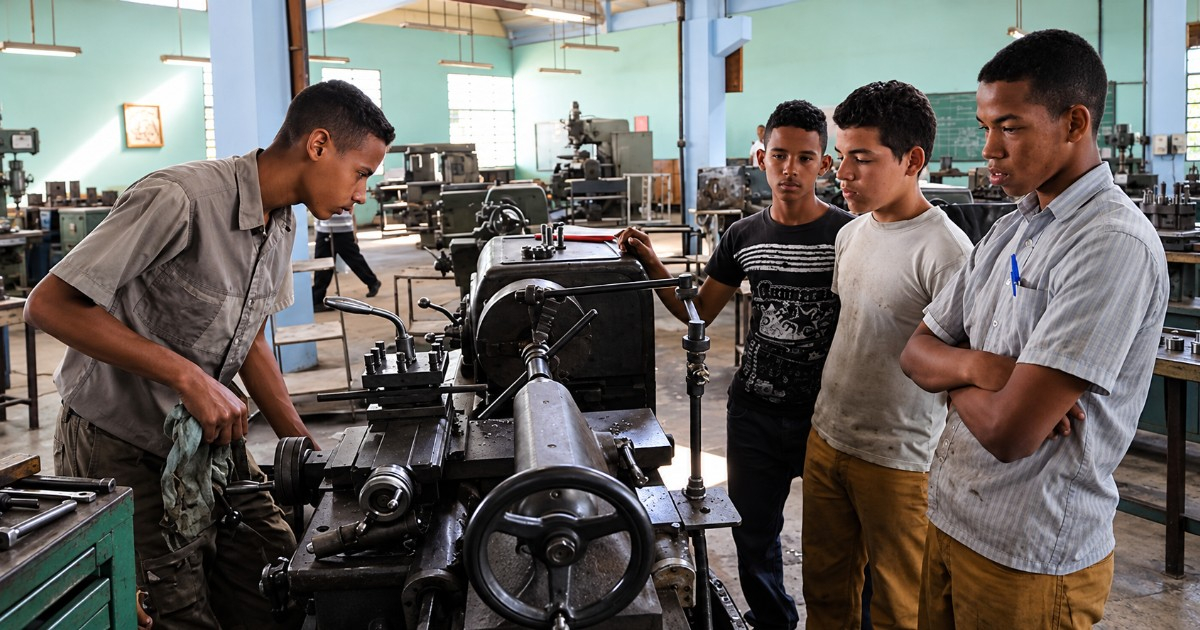
The polytechnic schools in Cuba began to introduce this semester a new subject aimed at teaching third-year students tools for entrepreneurship, innovation, and small business management, following a pilot experience carried out during the previous academic year.
The United Nations Development Programme (UNDP) reported that the subject will begin to be taught in polytechnic schools across the country starting from the 2026 school year.
The course is titled “Introduction to Innovative and Creative Entrepreneurship for Local Development with Entrepreneurial Technicians” and will complement the technical training that students receive in their respective specialties.
The goal, according to the program, is to train technicians who are capable of finding solutions to problems within their communities, developing their own initiatives, and acquiring useful knowledge to integrate into the job market or start a business.
The decision comes after a trial conducted during the last school year in 25 polytechnic centers, with the participation of over 4,600 students.
Young people from seven provinces received training on skills related to the business world, entrepreneurship generation, and access to employment.
Among them was José Ernesto Solano, a student at the polytechnic school Antonio Robert Ducas in Santiago de Cuba, who wishes to dedicate himself to barbering.
"Since I was little, I wanted to be a barber. Someone in my family taught me the basics. Later, my school offered a course that allowed me to learn other skills necessary for managing my business well," he told the UNDP.
Private enterprises from the local areas also participated. In Santiago de Cuba, for instance, the Zuturo project engaged with students regarding the needs and skills that the labor market of the private sector demands.
Another student, Samanta Osorio, who is studying Hotel Management at the Pepito Tey Polytechnic School, emphasized the practical component of her training: "I have learned to be creative, to find solutions with whatever little I have, from my locality."
The initiative is supported by the Swiss Agency for Development and Cooperation (COSUDE) and is accompanied by UNDP, in coordination with the Ministry of Education, the Ministry of Economy and Planning, the National Institute of Economic Research, and local governments.
The experience also encompasses the work carried out by PROFET, a project initiated in 2019 to strengthen Technical and Professional Education and improve employment opportunities for young people.
PROFET reached 53 polytechnic centers across 36 municipalities and all 15 provinces of Cuba, with initiatives related to specialties such as agriculture, construction, services, transportation, mechanics, and communications.
The program also aimed to strengthen the ties between educational institutions and the workplace entities in each territory.
Polytechnic and vocational schools generally accept young people from 15 to 16 years old and train workers in 103 specialties, including construction, information technology, and beauty services.
The introduction of content directly related to the creation and management of businesses occurs at a time when the Cuban government continues to implement changes within the framework of the private sector.
The importance of this new subject becomes more significant in light of the measures that the Cuban regime has adopted in recent years to expand and reorganize the role of the private sector in the economy.
This week, for example, Cuba officially incorporated into its legislation private companies with more than 100 workers, recognizing a new category of private enterprise for businesses that exceed the limit of 100 workers set for micro, small, and medium-sized enterprises.
The new legislation also allows these companies to define their structure and workforce, make investments, and, with prior authorization, import and export directly, while the State maintains various mechanisms for supervision and control over their operations.
Related videos:
Filed under: