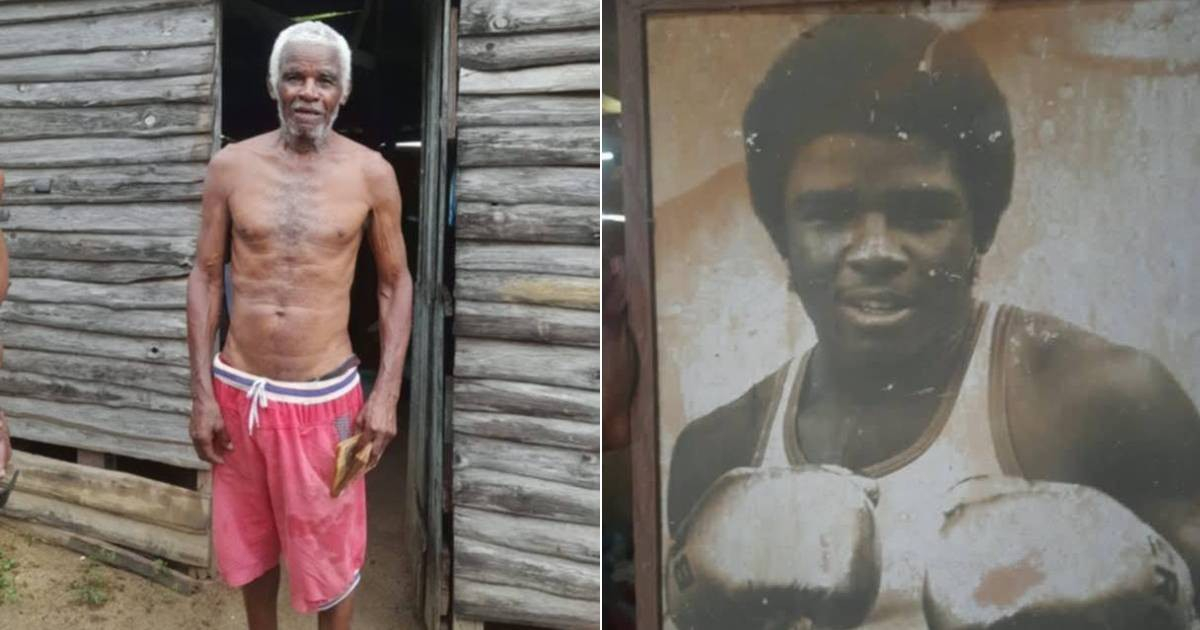
The former Cuban athlete Bernardo Comas, amateur boxing world champion in 1982, currently lives in precarious conditions in Camagüey, according to a report by his own family, who is calling for support for someone who once elevated the name of Cuba to the highest podium.
According to information shared by journalist José L. Tan Estrada on his social media, the former boxer resides in a house in the Camilo Cienfuegos neighborhood, near the Agricultural Fair located behind the Japanese Park in that city.
Comas exhibits signs of senile dementia and requires constant care. His family believes that the cognitive decline may be linked to the numerous head injuries sustained throughout his lengthy career, although this possible connection has not been medically established according to the available information.
The one who bears the burden of her care is her mother, an elderly woman who also faces her own health issues.
The family also claims that the pension received by the former athlete is insufficient to cover his basic needs, and that he has approached various entities for assistance without receiving a response.
This is joined by another claim: according to Comas's mother, a payment corresponding to the gold medal won by the former boxer is still pending, a statement that has not been independently verified.
The contrast with his sports career is striking. Born in Las Tunas in 1960, Comas competed in the 75 kg division and accumulated 203 victories in 234 fights during his amateur career. He was world champion in Munich in 1982, crowned at the Pan American Games in Caracas in 1983, won titles at the Central American and Caribbean Games, and was a four-time national champion of Cuba. He retired in 1987 and later worked as a coach in Camagüey.
One of the great frustrations of his career was not being able to compete in the 1984 Los Angeles Olympics, a tournament that Cuba did not attend due to the boycott imposed by the regime.
The case of Comas is not isolated. In recent years, independent media have documented a series of similar situations: former boxer Gaspar Casamayor was reported in March 2026 for living on the streets of Santiago de Cuba despite being recognized as a "Sports Glory" by INDER; former athlete Aleida Palomo was reported in October 2025 ill and begging in that same city; and former volleyball player Abel Sarmientos passed away in Havana, mired in poverty.
In response to these allegations, the national commissioner for Athlete Support, Wilmer Lewis Calvo, denied in February 2025 during the Round Table that the sports heroes were abandoned, claiming that support structures exist for them.
The reality documented by independent media contradicts that official version.
The Comas family asks that his legacy not be confined to history books and demands greater recognition for someone who dedicated his life to representing Cuba on the most prestigious international amateur boxing stages.
Related videos:
Filed under: