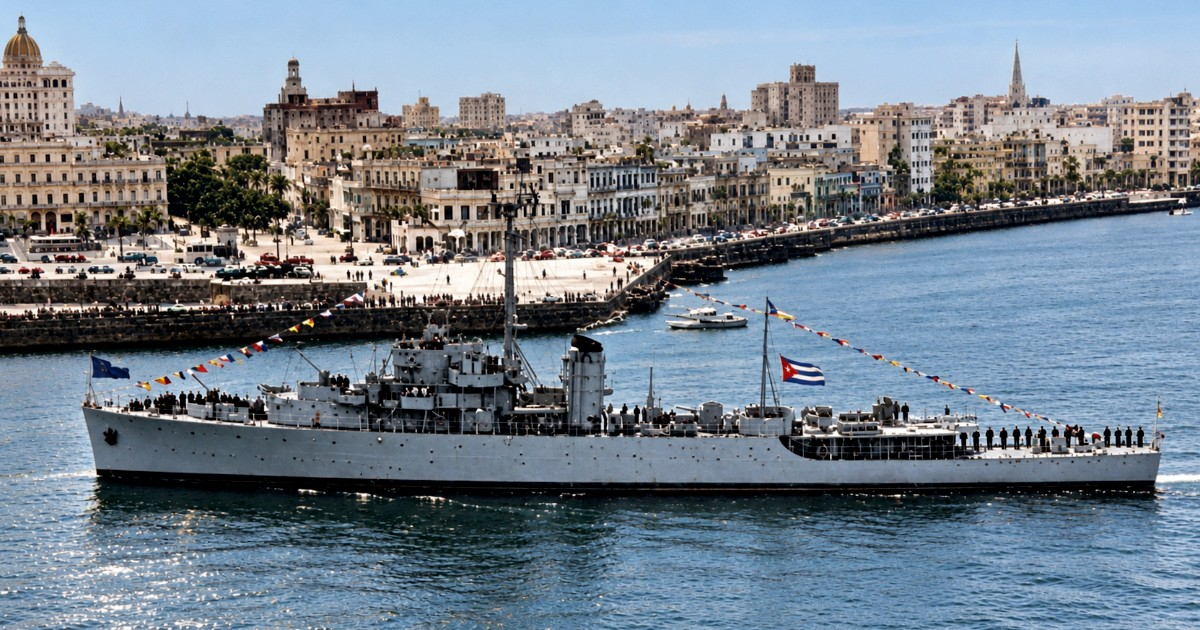
José Antonio Rodríguez Sosa, an officer of the Republican Navy of Cuba and exile activist for over six decades, passed away on September 4 in a hospital in Miami at the age of 87, surrounded by his family.
The Assembly of the Cuban Resistance publicly announced his passing through a statement released this Friday by Martí Noticias. The organization highlighted that Rodríguez Sosa, born in Havana on December 12, 1938, dedicated his entire life to fighting against the communist dictatorship from the very moment it took power on the Island.
Graduating from the last class of cadets at the Naval Academy of Mariel—the main training institution for naval officers in republican Cuba—Rodríguez Sosa rejected the proposals of the Castro regime in the early months of the regime and immediately joined the resistance in exile.
Orlando Gutiérrez-Boronat, national secretary of the Assembly of the Cuban Resistance, outlined a portrait of his career: "He led numerous fleets off the coast of Cuba, was a successful businessman, and directed the Association of Special Missions."
Furthermore, he emphasized that Rodríguez Sosa "was part of the group of Cuban patriots accused of attempting to bring justice to Fidel Castro in Isla Margarita during the Ibero-American Summit in 1997, but he was acquitted of that accusation. He was a gentleman, a patriot, and a man of integrity."
The episode of Isla Margarita that Gutiérrez-Boronat refers to was one of the most notable cases of anti-Castro activism in the 1990s.
The VII Ibero-American Summit took place in Venezuela on November 8 and 9, 1997. Weeks earlier, Puerto Rico authorities intercepted a vessel with four Cubans on board and an arsenal that included high-caliber rifles. The Cuban government attributed the operation to exiled militants from Miami; Rodríguez Sosa was among those accused but was acquitted.
Throughout his life in exile, he also built a successful business career and kept his activism alive alongside his brother Alexis, who passed away years before him.
The statement from the Assembly of the Cuban Resistance emphasized that "from the arrival of Castroism in Cuba in 1959 until his last days, he dedicated his life to the struggle for Cuba's freedom and to combating communism."
The organization, which in March of this year signed the Agreement for the Liberation of Cuba along with more than thirty exile organizations, has been one of the platforms where Rodríguez Sosa maintained his commitment until the end.
Reinol Rodríguez, a friend of the Rodríguez Sosa brothers, simply summarized the weight of this loss for the exile community: "Alongside his brother Alexis, who passed away a few years ago, he fought to restore freedom to Cuba. Another Cuban who dies in exile without giving up his dream of seeing a free Cuba."
Related videos:
Filed under: