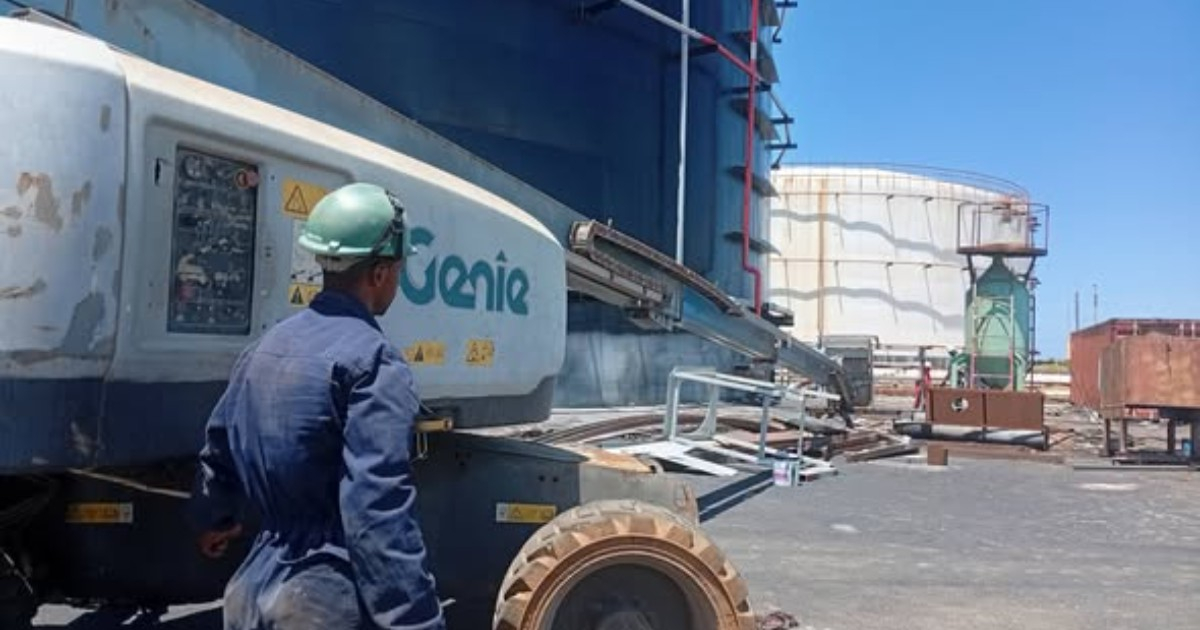
A photojournalist from the Periódico Girón in Matanzas publicly challenged the Ministry of Energy and Mines (MINEM) this Saturday by directly commenting on the Facebook post in which the agency refuted the local state media's report about a fire at the Supertankers Base of Matanzas.
Raúl Navarro González, photojournalist and director of Audiovisuals at Girón, demanded an apology for the newspaper's staff and technically argued that what happened was indeed a real fire, not just a minor smoke incident as stated by the ministry.
On Friday, September 11, Girón had posted on Facebook that during maintenance work on an empty tank at the base, "an accident occurred that caused a fire which was controlled by the forces of the Fire Department and other cooperating agencies from the Ministry of the Interior and other organizations," and that "the incident poses no risk of spread to nearby residents."
Hours later, the MINEM denied the version from the state media with a statement on the same social network: "Regarding the publication of a fire in one of the tanks at the Supertankers Base, we clarify that no such fire occurred; during maintenance activities being conducted on the tank, sulfur accumulated on the surface caused smoke that was quickly extinguished."
However, CUPET, in an expanded statement, admitted that during maintenance, when oxy-cutting is used to remove the roof, sulfur can combust, although it did not explicitly acknowledge that a fire occurred.
It was precisely in the official publication of MINEM where Navarro responded with an extensive technical comment. "It is very easy with a simple publication to undermine the work of an entire team like that of Periódico Girón from Matanzas," wrote the photojournalist.
His main argument was that the combustion of sulfur doesn't produce just smoke, but a real fire: "Sulfur in contact with welding work (or any ignition source) will cause a fire, not just smoke."
Navarro detailed that sulfur, when ignited, "produces a blue flame and generates sulfur dioxide (SO₂), which is a toxic and suffocating gas," and that "the white or gray smoke observed is the result of actual combustion with the emission of hazardous gases."
The reporter also provided precise technical data: the autoignition temperature of sulfur is approximately 232 °C, although in fine powder form it can ignite at 207 °C; sulfur powder dispersed in the air can form explosive mixtures with a lower explosive limit of around 35 g/m³; and the regulations of the United States Occupational Safety and Health Administration (OSHA) classify operations involving flames or sparks near sulfur as "hot work," requiring special permits.
His conclusion was straightforward: «Since they wanted to downplay the issue, putting us in a difficult position as liars, provide an explanation for the following statement. I demand an apology to our group.»
The episode reveals an unusual internal tension in the Cuban official press: a local state media outlet was publicly contradicted by national authorities from the energy sector, and one of its journalists responded by demanding an apology from the ministry on his Facebook page.
The incident occurs in a context of extreme sensitivity. The Supertankers Base is the largest oil storage infrastructure in the country and was the scene of the worst industrial disaster in recent Cuban history: on August 5, 2022, a lightning strike triggered a fire that devastated four of the eight tanks, resulting in 17 fatalities, more than 140 injuries, and estimated losses of 66 million dollars.
The installation is currently undergoing reconstruction with Cuban and Chinese brigades, and Cuba is experiencing a deep energy crisis marked by prolonged blackouts and fuel shortages, making any updates from this base significant news for the population.
Related videos:
Filed under: