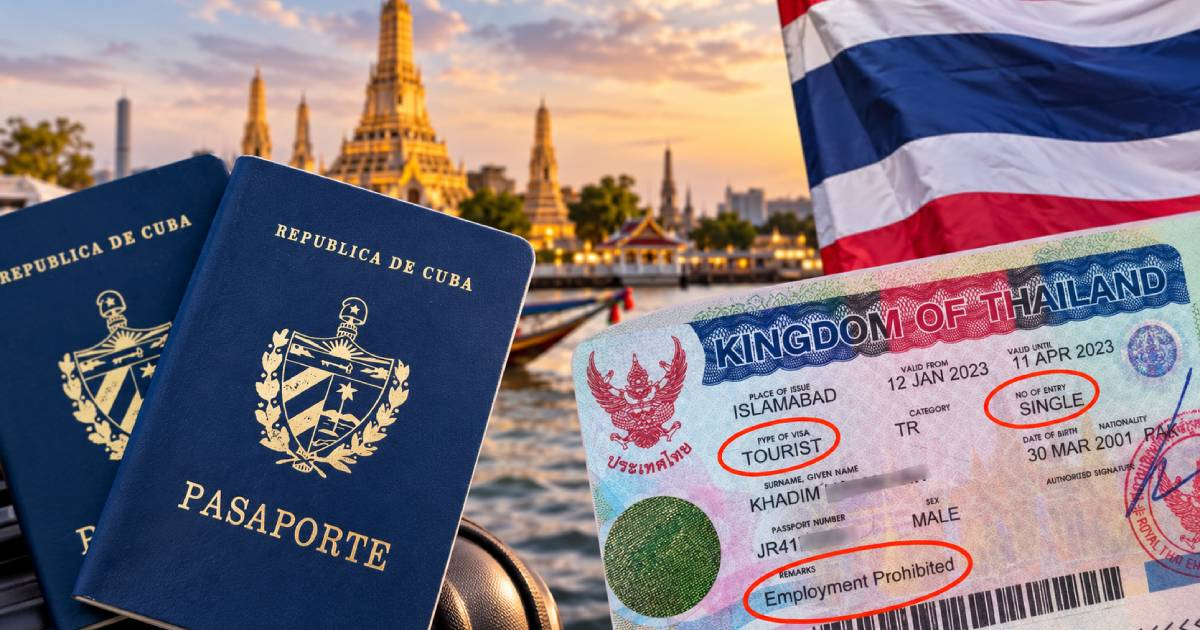
Cuban citizens with ordinary passports will no longer be able to travel to Thailand without a visa starting this Tuesday, September 15, following the Asian country's decision to eliminate the exemption that allowed them to stay for up to 60 days without that requirement.
The change was confirmed by the Royal Embassy of Thailand in Mexico City, which updated the entry requirements for the country on September 7.
The measure removes the 60-day visa exemption regime for Cuba, following announcements made by the Thai Ministry of the Interior on August 31. Cuba is among 21 countries that will lose this benefit, along with Mexico, Guatemala, Colombia, Uruguay, Ecuador, and Jamaica, among others.
For Cubans, this marks the end of a migration facility that had been in place for just two years. Thailand eliminated the visa requirement for travelers from the island in July 2024, when it expanded the number of nationalities benefiting from the exemption from 57 to 93.
From now on, those who wish to travel from Cuba will be able to apply for a visa entirely online through the official platform thaievisa.go.th, without the need to travel to Mexico to submit original documents.
Royal Embassy of Thailand in Mexico / Royal Thai Embassy in Mexico
According to the official website of the Thai embassy, for a tourist visa, it is required, among other documents, a passport with more than six months of validity, a recent photograph, identification proving your place of residence, round-trip tickets, accommodation receipts, and bank statements for the last three months.
The Embassy requires proof of a minimum balance of 20,000 Thai baht in each bank statement, which is equivalent to approximately 570 dollars.
The Embassy did not specify in its update the cost that Cubans will have to pay for the e-Visa. The corresponding fee is displayed during the application process on the official Thai e-Visa platform, once the type of visa and the diplomatic representation responsible for processing it are selected. The payment is made electronically and, once completed, is non-refundable.
The processing usually takes between five and ten business days, although authorities recommend submitting the application at least one month in advance.
An important detail for those living in Cuba is that they can complete the entire process electronically from the island. Applicants must be physically present during the procedure in one of the countries under the jurisdiction of the Thai Embassy in Mexico, which includes Cuba, as well as Guatemala, Honduras, Nicaragua, Haiti, and Belize.
The tourist visa allows a stay in Thailand for a maximum of 60 days per entry, with the option to apply for an extension of up to an additional 30 days from the country's immigration authorities. For a single entry, the e-Visa is generally valid for 90 days from the date of issuance.
The Embassy recommends carefully reviewing the documentation before submitting the application and warns that files requiring more than two modifications may be canceled.
The new restriction once again reduces travel options for holders of Cuban passports. In February 2026, Nicaragua resumed visa requirements for Cubans, against a backdrop in which numerous countries maintain visa requirements for travelers coming from the island.
Related videos:
Filed under: