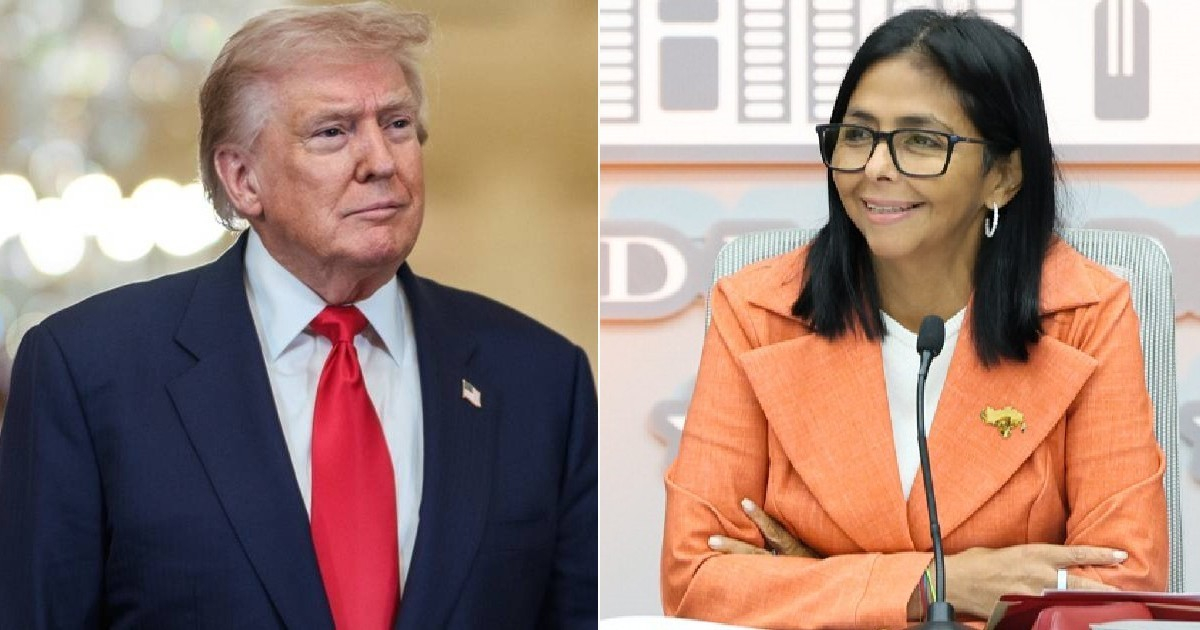
The President of the United States, Donald Trump, on Wednesday removed Venezuela from the category of countries that have "demonstrably failed" to meet their international obligations regarding anti-narcotics, in a decision that marks a historic turn in the relationship between Washington and Caracas following the capture of Nicolás Maduro.
The measure was reflected in the Presidential Determination on Major Drug Transit or Major Illicit Drug Producing Countries for Fiscal Year 2027, submitted to Congress on Tuesday and published this Wednesday by the Department of State.
Venezuela had remained in that category since 2005, when the government of Hugo Chávez expelled the DEA from the country, and stayed in it throughout Maduro's era.
Trump attributed the change to the cooperation that the interim government of acting president Delcy Rodríguez has maintained with Washington since U.S. military forces captured Maduro on January 3 of this year.
"In Venezuela, thanks to my Administration's successful apprehension and removal of the illegitimate ex-dictator and drug trafficker Nicolás Maduro, we are already seeing the results of increased cooperation with the interim government of the country to combat the cartels, including the elimination of Niño Guerrero, leader of the Tren de Aragua," the president wrote in the document.
Trump referred to the operation that eliminated Héctor Rusthenford Guerrero Flores, known as "Niño Guerrero," announced last June, and which Defense Secretary Pete Hegseth stated was carried out "in full collaboration" with Venezuelan security forces.
"Given the positive progress made under the interim management of President Delcy Rodríguez, I have determined that Venezuela should no longer be labeled for having demonstrably failed to meet its drug control commitments," Trump added, warning that he expects "continuous and measurable progress" in dismantling narcoterrorist groups.
Venezuela is not completely exempt: the country remains on the broader list of 23 nations deemed as major countries of transit or production of illicit drugs, alongside Mexico, China, Colombia, Nicaragua, and 18 other states.
In contrast, Colombia remains among the non-certified countries, although Trump opened the door to reconsidering that classification.
"Yes, if Colombia makes progress in the vigorous eradication of coca and dismantling its narcoterrorist networks over the next year, I will consider lifting the country's rating of 'demonstrated failure,'" said the president, referring to the government of the new Colombian leader Abelardo de la Espriella, who took office in August.
The U.S. revoked Colombia's certification as an ally in the fight against drugs in September 2025, amid tensions with then-president Gustavo Petro, whom Trump accused of having ties to drug trafficking.
Also remaining uncategorized are Afghanistan, Bolivia, and Myanmar, although Trump determined that U.S. assistance to Bolivia, Myanmar, and Colombia "is currently vital to the national interests of the United States."
The decision regarding Venezuela is part of the hemispheric strategy of the Trump administration, which in March of this year launched the Americas Counter Cartel Coalition, a security alliance with over a dozen countries from the Western Hemisphere aimed at reducing the flow of drugs into U.S. territory.
According to the agency EFE, Trump stated in the document that "the drastic political changes in South America over the past year have created historic opportunities for cooperation between the United States and the governments of the region."
Related videos:
Filed under: