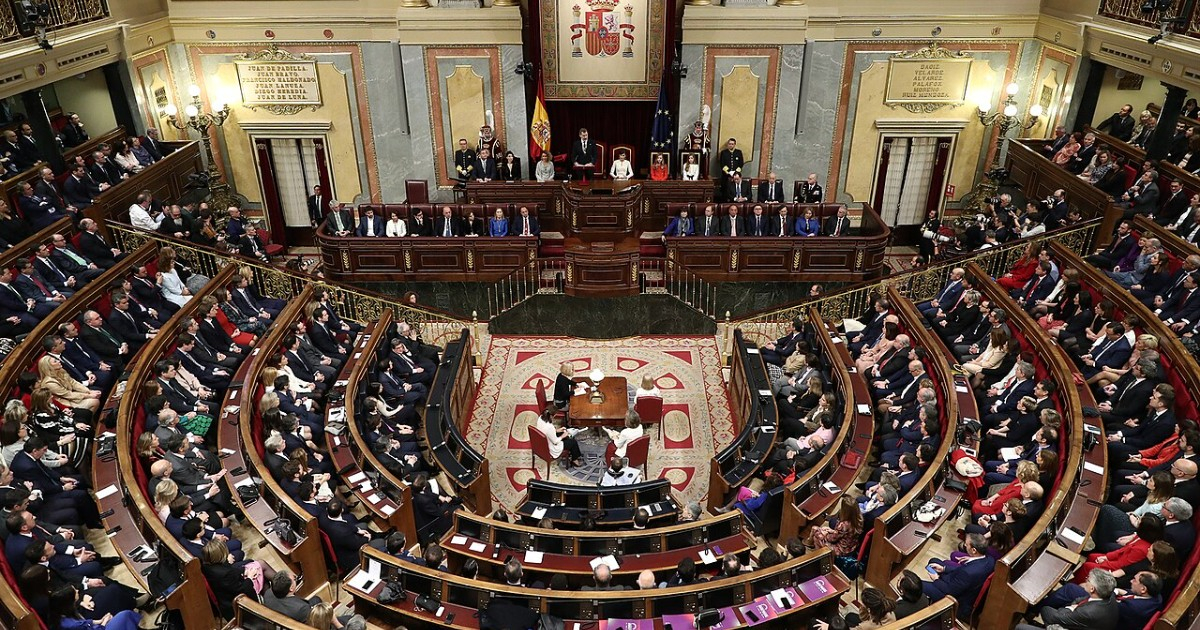
The Congress of Deputies of Spain rejected on Wednesday an initiative from Sumar that aimed to urge the Government to lead a favorable position for Cuba within the European Union regarding the economic measures from the United States and to strengthen cooperation with the regime on the island in sectors deemed essential.
The motion was rejected by 170 votes against, 163 in favor, and 13 abstentions, according to agency EFE reported.
The vote took place on the text resulting from the incorporation of an amendment presented by the Socialist Group.
The initiative, originally presented by Sumar, called on the Spanish government to maintain its demand for the lifting of the "economic, commercial, and financial blockade" imposed by the United States against Cuba and to lead within the European Union a stance opposing those measures.
También planteaba reforzar la cooperación con la isla, particularmente en áreas como energía, alimentación y productos farmacéuticos.
During the debate, the Sumar representative Enrique Santiago held U.S. policy responsible for worsening the situation facing the Cuban population and urged parliamentary groups to set aside "political and ideological considerations" in order to support the proposal.
The text, however, faced opposition from different factions and for various reasons.
The Junts deputy Isidre Gavin stated that his party opposes sanctions, but he rejected the idea that the "poverty and misery" of the island can be primarily attributed to U.S. President Donald Trump.
From Vox, the deputy Andrés Alberto Rodríguez described the initiative as a "political and moral absurdity" and questioned the expectation that the Spanish government would "protect the Cuban dictatorship" within the European Union.
The member of parliament from the Popular Party, Belén Hoyo, criticized that the proposal did not include references to the "dictatorship", the "political prisoners", "censorship", "repression", or "persecution" in Cuba.
On his part, Alberto Catalán, from Unión del Pueblo Navarro (UPN), described the initiative as "self-serving and hypocritical."
The spokesperson for the PNV, Maribel Vaquero, shared her party's opposition to the U.S. measures, but deemed the approach insufficient because, in her view, any stance on Cuba should also include a condemnation of "the regime's repression."
From the PSOE, the representative Rafaela Romero defended the need to distinguish between support for the Cuban population and backing for the authorities in Havana.
Romero stated that defending the Cuban people against U.S. measures "does not mean defending the Government" of Cuba, and challenged the notion that the suffering of the population can be used as a means of pressure to achieve political change.
In contrast, the BNG deputy Néstor Rego argued that supporting Cuba means protecting the sovereignty of nations, while Javier Sánchez Serna from Podemos demanded a "concrete" solidarity that would even include "military aid" and the sending of oil tankers to the island by several countries.
Representatives from ERC and EH Bildu also supported critical positions regarding Washington.
The Republican deputy Jordi Salvador called for "fewer words and more action," while Jon Iñarritu questioned U.S. foreign policy towards countries deemed adversarial.
La votación en el Congreso español ocurre después de varias decisiones y pronunciamientos en las instituciones europeas sobre la relación con La Habana.
In May, the High Representative of the European Union for Foreign Affairs, Kaja Kallas, confirmed that the Political Dialogue and Cooperation Agreement between the EU and Cuba was under review.
Kallas then acknowledged that the agreement "has not yielded the expected results" and called on the Cuban authorities for economic reforms and greater openness.
A month later, on June 18, the European Parliament approved a resolution that requested individual sanctions against Miguel Díaz-Canel and called for the suspension of the agreement with Cuba.
The text was approved with 283 votes in favor, 199 against, and 85 abstentions and also called for measures against GAESA leaders and the release of political prisoners.
In July, during a debate at the United Nations General Assembly on the U.S. embargo, the European Union reiterated its opposition to these sanctions, but at the same time stated that the crisis facing Cuba cannot be solely attributed to the embargo and called for political and economic reforms, as well as respect for human rights and the release of arbitrarily detained individuals.
Related videos:
Filed under: