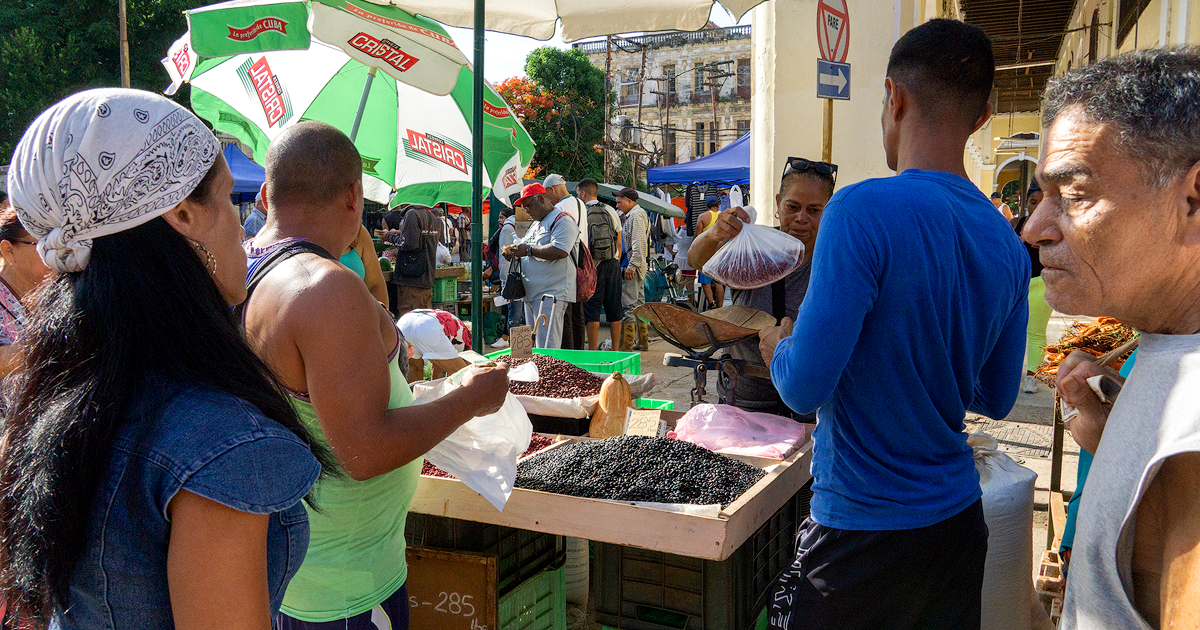
Rice, beans, chicken, pork, eggs, bread, hygiene products, medications, transportation, and basic services. A Cuban woman calculated the monthly expenses for a small family in Havana, and her estimate is around 205 thousand Cuban pesos (CUP), even without including several products.
Yulieta Hernández Díaz shared a detailed list of expenses this Thursday on with a simple phrase: "Sometimes I feel like crunching the numbers...".
Only in some of the main food items, Hernández estimated 9,600 CUP for 12 kilograms of rice, 6,000 for four kilograms of beans, 9,000 for eggs, 18,000 for chicken, and 24,000 pesos for pork.
He added 9,000 CUP for milk, another 9,000 for oil, 4,000 for coffee, 6,400 for onions, 4,500 for fruits, another 4,500 for root vegetables, and 19,200 pesos for bread.
The list continues with essential products for hygiene and cleaning at home: detergent, toilet paper, wet wipes, toothpaste, soap, shampoo, deodorant, feminine hygiene products, dishwashing detergent, and bleach.
He also calculated 7,000 CUP for medication, 24,000 for transportation, 2,500 for electricity, and other expenses for water, gas, phone, mobile data, and calls. Finally, he set aside 10,000 pesos for unforeseen expenses.
Hernández set the total at 205,000 CUP per month and summarized: "More than 200,000 CUP for a small family in Havana."
However, the breakdown itself shows that this is an estimation and not a fixed budget. The author excluded prices for items like beef and spaghetti, and also did not include in the total ice cream, cheese, ham, or chocolate, products that she accompanied with a shocked emoji, reflecting that today these items are considered luxuries for many Cuban families.
The author accompanied the message with an image in which the word "SOBREMORIMOS" appears shaped like the silhouette of Cuba and concluded her reflection with another phrase: "We continue SOBREMURIENDO."
The idea symbolically encapsulates an increasingly widespread perception among many Cubans: the shift from living to surviving, and from surviving to "over-dying," a way of expressing how the extension and deepening of the economic crisis have increasingly narrowed the margins of well-being and normalcy in everyday life.
The reactions precisely reinforced the idea that the account might fall short. "Check again, you missed some things to add," commented one person, while another noted: "All the basics, some things are missing."
Other users mentioned absent expenses such as clothing and footwear, purchasing water, vacations, or additional family needs.
A person summarized the situation by saying: «We are alive because we breathe», while another stated that to survive with the basics, they need more than 150,000 pesos per month.
There were also questions regarding some of the prices used. One commentator noted that the pound of pork might already be around 1,700 CUP and not the 1,500 used in the calculation, illustrating how prices can vary depending on the location and time of purchase.
Other Cubans have posed the same question as Hernández and have shared their own estimates, in a context where various calculations show an increasing gap between income and the cost of living.
In May, a study by economist Javier Pérez Capdevila estimated that an individual required at least 96,060 CUP per month to cover basic needs.
That budget included 70,070 pesos for food, 11,450 for personal hygiene, 5,800 for clothing and footwear, 4,740 for home cleaning, 2,000 for medication, and 2,000 for transportation.
Additionally, it excluded expenses such as electricity, water, internet, and recreation, which is why its own author considered it a minimum threshold.
The gap with labor income is considerable. Since July, the minimum wage in Cuba is 3,210 CUP per month, having increased from the previous 2,100 pesos. Using the 205,000 CUP estimated by Hernández as a reference, that amount is equivalent to almost 64 minimum wages.
The decline in purchasing power also occurs amid a new contraction of the economy.
The CEPAL projects that Cuba's GDP will drop by 10.3% in 2026, the worst forecast among the economies of Latin America and the Caribbean.
Related videos:
Filed under: