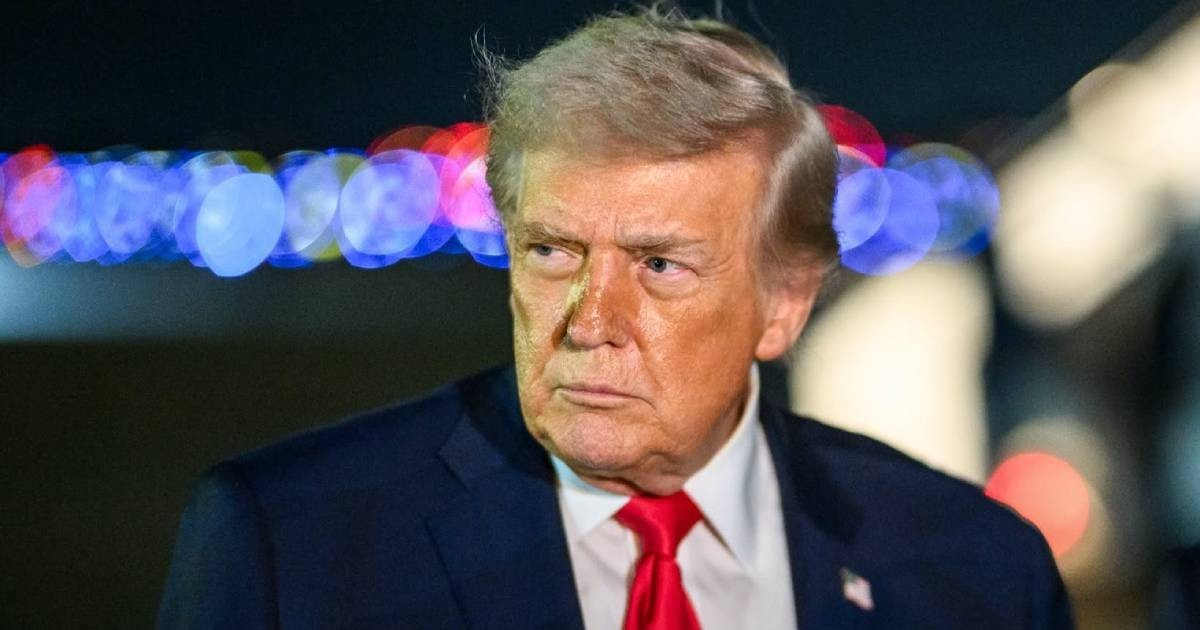
President Donald Trump announced this Friday that CNN, MSNBC and Politico are banned from the White House “effective immediately”, accusing the three media outlets of spreading false information about his administration and warning that other journalistic organizations could be next.
Trump made the announcement directly on Truth Social, where he stated he was "proud" to ban access to the three organizations due to what he described as a constant coverage of "fake news."
"The media should not be able to constantly write or report FICTION and LIES when covering the President of the United States, the Trump Administration, or the United States of America," wrote the leader, before warning: "Other fake news outlets will continue."
In his message, Trump also aimed specific criticisms at MSNOW—the network formerly known as MSNBC—and against Politico.
Regarding this last point, he stated that he received a government subscription of about 8 million dollars during the administration of Joe Biden, which he described as "illegal and ridiculous," and suggested that it could be a case of corruption.
However, that characterization of the payments to Politico has been questioned previously. The Associated Press documented in 2025 that federal agencies were purchasing subscriptions and licenses for news services, including Politico Pro, and that those payments were for service contracts, not for grants intended to fund editorial coverage.
That type of subscription also existed during Trump's first administration.
Politico then explained that it had never received government subsidies, aid, or grants, and that some federal agencies, as well as businesses and other organizations, paid for Politico Pro, its professional service for information and monitoring of public policies.
The ban announced this Friday was later confirmed by The Associated Press, which noted that Trump did not clarify how it will be implemented in practice or which spaces, events, or credentials will be included in the measure.
The case of CNN is particularly relevant as the network is part of the traditional group of five television stations that participate in the press pool for the presidency, responsible for accompanying the president and providing coverage of their activities when it is not possible for the entire press corps to have access.
AP indicated that the decision could open a new front regarding the First Amendment press freedom guarantees, although it is still unclear how the veto will be implemented or if the affected media outlets will take legal action.
The new episode comes after numerous clashes between Trump, his administration, and various media outlets and journalists.
The most recent incident directly related to CNN occurred in August, when Trump had a heated exchange with correspondent Kristen Holmes in the Oval Office.
The president repeatedly called her "fake news" and accused her of being a "fake reporter," while CNN later defended its journalist.
Two months ago, Trump walked out of an interview with NBC after calling the host Kristen Welker "corrupt or stupid" and also accused NBC, CBS, and ABC of being "corrupt" media outlets.
The confrontation with the press has also reached the courts, as in April, a federal judge dismissed a $10 billion defamation lawsuit filed by Trump against The Wall Street Journal and Rupert Murdoch over a report related to Jeffrey Epstein.
Related videos:
Filed under: