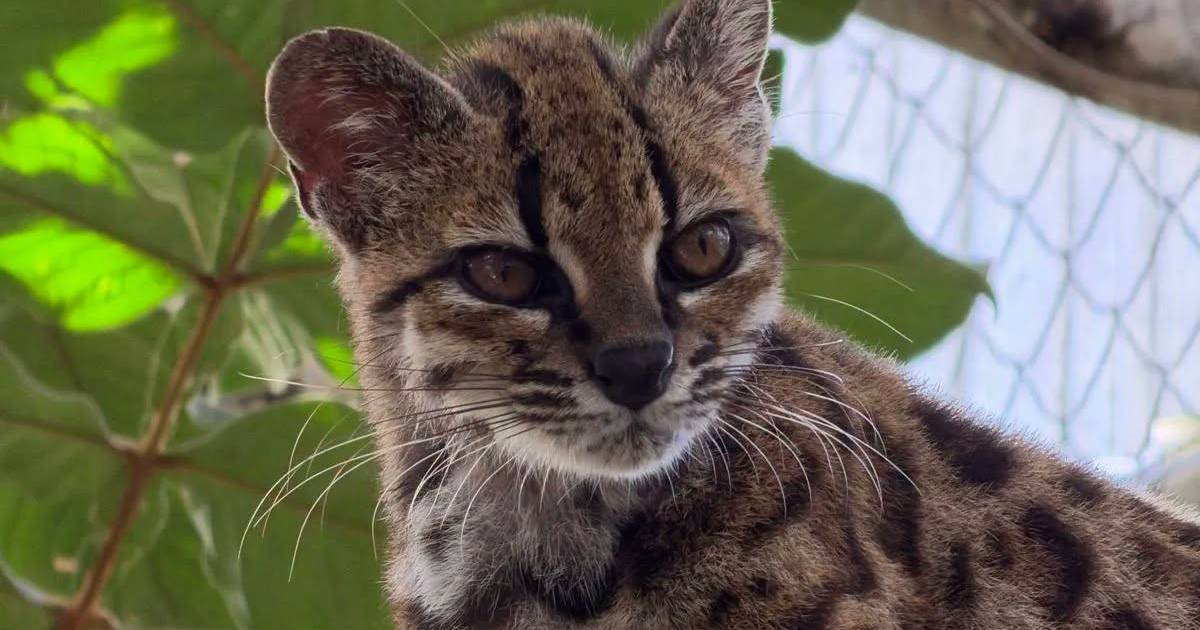
A Bolivian family raised a small feline for over a year, believing it was a domestic cat, until its behaviors—hunting chickens, meowing differently, and acting like a wild predator—set off alarm bells.
The DNA analysis confirmed what no one had imagined: it was a species completely unknown to science, named Leopardus tilcayo and formally described this Thursday in the journal Current Biology.
It is the first time in over a century that a new species of living feline has been officially named and described in the world, a scientific milestone featuring researchers from Bolivia, Belgium, and Brazil.
The animal is called tilcayo, a name that the local communities in the Bolivian Yungas have been using for a long time. It lives in the cloud forests of that mountainous region, characterized by its high humidity and permanent cloud cover on the eastern slope of the Andes.
In terms of size, the tilcayo is even smaller than the average domestic cat: it measures about 46 centimeters in length and weighs approximately 1.4 kilograms.
"His fur is light brown [...] and features irregularly shaped rosettes all over the body," described Paola Nogales-Ascarrunz, an explorer for National Geographic and one of the authors of the study.
The specimen that lived with the local family—a 10-year-old male—currently resides in the Senda Verde Wildlife Sanctuary in Coroico, Bolivia.
It was precisely this animal that raised the scientists' suspicions: its physical characteristics did not match the existing descriptions of tiger cats, most of which were based on specimens from Brazil.
"This led us to ask: what tiger cat do we really have in Bolivia?" explained Nogales-Ascarrunz.
The team analyzed the DNA of 38 cats from various South American countries, including eight museum specimens, and reached a conclusion that reshapes the taxonomy of the group: tiger cats are not two species, as previously recognized by the International Union for Conservation of Nature (IUCN) Red List, but rather five genetically distinct species.
The analysis indicates that the lineage of the tilcayo diverged from other tiger cats approximately 1.4 million years ago. "We never expected this Bolivian tiger cat to be a distinct species, and no one had proposed it as a different animal before," admitted Jonas Lescroart, evolutionary biologist at the University of Antwerp and the main co-author of the study.
There is still much to learn about the habits of the tilcayo. Trail cameras suggest that it is nocturnal, and remains of small rodents found in its droppings indicate its diet. "At the moment, our information is limited to the two live specimens we examined and a small number of trail camera records," acknowledged Lescroart.
The team also described a new subspecies of tiger cat in the Yungas of Peru, which they named Leopardus tigrinus antisuyo, in honor of the Antisuyo, the region of the ancient Inca Empire where it lives.
The researchers shared their findings with the IUCN, whose upcoming review will evaluate the five lineages separately.
According to Lescroart, the tilcayo could be classified as endangered when analyzed independently, a threat that is exacerbated by the increasing pressures Yungas face from deforestation, agricultural expansion, fires, and mining.
“There are many species yet to be discovered in the world, and they risk disappearing before we even get to know them,” warned Eduardo Eizirik, evolutionary biologist at the Pontifical Catholic University of Rio Grande do Sul and lead author of the study.
Related videos:
Filed under: