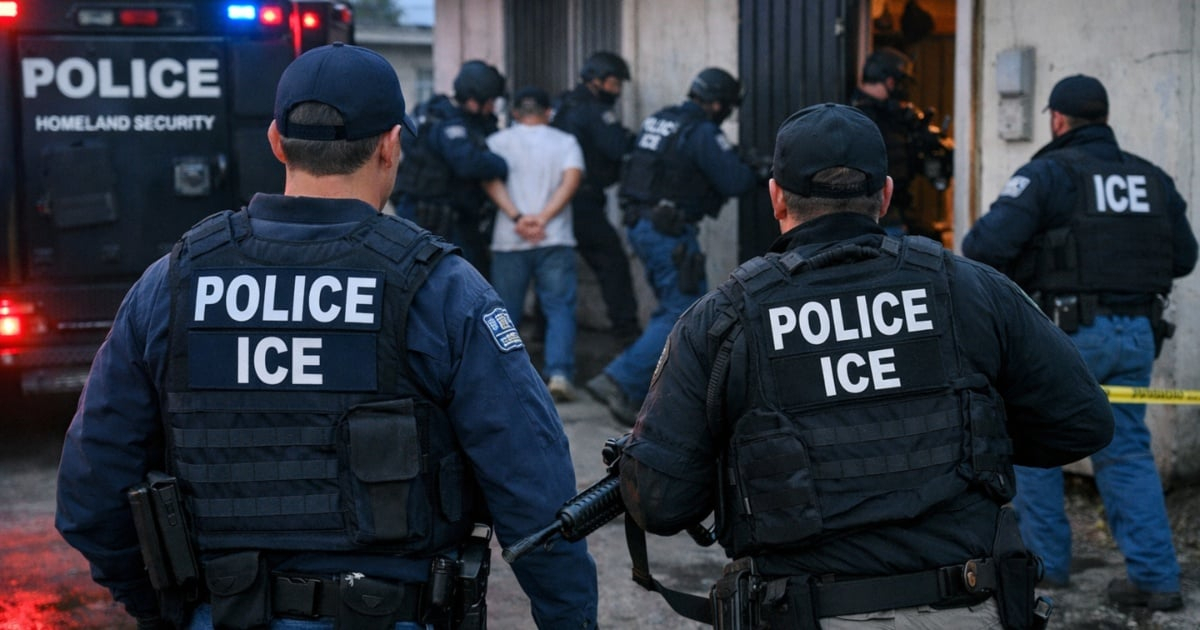
A federal judge this week blocked immigration arrests without a court order carried out by the Immigration and Customs Enforcement (ICE) in seven counties in Southern California, in a ruling that represents one of the biggest judicial setbacks to the Trump administration's mass deportation policy.
The judge Maame Ewusi-Mensah Frimpong from the Central District of California, issued the preliminary injunction order on September 2 in the case Vasquez Perdomo v. Mullin, although it was unsealed and made public last Wednesday.
The resolution applies in the counties of Los Angeles, Orange, Riverside, San Bernardino, Ventura, Santa Barbara, and San Luis Obispo.
Under the order, ICE agents will only be able to make civil arrests without a warrant if they first individually determine that there is probable cause to believe that the person is undocumented and that it is likely they will flee before a warrant can be obtained.
The judge also demands that the agents document this analysis in each case and that they stop relying on a memorandum issued in January 2026 by the then-interim director of ICE, Todd Lyons, which illegally suggested that merely being undocumented was enough to presume a flight risk.
The evidence presented in the trial was compelling: from a sample of 113 arrest records provided by the government during the proceedings, nearly 80% contained no assessment of flight risk or were limited to generic language.
The judge herself stated that federal agents "regularly refrain from conducting any risk assessment regarding flight."
A documented case illustrates the pattern: the government claimed that a detainee "was fleeing" from the agents before being interrogated, but a video of the arrest showed him walking at a normal pace and texting on his phone when the agent approached him.
In response to the argument made by federal attorney Daniel Mummolo, who stated that there is no legal obligation to document the evaluation, the judge replied directly: "They have not presented any evidence of agents saying, 'Yes, I didn't write it down, but I did do it.'"
Frimpong also rejected the government's request to suspend or delay the order in order to allow time for an appeal, and certified the case as a class action that covers all individuals arrested without a court order and without individualized assessment since June 6, 2025.
The lawsuit was filed in July 2025 by five Latino workers and three organizations —the Coalition for Human Rights of Immigrants (CHIRLA), the Los Angeles Worker Centers Network (LAWCN), and United Farm Workers (UFW)— alongside the American Civil Liberties Union (ACLU) of Southern California and other advocacy groups, in response to an unprecedented wave of operations that included raids in agricultural fields in Oxnard and Coachella.
"This ruling is one of the most significant decisions to date in the community's effort to put an end to the cruel and illegal practice by the federal government of detaining individuals and separating them from their families," stated Mayra Joachin, attorney for the ACLU of Southern California.
For her part, Teresa Romero, president of the United Farm Workers, stated: "More than a year ago, farm workers in Southern California endured weeks of horrific attacks that targeted them for the color of their skin. This decision reaffirms that those illegal and racist raids should never have happened."
The ruling adds to similar decisions already issued by federal judges in Oregon, Colorado, Washington D.C., and the Eastern District of California, which establishes a pattern of increasing judicial resistance to the mass deportation campaign driven by the Trump administration. The Department of Homeland Security did not respond to requests for comment on the ruling.
Related videos:
Filed under: