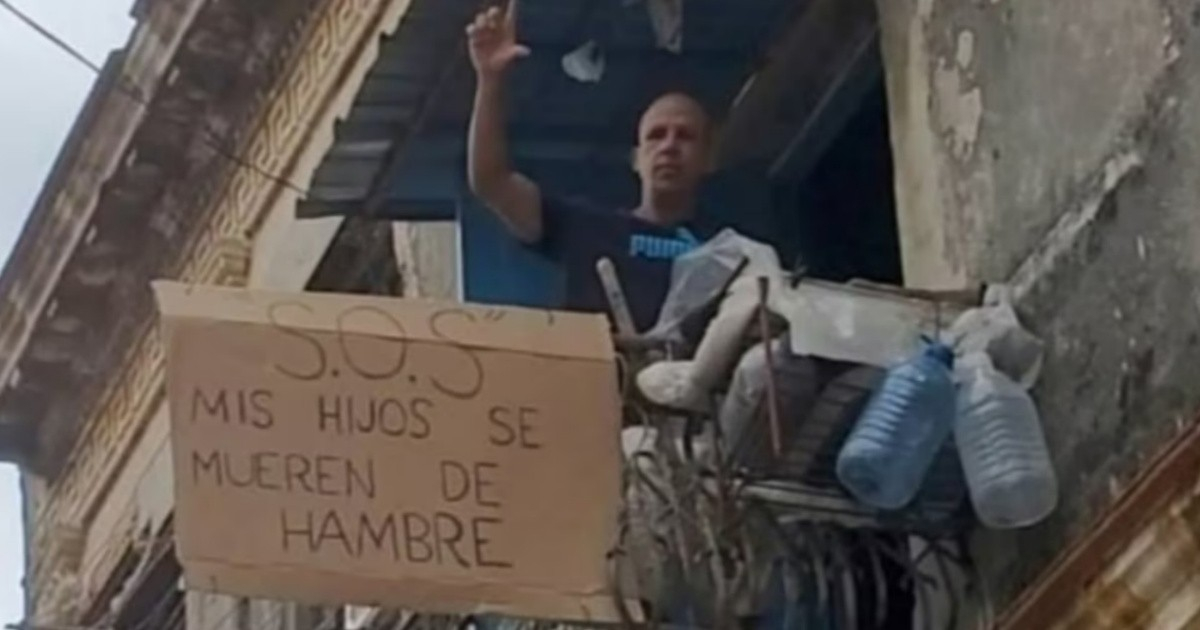
The political prisoner José Antonio Pompa López, a member of the opposition movement Cuba Primero, remains confined in "La Polaca," the maximum security section of the Agüica prison in Matanzas, despite the fact that the prison authorities themselves acknowledged that this regime is not applicable to him.
This section of the Matanzas prison is typically reserved for inmates serving life sentences, with family visits allowed only every four months.
His wife, Suarmi Hernández, reported to Martí Noticias that she went to the Directorate of Penitentiary Establishments of the Ministry of the Interior, at 15 and K, El Vedado, Havana, where they confirmed to her that her husband's situation is irregular.
"He shouldn't be there, that's a violation," Hernández asserted after that action.
The woman reported that for a month she was warned that visits would change to every four months, in line with the regime applied to those sentenced to life imprisonment who share that section with Pompa.
"They gave me the visit; I thought they weren't going to let me have it. Because last month they told me that it couldn't be seen every month anymore, because since I was with the life sentences —it's called La Polaca, in that prison—, that regime is every four months," he explained.
In addition to the visiting restrictions, Hernández described deplorable conditions within "La Polaca": "The food they are given is spoiled rice with raw corn."
The wife of the political prisoner also requested the authorities to transfer Pompa to a prison in Havana, the province where the family resides, but the request was denied.
The result is that you must travel approximately 200 kilometers for each visit, along with everything that entails in today's Cuba.
"Look at what time I arrived, almost one in the morning, all alone. It's dangerous, given the situation in the country. There are many assaults, a lot of violence, because of the system we are living under," she reported.
Pompa López was sentenced in October 2025 to eight years in prison for the alleged crime of "propaganda against the constitutional order," following a trial held at the Municipal Court of Guanajay, Artemisa, along with fellow members of Cuba Primero Daniel Alfaro Frías and Lázaro Mendoza García.
In November of that same year, he was transferred from the Combinado del Este prison in Havana to Agüica, distancing him from his family by nearly 195 kilometers.
The case is part of a systematic repression against Cuba Primero, an opposition movement that the regime included in a list of organizations linked to terrorism in July 2025.
This month, a court in Las Tunas sentenced eight more members of the movement to prison terms of between seven and eight years on similar charges.
The general context is one of increasing repression: according to Prisoners Defenders, Cuba reached a historical record of 1,339 political prisoners in September 2026.
Related videos:
Filed under: