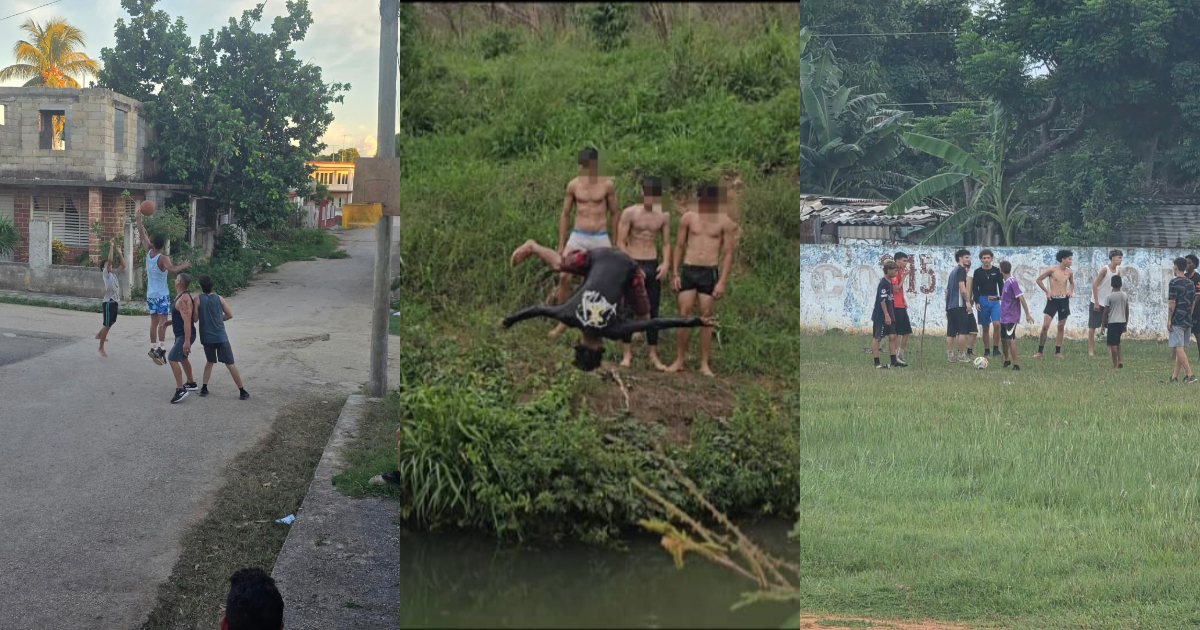
In any functional society, youth is a stage of exploration, socialization, and leisure. However, in present-day Cuba, this natural development clashes with the economic collapse and the degradation of state infrastructures, placing young people in a context of profound vulnerability.
They survive by facing the daily challenge of seeking a minimum of recreation. So, how can they ensure their physical, mental, and social development when official options have become outdated and private alternatives are financially out of reach?
Young people have developed a collective economy: entertainment is created in the streets, in the living rooms of their homes, and through informal networks.
For decades, the regime on the island organized youth recreation in a top-down manner through discotheques, cultural and sports centers, as well as popular camping. Today, many of these spaces are abandoned.
The Joven Club de Computación, established to centralize access to digital entertainment, have also become obsolete due to lack of maintenance, outdated catalogs, and power outages. They no longer resonate with a generation that has global references.
The youth offline
Unstable connectivity and high mobile data costs mean that many video games are played without a permanent connection. Content is downloaded in advance and stored on consoles, memory devices, or phones. Those who can try to update them online, but a continuous connection is not the usual condition for playing.
Digital piracy and the informal market support a network of services that includes bulk downloads through virtual private networks (VPNs) to bypass regional restrictions, as well as the importation and resale of peripherals.
The ads listed on Revolico provide insights into this market, although prices vary depending on the equipment, service, and title. Loading a memory card with several games can cost between 1,500 and 3,000 Cuban pesos (CUP). Used physical discs or copies of popular titles can range from 2,000 to 5,000 CUP, depending on the type of disc and demand. These prices are not fixed rates.
For many young people, bearing these costs or downloading games due to lack of mobile data is challenging. Access depends on those who manage and market the games. In light of these difficulties, they turn to the informal rental of consoles in private homes, where these devices are offered as a source of household income.
To play at one of the group members' homes, they turn to the traditional "ponina," a collection among four or five friends. According to the young people surveyed, renting a PlayStation costs at least 150 pesos per hour, but they need to gather double or triple that amount to cover a full session.
The young people take turns handling the controls to play titles like Call of Duty, FC 26, Mortal Kombat, Naruto, or Minecraft.
The same logic applies to mobile devices with games like Free Fire, Call of Duty Mobile, and DLS 26. When data runs low, young people share it via Bluetooth, Zapya, or hotspot to play together without consuming everyone’s balance.
Titles that require a high-speed and uninterrupted connection, such as Roblox, are often out of reach for many young Cubans. Instead, campaign and story modes that function offline, like those found in Grand Theft Auto (GTA), are better suited to these conditions.
Friends' gathering
Engaging in a private business also clashes with low family incomes. According to the young people surveyed, sharing a pizza and a soft drink can cost around 2,300 Cuban pesos. A dinner at a restaurant can exceed 6,000 pesos per person. This is why they turn to mutual support or "ponina" when someone cannot pay.
The National Office of Statistics and Information (ONEI) estimated the average monthly salary for 2025 to be 6,930 Cuban pesos. A dinner would cost nearly an entire average monthly salary. Not all parents can afford this expense, which is why such outings become a luxury beyond the reach of many young people.
The neighborhood as a field
Public spaces are one of the main ways to stay active and socialize. Private gyms are an alternative, but they can cost between 2,000 and 4,000 pesos monthly.
The deterioration of the sports facilities is also evident: there is a lack of maintenance and equipment, along with closures that limit options. During power outages, the neighborhood can turn into a playing field. It is common to see basketball games with handcrafted hoops set up on electric light poles.
On school grounds or in the streets, "soccer is played under any conditions and with whatever materials are available: worn-out balls, volleyballs, basketballs, and even deflated soccer balls," says a young interviewee.
They also play in worn-out shoes, as not everyone has family or friends who can send them sports shoes or cleats from abroad.
Given the limitations of transportation and the scarcity of bicycles, walking to the nearest river has become a common alternative for recreation and connecting with nature.
The free time of young Cubans reveals a gap between the official discourse on recreation and everyday life in the communities. Faced with structural shortcomings, the youth reorganizes their forms of entertainment.
A "ponina" allows renting a console; a phone replaces, when possible, the connection that they cannot afford. An improvised basket turns the neighborhood into a court, a worn-out ball takes center stage in a game, and a walk transforms the river into a meeting place.
Young Cubans spend their free time with what they have, reinventing their space amid the crisis.
Related videos:
Filed under: