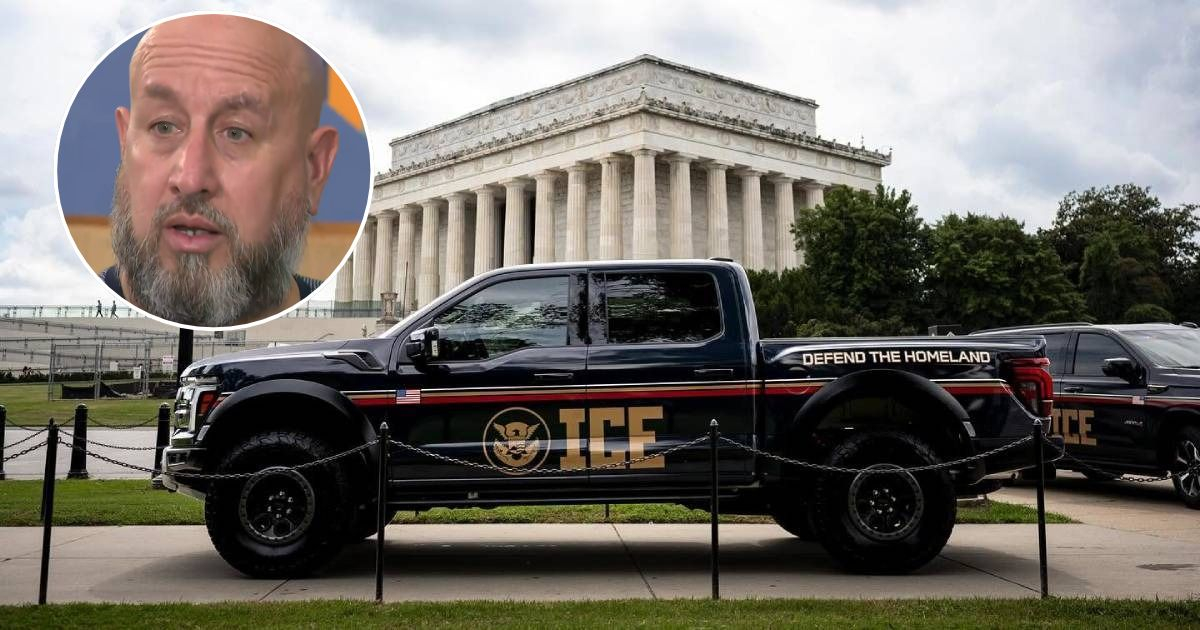
A 51-year-old Cuban regained his freedom after spending eight months in immigration custody in the United States, following a federal judge's approval of his habeas corpus petition and ordering his immediate release.
Marlon Cervelo Trujillo was able to reunite with his wife, Judith Castellanos, who traveled to Houston, Texas, to welcome him after months of being apart, as reported by CBS News Miami.
"I feel very happy," Castellanos expressed during the reunion.
Cervelo had been detained in Florida but was ultimately released in Texas on September 18, after a federal judge granted his habeas corpus petition. He was scheduled to have a hearing related to his immigration status on September 21, three days later.
The Cuban left with an electronic monitor on his ankle and will remain under immigration supervision until further notice. His release does not in itself eliminate the immigration process or the deportation order that is in place against him.
Arrested during an appointment with ICE
Cervelo had previously told CBS that, after serving a sentence related to a federal drug case, he continued to attend his appointments with immigration authorities and was detained during one of them. He was detained in January 2026.
According to ICE, the Drug Enforcement Administration (DEA) arrested Cervelo in October 2020 for a cocaine-related case. The agency stated that in January 2023 he was convicted of conspiracy to possess with intent to distribute five kilograms or more of a mixture or substance containing a detectable amount of that drug.
An immigration judge ordered his expulsion from the United States in August 2023, according to information provided by ICE to CBS.
During the months he was in custody, Cervelo was moved between different facilities. CBS reported that he was among the detainees transferred from Krome to the Federal Detention Center (FDC) in Miami during the summer, amidst evacuations due to wildfires.
In July, his wife reported to Local 10 the conditions in which he was being held after being transferred from Alligator Alcatraz to the FDC in downtown Miami. Castellanos then stated that the detainees were enduring high temperatures due to issues with the air conditioning. Other families reported difficulties accessing water and the presence of cockroaches. The Federal Bureau of Prisons confirmed a malfunction in one of the air conditioning units and temporary water pressure issues, although they stated that both situations had been addressed.
Cervelo, after regaining his freedom, acknowledged the impact that the prolonged period in custody had on him.
"I'm happy because I'm back with my family," Cervelo said, although he noted that going through several detention centers had been a traumatic experience.
His wife explained that one of the most distressing situations was not knowing where her husband was after various transfers. She recounted that there were times when she couldn't locate him in the system and depended on him being able to communicate to find out where he was.
ICE confirmed to CBS that the federal judge ordered the release and that the agency released Cervelo on September 18. The information disclosed by the network does not specify the specific legal reasons that led the judge to grant the appeal.
Habeas corpus, a legal avenue used by other Cubans
The habeas corpus allows a detained individual to approach a federal court to challenge the legality of their detention. Immigration attorney Morella Aguado explained to CBS, not being connected to the Cervelo case, that through this legal remedy, one can request a bail hearing or the release of the detainee.
The case of Cervelo adds to others involving Cuban immigrants who have recently turned to federal courts to challenge prolonged immigration detentions.
In early September, the case of Félix Abreu Medina came to light, who had been detained for about seven months despite having received a favorable decision on his asylum application. His defense submitted a habeas corpus, and a federal court ordered that he be given a bail hearing or released within ten days. He subsequently secured bail.
Rogelio Roche, a Cuban with an old deportation order, filed a habeas corpus after ICE detained him while attempting to carry out his removal. A federal judge ruled that it should be examined whether there were legal reasons to extend his detention, given the difficulties in executing his deportation.
Another recent case is that of Antonio Frómeta Ascón, 63 years old, who has been in ICE custody for over a year after Cuba refused to accept him. In March, he filed a habeas corpus petition before a federal court in Texas to challenge the extension of his detention while the United States attempts to find a country willing to accept his deportation.
However, filing this resource does not guarantee release on its own nor does it automatically halt a deportation. In June, Emilio Nieves, a Cuban asylum seeker was deported to the island while his habeas corpus petition was still pending.
In the case of Cervelo, the intervention of the federal court did lead to the end of his detention by ICE, although he will still be subject to immigration supervision and his deportation order remains in effect.
Related videos:
Filed under: