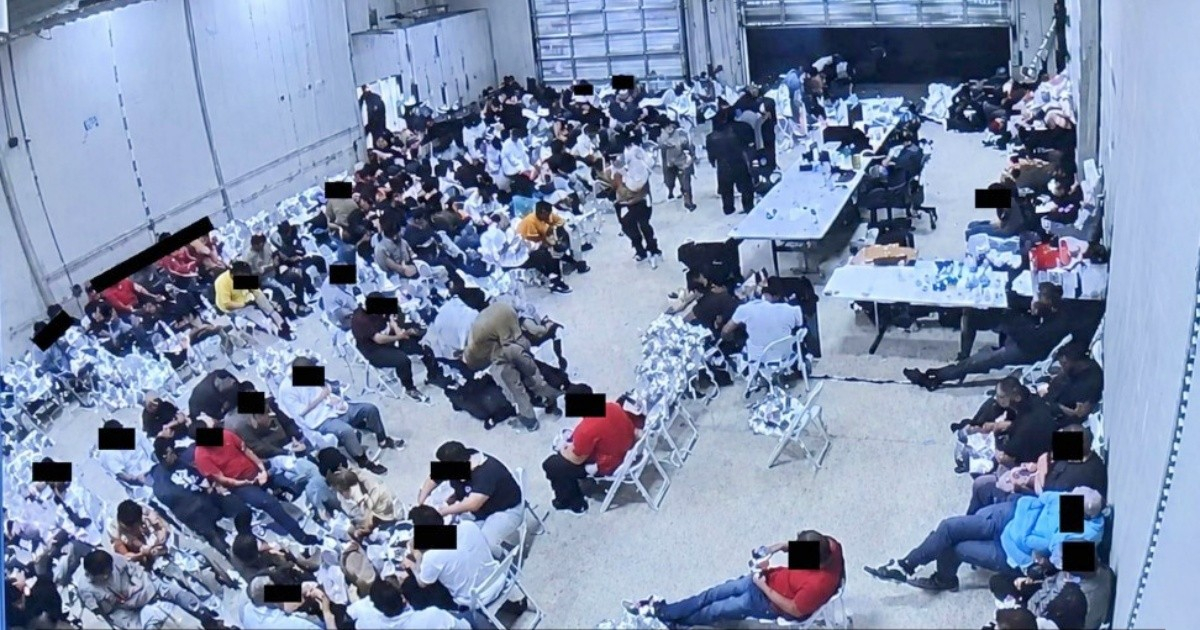
The federal fiscal year that closed this Wednesday became the fiscal year with the highest number of deaths in custody recorded by the Immigration and Customs Enforcement (ICE): 37 people died in custody of the agency between October 2025 and September 2026.
The figure represents a new high in deaths under ICE custody during a fiscal year, according to an investigation by Bloomberg Law.
The number exceeds the 23 fatalities recorded during fiscal year 2025 and triples the 12 deaths recorded during fiscal year 2024, in a context of expansion of the detention system during the second Trump administration.
The causes of the deaths were diverse and, in many cases, had not yet been determined or remained under investigation at the end of the fiscal year.
Among the deaths recorded during the year are several cases of Cuban citizens that have prompted investigations, legal claims, and public complaints.
The dismantling of supervision
The increase in deaths coincides with a significant reduction in various oversight mechanisms of the detention system.
According to Bloomberg Law, the Office for Civil Rights and Civil Liberties of the DHS went from over 100 employees to fewer than five following the administration's budget cuts. The Detention Ombudsman Office was also closed after Congress eliminated its funding.
Peter Mina, former civil rights official at the DHS, warned Bloomberg Law: “At this rate, the standards will continue to drop because the goal is to increase the number of people in detention.”
According to Bloomberg Law, the Office of Inspector General (OIG) of the DHS has been designated as the external body responsible for inspecting and overseeing the detention conditions of ICE.
In September, critical reports were published about three facilities: Krome North (Miami), where the use of chokeholds was documented; the center known as Alligator Alcatraz, which was closed in June 2026; and the Cibola Correctional Center (New Mexico).
Claire Trickler-McNulty, a former official of ICE and DHS, warned that the OIG cannot replace the preventive role of the dismantled agencies: "The ideal is a layered oversight approach, because each entity has a different role."
The death of the Cuban Geraldo Lunas Campos
Geraldo Lunas Campos, 55 years old, passed away on January 3, 2026, at the Camp East Montana detention center, located at the Fort Bliss military base (El Paso, Texas).
The county coroner ruled his death a homicide by asphyxia, contradicting the account provided by the Department of Homeland Security, which described the incident as an intervention to prevent self-harm.
Witnesses told Associated Press that Lunas Campos, already handcuffed, was restrained by at least five guards, one of whom strangled him with an arm around his neck while he repeatedly said, "I can't breathe."
He arrived in the United States in 1996 as a balsero, lived for more than two decades in Rochester, New York, and was the father of four children.
I had a deportation order since 2005 that was never enforced because the Cuban government refused to issue the necessary travel documents.
The FBI opened a criminal investigation into the case, confirmed in April 2026 by the acting director of ICE before Congress.
The family also filed a civil lawsuit for over one million dollars against the guards and companies associated with the center.
The death of Lunas Campos was one of three recorded at Camp East Montana in just 44 days.
More than 160 calls to 911 from that center, obtained by ProPublica and The Texas Tribune, documented medical and mental health emergencies that staff were unable to address.
Other deceased Cubans
Denny Adán González, 33 years old, was found dead on April 29 at the Stewart Detention Center (Lumpkin, Georgia).
His cellmate reported that it was "impossible" to take one's life in the isolation cell where he was held. The mother stated: "The guards killed him."
Aled Damien Carbonell-Betancourt, 27 years old, died on April 12 at the Federal Detention Center in Miami. His death was initially classified by ICE as an alleged suicide and remains under investigation.
The family of the Cuban Juan Miguel Muñoz Peñalver, 21 years old, filed a federal lawsuit against the government of Louisville (Kentucky) following his death in February, which was classified as suicide due to acute psychosis caused by dehydration.
"It is a death by dehydration in a first-world country. How is that possible?" declared Jon Little, the family's attorney, to the Courier Journal.
Las muertes bajo custodia de ICE y las condiciones del sistema de detención migratoria continúan generando investigaciones y escrutinio público. Consulta la sección de para mantenerte informado sobre todo lo que ocurre con las políticas migratorias y sus consecuencias.
Related videos:
Filed under: