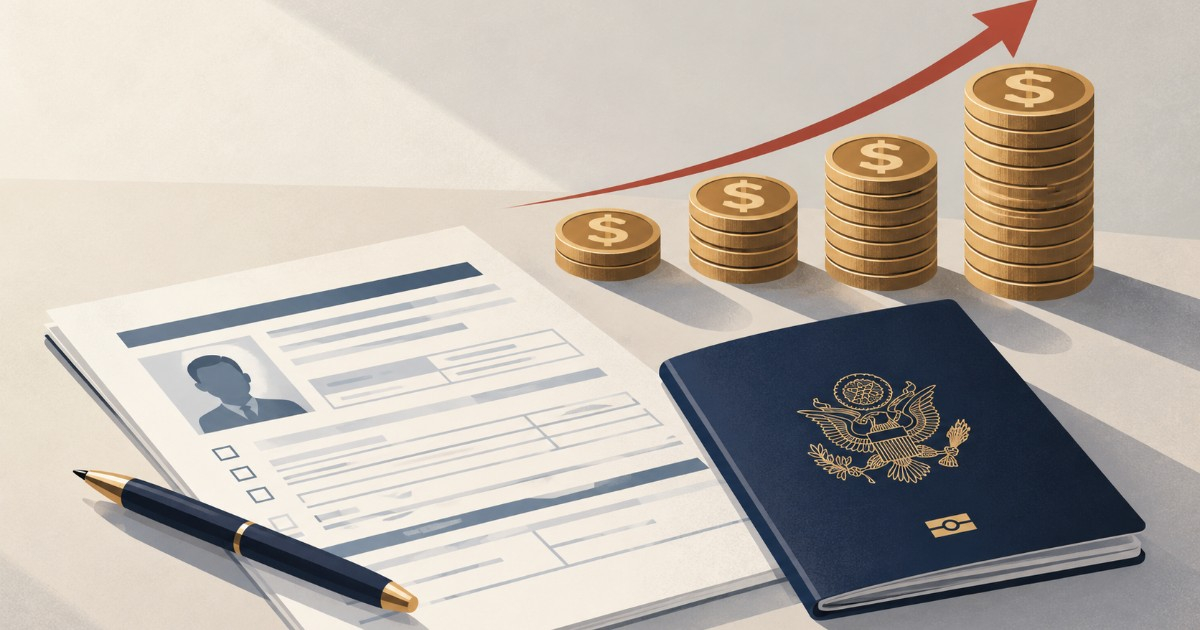
The United States Citizenship and Immigration Services (USCIS) published an official notice of inflation adjustment for immigration fees for fiscal year 2027 this Thursday in the Federal Register, effective on October 16, 2026.
The agency warns that any immigration benefit application postmarked on that date or later that does not include the correct fee will be rejected.
The adjustment responds to the mandate of Law H.R. 1 —One Big Beautiful Bill Act (Public Law 119-21)—, signed by President Donald Trump on July 4, 2025, which introduced mandatory fees for asylum, parole, and specific categories of work permits, and mandated their annual update according to inflation.
Los cambios en las tarifas de USCIS son solo una parte del panorama migratorio en constante evolución. Mantente informado sobre deportaciones, visas, parole y mucho más en nuestra sección de
The variation in the Consumer Price Index for Urban Consumers (CPI-U) between July 2025 and July 2026 was 3.36%, which accounts for the fact that increases are modest but necessary.
Rates that will increase starting October 16
These are the most significant changes for the Cuban community and for those undergoing asylum, parole, or Temporary Protected Status (TPS) processes:
Annual Asylum Fee (AAF): increases from $102 to $105, an increase of $3.
Pending initial asylum EAD (I-765, c8): increases from $560 to $570, a rise of $10.
Initial EAD by parole (I-765, c11): rises from $560 to $570, an increase of $10.
Initial EAD for TPS (I-765, a12/c19): increases from $560 to $570, a rise of $10.
TPS (Form I-821): rises from $510 to $520, an increase of $10.
Immigration parole fee associated with the I-131: increases from $1,020 to $1,050, an increase of $30.
Rates that do not change
Several rates remain unchanged because the statutory rounding does not result in an increase or because the law does not provide for adjustments for those categories
Initial asylum application (I-589): remains at $100.
Renewal or extension of EAD for asylum: remains at $275.
Renewal or extension of EAD for parole or TPS: remains at $280.
Special Immigrant Juvenile (SIJ): remains at $250.
I-94 Form: remains at $24.
What Cubans should know
Cubans with active asylum processes may be affected by the increase in the Annual Asylum Fee, which rises from $102 to $105, and by the increase in the for asylum applicants, which increases from $560 to $570.
Those who entered the country through parole —including beneficiaries of the now-defunct CHNV program— should also consider the new cost of the initial c11 category EAD, which will be $570, as well as the increase to $1,050 for the parole-related immigration charge outlined in H.R. 1 when applicable.
Cuba does not currently have a TPS designation on the USCIS list, so the fees for the I-821 and the TPS EAD do not apply to Cubans based on their nationality.
It is important to clarify that these fees are specific charges created by H.R. 1 and may be in addition to other USCIS form fees; therefore, they do not automatically represent the total cost of a procedure. Furthermore, the charge related to asylum does not qualify for a fee waiver, making payment mandatory when applicable.
Before submitting any application starting October 16, it is advisable to check the updated fees on the to avoid having an application rejected due to an incorrect payment.
Those with a should also be aware that USCIS has established consequences for not paying the Annual Asylum Fee within the timeframe indicated in the corresponding notice. However, since August 5, 2026, a court order temporarily prevents the agency from applying those consequences while the litigation continues.
Related videos:
Filed under: