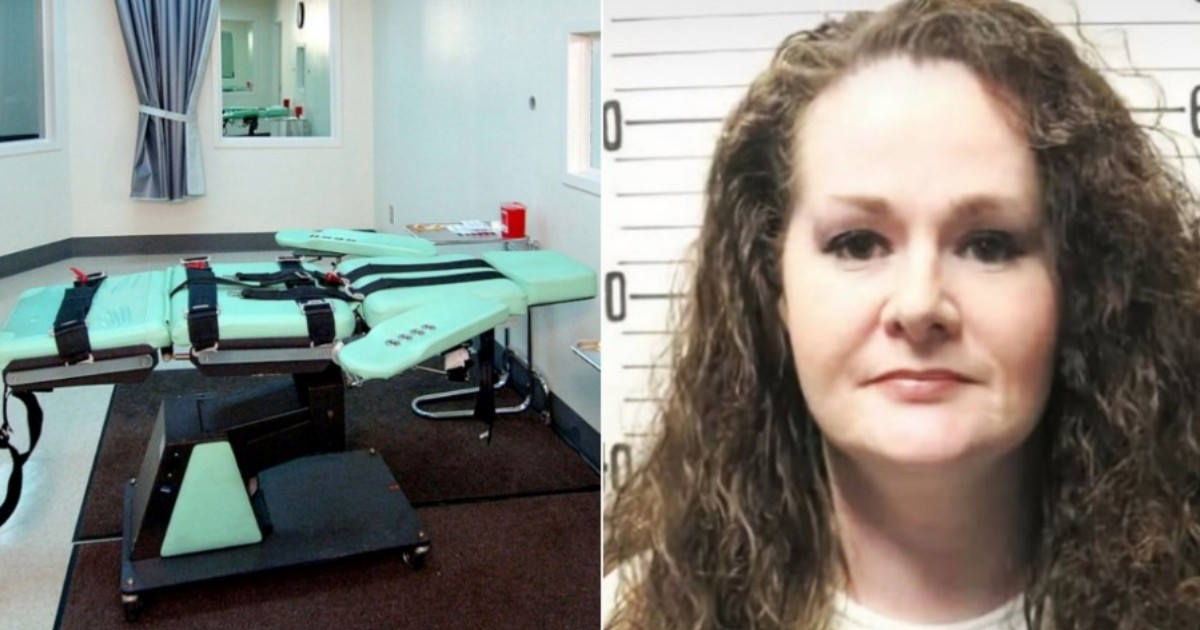
Christa Gail Pike, 50 years old, survived two doses of pentobarbital during the execution attempt at the Riverbend Maximum Security Institution in Nashville, Tennessee.
Pike was released from prison in an ambulance and remains in critical condition at an outside hospital. The woman had been sentenced to death in 1996 for the murder of Colleen Slemmer, 19 years old, committed in 1995 in Knoxville.
If her death penalty had been carried out, she would have been the first woman executed in Tennessee in over 200 years.
A legal drama before the execution
The day was marked by an intense legal battle. One hour before the scheduled start, the Sixth Circuit Court of Appeals voted two to one to grant a temporary stay in order to properly examine the issues raised in a pending motion by Pike.
The state of Tennessee immediately turned to the Supreme Court of the United States, which lifted the suspension just hours later.
Judges Sonia Sotomayor, Elena Kagan, and Ketanji Brown Jackson dissented from the decision.
Sotomayor wrote that the decision paved the way for the execution "before she can properly examine the legal appeals that she still has pending against her conviction."
"I am ready to be free. It's a happy day."
At 7:27 PM on Wednesday, Pike was strapped to the stretcher.
Her spiritual advisor sang a song with the phrase "I love you" alongside her and stroked her forehead. Before the medication administration began, Pike made her final statement: "I am ready to be free. It is a happy day."
Pike complained after feeling pain in his arm and asked the officials if he was supposed to feel this way. At 7:46 PM, the curtain separating the execution chamber from the witness area was closed.
Three minutes later, it opened again: Pike was still alive. Shortly after, she seemed to begin losing consciousness and started making sounds similar to snoring.
The Tennessee protocol includes a second dose of pentobarbital if the inmate does not die after the first dose. That backup dose was administered, but Pike did not die following its administration either.
For about an hour, witnesses heard Pike make sounds similar to snoring, even after the curtain was drawn shut again. At 8:53 PM, the evacuation was announced. Fire trucks and ambulances arrived at the venue around 9:14 PM.
What could have gone wrong during the execution?
The authorities in Tennessee have not yet publicly determined what went wrong during the procedure. Pike's lawyers pointed to possible issues with intravenous access as one of the explanations for what happened.
The lawyer Randy Spivey stated that he counted at least seven instances where needles were attempted to be inserted into Pike's left arm during the procedure.
According to Spivey, during the attempts to locate a vein, Pike indicated to the officials where they could try. "Please, try here, please, try here," the lawyer recalled the woman saying. Spivey added that Pike repeatedly asked them to try placing the line higher, near the shoulder, according to statements collected by the Associated Press.
The lawyer Steve Ferrell stated that Pike suffers from a blood disorder that makes accessing his veins difficult and raised the possibility that the intravenous line may not have been inserted correctly into a vein, causing part of the pentobarbital to accumulate in the arm instead of reaching the bloodstream properly.
According to that hypothesis, an insufficient concentration of the drug in the bloodstream could have prevented it from producing the expected lethal effect. Authorities have not yet confirmed that this was the cause of the failure.
Robin M. Maher, executive director of the Death Penalty Information Center, described what happened as "singular and unprecedented": seven other individuals had survived issues related to intravenous access before receiving the drugs, but, according to Maher, no one had remained alive after the medications used in an execution were administered.
The crime for which Christa Pike was sentenced to death
Christa Gail Pike was sentenced to death for the murder of Colleen Slemmer, a young woman who, like her, was participating in the Job Corps program in Knoxville.
The crime occurred on the night of January 12, 1995. According to the facts presented by the Tennessee Supreme Court, Pike left the center accompanied by Slemmer, her boyfriend, Tadaryl Shipp, and another student, Shadolla Peterson.
The group headed to an isolated area near the agricultural campus of the University of Tennessee, where Slemmer was attacked during an episode that lasted between 30 minutes to an hour.
During the assault, Slemmer was beaten and suffered numerous cuts and injuries. Pike admitted to investigators that he had slashed her neck, hit her repeatedly, and thrown a piece of asphalt at her head when she tried to escape.
The autopsy determined that the young woman died from the blunt force trauma she sustained to the head. A pentagram was also carved into the victim's chest. After the crime, Pike took a fragment of Slemmer's skull, which was later recovered by investigators.
Pike was found guilty of first-degree murder and conspiracy to commit murder and, in March 1996, received the death penalty for the homicide, in addition to a consecutive 25-year sentence for conspiracy.
The state says it followed the protocol, but it does not explain what went wrong
The Tennessee Department of Corrections stated in a press release that it had followed "every step of the legal and established execution protocol," but did not provide any explanation for what went wrong.
Tennessee adopted its current execution protocol in 2024 using a single substance, pentobarbital.
The Republican governor Bill Lee described the incident as "deeply disturbing," ordered an external review of the procedure, and suspended the only other execution scheduled in Tennessee for this year.
Pike's lawyers requested the commutation of his death sentence, arguing that, in their opinion, what occurred during the attempted execution amounted to torture.
The UN High Commissioner for Human Rights, Volker Türk, urged the authorities in the United States not to attempt to execute Christa Pike again.
Türk described the physical and mental suffering caused by failed attempts as "abhorrent and cruel," and reiterated his rejection of the death penalty.
Meanwhile, May Martinez, mother of Colleen Slemmer, who traveled to Nashville to witness the execution, summed up her pain when speaking with the AP agency: “It was a disaster. I did not get justice for my daughter.”
Related videos:
Filed under: