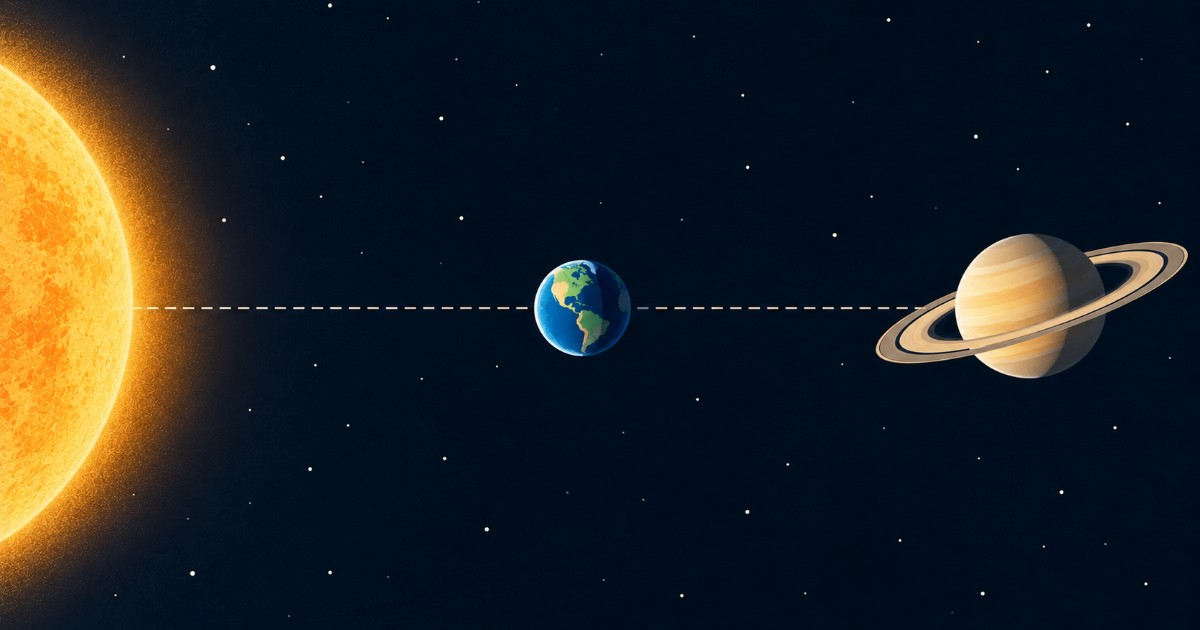
Saturn will be one of the major highlights in the sky this weekend. The ringed planet will reach its opposition on Sunday, October 4, 2026, a phenomenon that provides one of the best opportunities of the year to observe it from Earth, according to the October skywatching guide published by NASA.
During opposition, Saturn is located in a part of the sky opposite the Sun and remains visible for much of the night. The phenomenon can be observed from Cuba, the United States, including Florida, Spain, and other places where weather conditions permit.
What does it mean for Saturn to be in opposition?
Opposition occurs when the Earth is approximately positioned between the Sun and Saturn. From our perspective, the planet is located directly opposite the Sun in the sky.
This has a particularly useful consequence for those who want to observe it: Saturn rises roughly when the Sun sets and stays above the horizon for a good part of the night.
NASA highlights the opposition of Saturn as one of the main astronomical events of October 2026 and notes it as a particularly favorable time to observe the planet.
Can Saturn be seen with the naked eye?
Yes. Saturn can be located without the need for a telescope and will appear in the sky as a bright point of light.
Unlike many stars, planets typically exhibit a relatively stable light, although atmospheric conditions can affect their appearance.
What should not be expected is to clearly distinguish their famous rings with the naked eye. To observe that feature, it will be necessary to use a telescope.
NASA explains in its sky observation resources that Saturn is one of the planets that can be seen with the naked eye, while a telescope allows for the viewing of details that are not visible without magnification.
How to locate Saturn this Sunday
One of the simplest ways to find it will be to start observing after dark and look towards the eastern sector of the sky. As the night progresses, Saturn will rise higher and appear to move westward due to the rotation of the Earth.
The exact position varies depending on the city, date, and time. Therefore, there is no single valid time reference for all readers.
To plan your observation, you can use the NASA/JPL Night Sky Planner, which allows you to explore the night sky and prepare an observation session based on your location.
How to see it from Cuba
Saturn can also be observed from Cuba. After sunset, it will begin to appear in the eastern part of the sky and will remain visible for a good part of the night, as long as the weather conditions permit.
From Havana, Santiago de Cuba, Camagüey, and other locations, it can be easily identified as a bright point. A telescope will not be necessary to find the planet, although one will be needed to discern its rings.
The exact position will change depending on the time and location of observation. Therefore, you can consult the NASA/JPL Night Sky Planner or an astronomy app set up with the observer's location.
To improve visibility, it's advisable to find a location with a clear horizon and to stay as far away as possible from streetlights and other intense sources of artificial light.
How to see it from Miami and Florida
In Miami and other areas of Florida, Saturn will begin to be available for observation after sunset and will remain visible for many hours.
The most important thing will be to find a place with a clear view of the sky and the least possible light pollution. Staying away from streetlights, brightly lit parking lots, and tall buildings can make observation easier.
Those who use a telescope can achieve better results when Saturn has gained a certain height above the horizon. When an object is very low, its light passes through a greater amount of atmosphere, and the image may be less stable.
Before heading out, it's advisable to check the position of the planet for the chosen time and location using the NASA/JPL night sky planner or an astronomy app set up for the observer's city.
And from Spain
The same phenomenon can be observed from Spain. After sunset, Saturn will appear in the eastern part of the sky and will remain visible for a good part of the night.
There is no single optimal time for the entire country. The exact position varies between Madrid, Galicia, Andalucía, the Canary Islands, and other areas, so it is more useful to consult a celestial map set to the specific location.
In all cases, the weather conditions will be decisive. If the sky is overcast, Saturn will not be observable even if the opposition is taking place.
What is needed to see the rings?
At first glance, Saturn will essentially appear as a bright point. Binoculars can help locate it, but they typically do not provide enough magnification to clearly appreciate its ring system.
With a small telescope and good observation conditions, it is possible to distinguish the rings around the planet. A larger aperture telescope and a stable atmosphere can reveal more details.
To observe Saturn at night, special filters used for looking at the Sun are not needed. The Sun should never be viewed directly with binoculars or telescopes without proper protective equipment.
It won't be a brief show
The opposition has a specific date, but Saturn will remain observable after Sunday. The planet will continue to provide good opportunities during the following nights.
The advantage of October 4th is the especially favorable geometry between the Sun, Earth, and Saturn. If clouds obstruct the view that night, there will still be opportunities to observe it in the days that follow.
The NASA guide for October 2026 allows you to explore this and other phenomena of the month, while the NASA/JPL Night Sky Planner helps prepare your observation based on the reader's location.
Related videos:
Filed under: