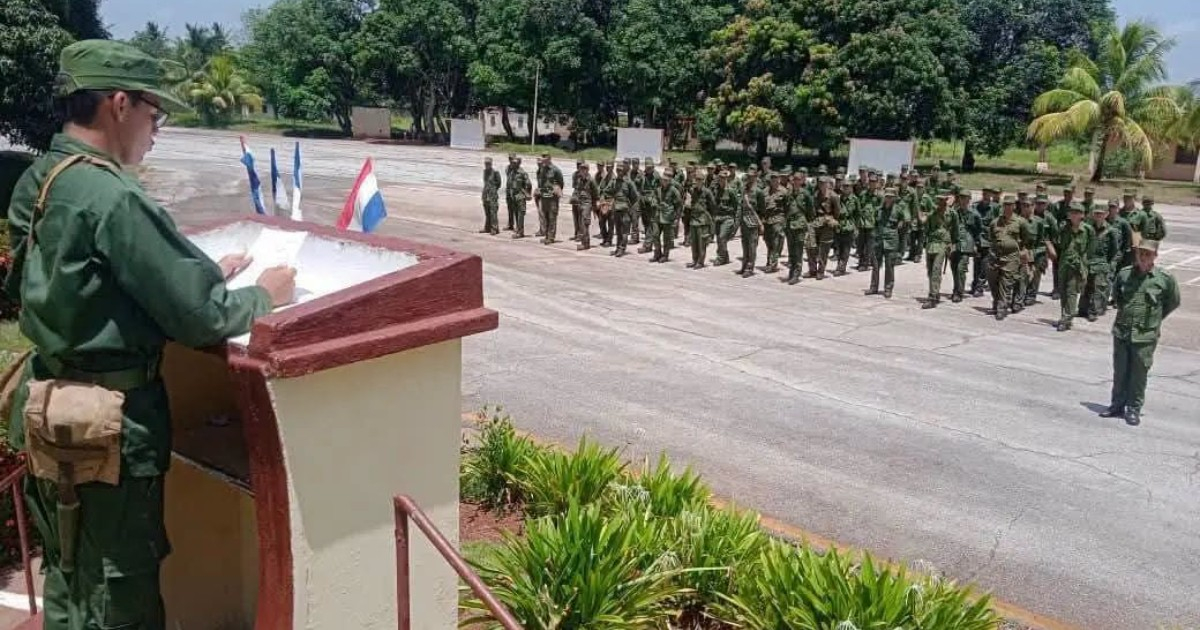
The Cuban researcher and journalist José Manuel González Rubines published an analysis on September 30th in which he concludes that the Mandatory Military Service (SMO) in Cuba operates as a system of social selection for recruitment, inflicting its most severe consequences on the island's poorest and most vulnerable youth, while the children of the elite evade service or fulfill it under radically different conditions.
The text, published on the CubaxCuba platform, is based on two specific cases that occurred in the same week. Yandiel Jurado Lastre, known as “Ricky,” passed away on September 20 in Manzanillo, Granma, when a companion handling a rifle accidentally shot him in the forehead while he was talking on the phone with his girlfriend.
Two days later, Leordanis Ramón Ricardo Batista, “Leo,” took his own life in a unit of the Youth Labor Army in Nipe, Holguín, just two months after being incorporated, despite his family having warned that he had been receiving psychological care since the age of nine for nervous disorders. With both deaths, the list documented by González Rubines reached one hundred names.
The researcher bases his analysis on the report "Dying in Uniform," by journalist Marleidy Muñoz, published by elTOQUE at the end of September, which documents 89 deaths of Cuban recruits between 2017 and 2026. Of these cases, at least 23 involved young men transferred outside their home province, mainly from central or eastern territories to units in Havana, Mayabeque, Matanzas, and Artemisa, where their families could not visit them or respond in time.
"The Cuban Military Service systematically targets the most vulnerable sectors of the social structure: children of rural families, those with low incomes, without family networks abroad, and lacking any capital that would allow them to evade recruitment or improve their conditions within the barracks," writes González Rubines. He points out that the children of the nomenclature, retired officers, or families with remittances and connections in the administration either do not enter the Military Service or fulfill it close to home, in administrative roles and with frequent leaves.
The analysis identifies two social selection filters that operate simultaneously. The first determines who gets in and where they are sent; the second is the everyday corruption within the units. "In these cases, corruption is not a secondary defect of the system, but one of its modes of operation," the researcher argues. Poorly paid officials with almost absolute power over recruits without channels for complaints sell passes and accept lax medical evaluations in exchange for material goods: a goat, a lawnmower, or a refrigeration unit, according to testimonies gathered in the text.
The result of both filters is evident in the data: "Many of the young people appearing in the databases are farmers, workers, children of single mothers, boys from small towns. They represent a humble layer that the institution consumes without the slightest remorse, to uphold a structure of units and work that has not defended anything other than itself for decades."
González Rubines emphasizes that what sets Cuba apart from other countries with conscription services is not the existence of these mechanisms, but rather "their connection to a political regime that denies the existence of the problem, criminalizes families who report, archives investigations, and claims before international organizations that the service is 'voluntary' and that 'children are not recruited'." This statement contradicts the legislation in effect since 1963, which requires males aged 17 to 28 to fulfill military service under penalty of criminal prosecution.
Families that have demanded justice have faced systematic reprisals. Out of 46 families consulted by elTOQUE, only eight reported any official investigation, and in no case were responsibilities determined. The father of Orlando Lago Vega, who was shot while sleeping in June 2020, was sentenced in 2023 to one year and six months in prison for insisting that the case be investigated.
The report from elTOQUE includes a statement from Mirna Quiala, the mother of Osmel Manresa—who died in 2018 during the SMO—that González Rubines cites as a summary of the phenomenon: "In this country, mothers give birth to children, and they govern them." The researcher adds, "and they also bury them."
Related videos:
Filed under: