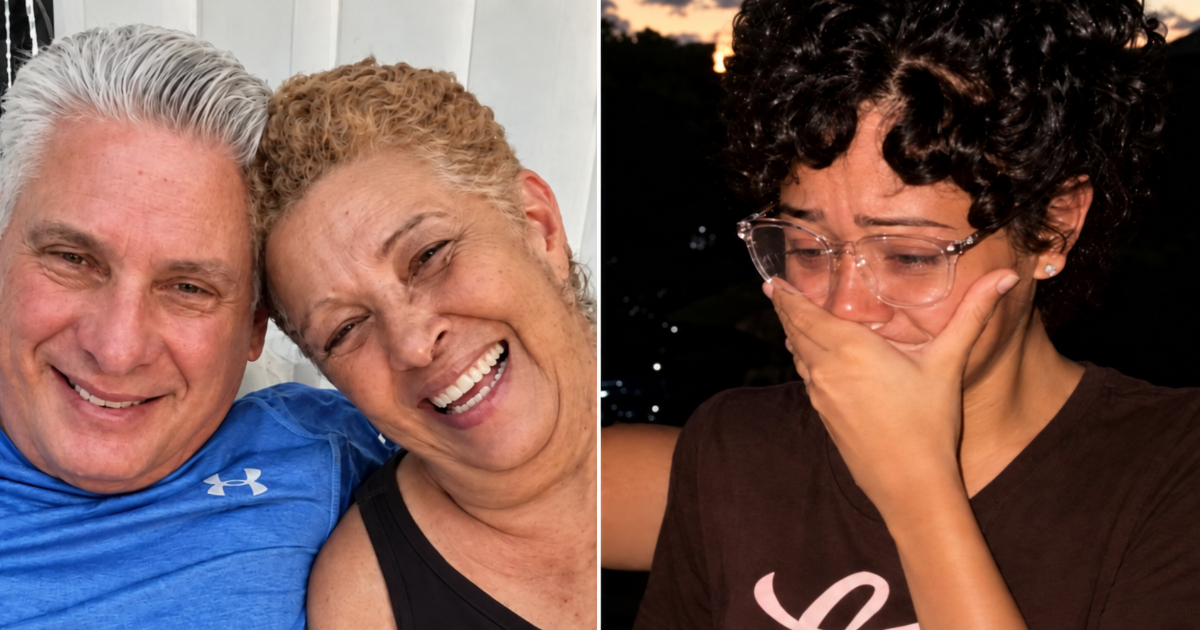
María del Carmen Hernández Carús, mother of Leticia Martínez Hernández, head of Communication for the Cuban Presidency, posted a message on social media that aims to present itself as a Christian reflection but serves as a political maneuver.
The mother of the loyal Leticia did not condemn the repression, did not question the trial against Anna Sofía Benítez Silvente (Anna Bensi on social media) and her mother did not pause to reflect on the arbitrariness of a state that punishes two women for denouncing the intimidation of an agent, but dedicated lengthy paragraphs to casting suspicion on the churches, pastors, and believers who showed solidarity with them.
His text opens with a false neutrality: "I am not going to comment on the young woman," he says. Nor, he assures, will he speak "about the trial, or whether there was a crime or not, or whether justice is served or not." However, that supposed silence does not last long.
Hernández Carús does not comment on the abuse of power; instead, he critiques those who report it. He does not directly address the main issue, yet he grants himself moral authority to question the consistency of the religious individuals who sought justice.
There is the maneuver: to shift the focus. The issue is no longer about a young woman and her mother subjected to a criminal process — initiated by the institutions of a totalitarian state — for exercising their right to express themselves, but rather about the supposed "incoherence" of the churches.
The victim disappears. The repressive State does as well. In its place appears the old alibi of the regime: the blockade, the sanctions, the United States, the sick children, the external threats. All together, all mixed, all used as a smokescreen to evade a fundamental question: why does the Cuban regime persecute and condemn two citizens who publicly defended themselves against the pressure of State Security?
Hernández Carús criticizes the churches for not speaking out, as she claims, with the same strength in the face of other sufferings. However, the Bible she invokes does not say that one should remain silent in the face of a specific injustice because there are other injustices in the world. On the contrary: “Open your mouth for the mute,” says Proverbs.
Solidarity with Anna Bensi and her mother is not Christian inconsistency. Inconsistency is using religious language to demand selective silence in the face of the violence of power.
The publication reaches its most revealing point when Hernández Carús questions the arrested pastor, known as the "Herald of Christ." He claims to have seen him resist, ask for the arrest to be filmed, and then asserts that he remembered Jesus.
The comparison is blatantly obscene because it is manipulative and twisted: it invokes Christ not to challenge those who arrest, pursue, or condemn, but to suggest that the persecuted should passively accept the abuse.
Hernández Carús cites Jesus before Pilate, but seems to forget who Pilate was in that scene: the representative of political power who, while knowing he was in front of an innocent, ultimately delivered him up. Pilate washed his hands. She does something similar: says she does not judge the case, but ends up pointing fingers at those who accompany the victims.
His reading of John 19 attempts to turn Jesus' meekness into obedience to any state abuse. However, Christianity did not emerge as a doctrine of submission to power. The apostles responded to the authorities: “We must obey God rather than men.” The biblical tradition is filled with prophets who denounce the oppressor, not pious officials demanding composure from the oppressed.
What seems to bother Hernández Carús is not the injustice itself, but that there are believers willing to call it by its name. That is why he accuses of selectivity. That is why he introduces the blockade. That is why he invokes other struggles of Cuba, not to claim freedoms, but to downplay the specific persecution against Anna Bensi and her mother.
That logic does not seek coherence. It seeks paralysis.
In the parable of the Good Samaritan, Jesus does not praise the one who walks by seeking doctrinal excuses. He praises the one who stops to help the wounded. Hernández Carús's publication does not stop to address the wounds of Anna Bensi and her mother. Instead, it pauses to examine whether those who assist them are sufficiently consistent with the official narrative. He is not beside the wounded on the road; he is questioning the Samaritan.
The problem is not that Hernández Carús quotes the Bible. The problem lies in the purpose of the quote. He uses it to obscure an injustice, not to shed light on it. To reprimand the victims and their supporters, not to challenge the power that oppresses them. To wrap a practical defense of the regime in Christian language.
It is also striking his tone of moral superiority. From his closeness to the official ecosystem, Hernández Carús allows himself to lecture about Christianity to those who side with the persecuted. It is a scene of hypocrisy that is hard to conceal: a defender of totalitarian power judging the faith of those who stand with victims of repression.
“By their fruits you shall know them,” says the Gospel. The political outcome of its publication is evident: undermining the legitimacy of the solidarity with Anna Bensi and her mother, introducing the worn arguments of official propaganda, transforming faith into obedience, and shifting the debate from state violence to the alleged incoherence of those who denounce it.
The maneuver is not new, but it is profoundly immoral. It consists of demanding moral accountability from the victim and those who accompany them, while absolving by omission the regime that pursues, surveils, arrests, and condemns. It involves invoking Christ while politically siding with Pilate.
Hernández Carús did not make a Christian reflection on justice. He used Christianity as a guise to, indirectly, defend the power that denies it and manipulates it at will.
Related videos:
Filed under: