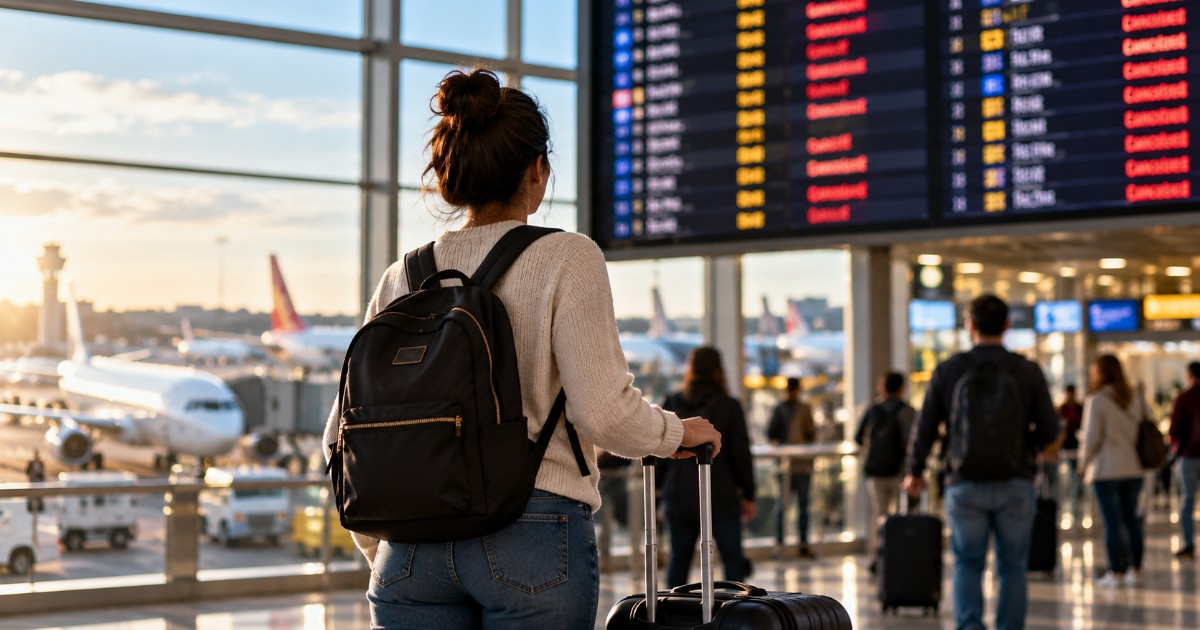
Travelers flying from Spain and other European Union countries will have new rules for claiming money, receiving assistance, and seeking alternative flights when they experience cancellations or significant delays.
The European Union has just released the Regulation (EU) 2026/2202, a comprehensive reform of the air passenger protection rules that updates the system in place since 2004.
Among the new features are automatic refunds within a maximum of seven calendar days, compensation of up to 600 euros, a three-hour period for the airline to provide specific alternative transport before the passenger can seek their own, and new obligations regarding meals, hotels, carry-on luggage, and information for travelers.
But there is a date that must be clear: these new rules will not take effect immediately.
The Regulation was published on October 2, 2026, and will formally come into effect on October 22, but it will be applicable from October 23, 2027.
Until then, the current European regulations on air passengers remain in effect.
The final text can be consulted in the Regulation (EU) 2026/2202 published on EUR-Lex.
Up to 600 euros if the flight arrives more than three hours late
The reform maintains a compensation structure very similar to the current one.
When the passenger is entitled to compensation, the amounts will be:
250 euros for trips of up to 1,500 kilometers.
400 euros for trips longer than 1,500 kilometers within the European Union and for other trips ranging from 1,500 to 3,500 kilometers.
600 euros for the other trips, mainly the long-distance ones.
One of the legal novelties is that the Regulation explicitly incorporates the right to compensation when the passenger arrives at the final destination with a delay of more than three hours, a protection that until now partially depended on the interpretation developed by the Court of Justice of the European Union.
On certain long-haul flights, the compensation of 600 euros may be reduced by 50% when the arrival delay does not exceed four hours.
Cancellations made less than 14 days in advance may also result in compensation
When an airline cancels a flight, passengers will still have the right to appropriate compensation if they were notified less than 14 days in advance.
There is an exception when the company offers alternative transportation that allows departure no more than one hour earlier than scheduled and arrival at the destination with less than two hours of delay.
Economic compensations may also be eliminated when the airline proves that the issue was due to extraordinary circumstances that could not have been avoided by taking all reasonable measures.
The airline will have to demonstrate the extraordinary circumstances
The new framework aims to reduce one of the main points of conflict between passengers and airlines: when a cancellation or delay is truly considered a result of extraordinary circumstances.
The regulations include a non-exhaustive list of such situations and place the burden of proof on the airline.
The airline must not only demonstrate the existence of the extraordinary circumstance but also establish a direct causal relationship with the issue experienced by the flight and show that it took all reasonable measures available.
If you use this reason to deny compensation, you must provide the passenger with a clear and well-founded explanation.
The reimbursement should arrive within seven calendar days
When an incident allows the passenger to choose between continuing the trip or getting a refund, the decision will be up to the traveler.
If you choose to request a refund, the company must automatically return the corresponding price within a maximum of seven calendar days from the selection.
The refund will include the cost of the segments of the journey that were not completed, and when the segments already traveled have lost their purpose within the original trip, those segments may also be included along with a return to the initial departure point.
The regulation also includes intermediary commissions when applicable.
They will not be required to accept a voucher
Airlines may continue to offer vouchers or travel credits as an alternative.
However, the new Regulation explicitly states that the passenger is not obligated to accept a voucher instead of cash.
The acceptance of the voucher must be explicit and documented on a durable medium.
Companies will also not be able to design the process using pre-selected options or default settings that steer the consumer towards the voucher.
If they don't offer you another trip in three hours, you can organize it yourself
One of the most significant changes affects alternative transportation.
When the passenger decides to continue to their destination, the airline must seek reasonable options, which may include another flight with the same company, a different route, another airport, flights with another airline, or even another mode of transportation when appropriate.
The alternative must maintain comparable conditions.
For example, a person who has booked a direct flight should not be forced to unnecessarily accept multiple connections if a better comparable option is available.
If the company does not provide an alternative transportation option within three hours under comparable conditions, the passenger may arrange for another way to reach their destination on their own.
Up to four times the ticket price to cover that alternative transportation
When the traveler has to find an alternative on their own because the company did not comply within that timeframe, they may claim the necessary, reasonable, and appropriate expenses.
The limit will be of up to 400% of the total price of the ticket or tickets and the corresponding intermediary fees.
The reimbursement of these expenses should normally occur within 14 calendar days following the request.
In certain extraordinary cases where the airport has activated a contingency plan, the timeframe may be extended.
Drinks every two hours and food after three
The reform also specifies much more clearly what assistance a person stranded at an airport should receive.
When the right to assistance applies, the company must provide free beverages every two hours of waiting.
After three hours, a meal must be provided, followed by another every five hours, with a maximum of three meals per day.
Internet access and two phone calls are also included.
Hotel and transportation if an overnight stay is needed
When the incident forces the passenger to spend one or more nights waiting for the flight or alternative transportation, the company must provide hotel accommodation free of charge.
You will also need to cover the transportation between the airport and the accommodation.
If the airline does not provide the assistance that is due, the passenger may arrange it on their own and subsequently request reimbursement for necessary, reasonable, and proportionate expenses.
The company should inform you if you may be entitled to money
Another new measure aims to prevent passengers from losing compensation simply because they are unaware of their rights.
When an incident may result in compensation, the airline must send electronically, within 96 hours after the conclusion of the trip, information about the passenger's rights and clear instructions on how to claim.
The traveler will have nine months from the date of the flight to submit their compensation request.
30 days to pay the compensation or explain why it is being rejected
Once the application is submitted, the airline must acknowledge receipt immediately.
Afterwards, you will have a maximum of 30 calendar days to pay the compensation or provide a justification for why you believe it is not applicable.
If extraordinary circumstances are invoked, the cause must be identified, and an explanation should be provided for why there is a direct relationship between it and the cancellation or delay.
If payment is not made, the passenger may proceed with the formal claim process outlined in the new regulations.
The loss of a connection is also expressly regulated
The reform dedicates a specific article to passengers who miss a connecting flight included in a single transportation contract due to an issue with the previous flight.
In that case, the responsible airline must provide alternative transportation and assistance.
If it cannot offer an alternative within five hours following the scheduled departure of the missed flight, it must also provide the option for a refund.
If the passenger arrives at their final destination with a delay of more than three hours, they may also be entitled to the appropriate compensations.
They can no longer cancel your return because you didn't use the outbound journey
The reform introduces another protection that is particularly useful for those purchasing round-trip flights.
An airline cannot deny boarding or charge a fee for using the return flight simply because the passenger did not complete one or more outbound segments included in the same contract.
It is the prohibition of the well-known practice of no-show, which for years has caused some travelers to automatically lose the remaining segments of their reservation.
The rules regarding carry-on luggage are also changing
The EU will require airlines to allow a personal item in the cabin at no extra cost, subject to applicable safety regulations.
They must also allow, depending on the cabin's capacity, one piece of hand luggage.
But this does not mean that all fares have to include a cabin bag for free.
The major new transparency requirement is that, before starting the booking process, companies must default to showing rates that include a carry-on luggage item.
They will be able to continue offering different rates for those who voluntarily choose to travel without that luggage.
Additionally, if for reasons of capacity or safety the airline requires a carry-on bag that could be taken into the cabin to be placed in the hold, it cannot charge an additional fee for doing so.
What does it mean for Cubans who travel between Spain and Cuba?
The new rules do not depend on whether the passenger is a European citizen.
When they come into effect in October 2027, they will protect any passenger using a flight covered by European legislation.
In a journey from Spain to Cuba, the rules apply even if the airline is not from the European Union.
In the opposite direction, from Cuba to Spain, they apply when the flight is operated by an airline from the European Union.
This may be especially relevant for the Cuban community in Spain, which has experienced a significant reduction in direct connectivity with the island during 2026.
CiberCuba recently explained which airlines continue to operate to Cuba and which remain suspended, amid the aviation fuel crisis affecting the island.
Air Europa currently maintains its connection to Havana, although it has had to make technical stops for refueling, while Iberia has suspended its direct flight for a large part of 2027.
The situation regarding the routes may change before the new regulations come into effect, so coverage should be verified based on the specific company and itinerary on the travel date.
The new rules cannot be claimed yet
The new regulations have been approved and published, but that does not mean that an affected passenger today can demand all these updates.
The current rules will continue to apply until October 22, 2027.
The new regime will become mandatory on October 23, 2027.
For those traveling after that date, the most practical updates will include much clearer timelines, better options for alternative transportation, and more defined complaint mechanisms.
The reform does not eliminate all conflicts between airlines and passengers, but it more clearly outlines what a company must do when a flight is canceled, delayed, or leaves a traveler stranded away from their destination.
Related videos:
Filed under: