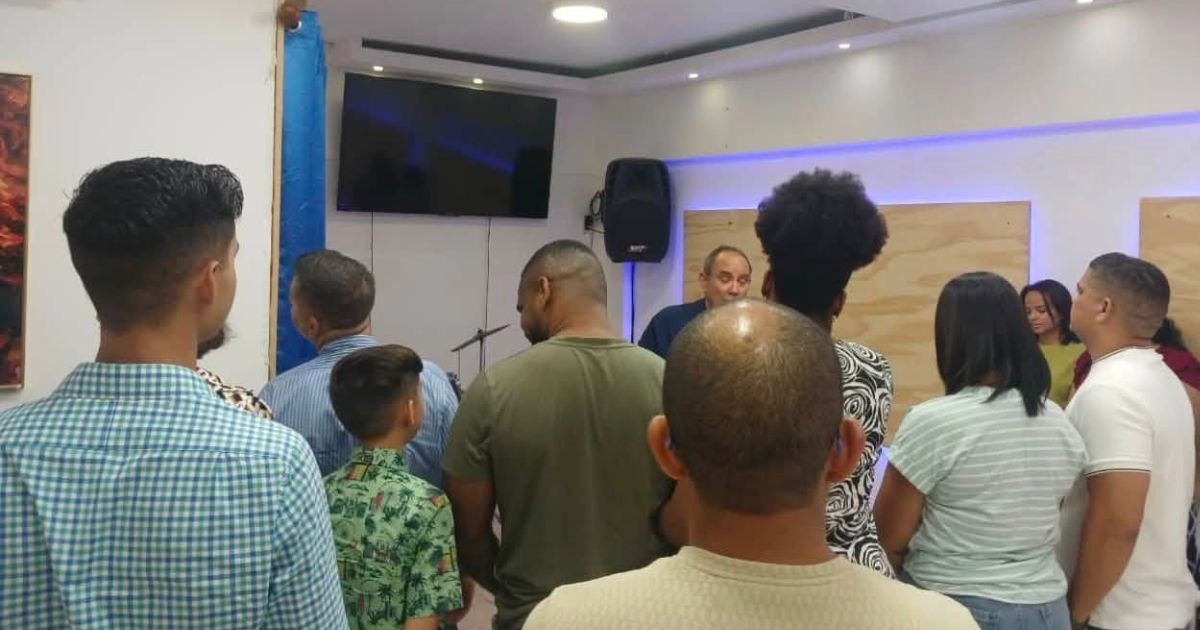
The Executive Presbyterate of the Assemblies of God in Cuba disseminated this Tuesday some “pastoral guidelines on the member's covenant and political expression” in which it establishes a clear distinction between the party militancy of the church as an institution and the individual right of its members to express political opinions, criticize public policies and rulers, and denounce situations of injustice.
The document, attributed to the highest executive body of that evangelical denomination on the island and reproduced in full by Cuban religious channels, states among its explicit objectives to “not silence the voices of those who rise against injustice.”
The starting point is the so-called "Member's Pact," which establishes that believers must remain faithful to their civic duties while never "interfering in political factions." The new direction does not change that rule; rather, it aims to clarify what this means in practice.
According to the text, “interfering in political factions” means that the church, from its pulpits, services, cells, official networks, or institutional structures, takes a side for or against a specific party, political movement, candidate, or system of government; uses its resources to promote a partisan agenda; or demands a uniform political stance from its members.
However, the directive clarifies that this prohibition does not prevent a Christian, in their capacity as a citizen, from holding their own political beliefs and expressing them in their home, personal conversations, or social media, as long as they do so in an individual capacity, without using the church's name and without inciting hatred or violence.
The document goes further and asserts that a believer can make criticisms or support public policies or rulers based on biblical principles such as justice, truth, and the defense of the innocent, as well as denounce from the pulpit "social sin, corruption, and lies," so long as they do not turn the church into a partisan platform.
In one of its central passages, the orientation summarizes that the agreement “does not prohibit Christians individually from holding and expressing political opinions”, as long as they act outside the exercise of their ecclesiastical representation and with respect for the law and their Christian conscience.
It also establishes that having differing opinions on government management, criticizing a law or policy deemed unjust in a reasoned manner, or supporting or rejecting a particular economic or social measure does not constitute grounds for a split within the church.
On the contrary, it points out that behaviors such as inciting physical violence, fostering racial or class hatred, promoting armed insurrection, using the pulpit to support or attack political parties, or generating political factions within the congregation are incompatible with ecclesial communion.
In the section dedicated to social media, the Assemblies of God recognize these platforms as valid spaces for expression, although they urge their members to avoid insults, misinformation, and hatred, both towards officials and citizens, and to substantiate their posts before sharing them.
The final exhortation to the pastors is particularly straightforward: “We are not called to make the church a political party, nor to cowardly remain silent in the face of injustice.”
The text calls for defending the freedom of conscience of believers while at the same time preserving the unity of the religious community.
The clarification comes at a time of intense debate regarding the role of Christian churches in the face of the political reality in Cuba. In recent days, various religious leaders and denominations have questioned the repression against individuals who publicly express their discontent.
One of the most recent cases is that of Ariel Limias Leyva, former pastor of the Assemblies of God, who remains detained at Villa Marista and faces a charge of "enemy propaganda against the constitutional order" after protesting alone in front of the Capitol in Havana with an antigovernmental banner.
Limias had previously been identified as a former member of the clergy of that denomination and, according to his family, he did not belong to opposing organizations.
The religious debate was further expanded with a letter from the bishop and 21 members of the clergy of the Episcopal Church in Cuba, in which they expressed solidarity with Anna Bensi and her mother, denounced the social crisis in the country, and questioned the use of violence, intimidation, and police harassment against those who raise their voices to demand rights.
The new guidelines from the Assemblies of God have generated numerous reactions among believers. Most of the collected comments celebrate that the church distinguishes between institutional partisanship and individual freedom of conscience, and several faithful interpret the text as a confirmation that denouncing an injustice does not necessarily contradict the Christian faith.
Other comments, however, show that the issue continues to divide religious sectors. Some believe that Christians should limit their public actions to prayer and obedience to authorities, while others argue that remaining silent in the face of abuses or unjust laws is incompatible with their interpretation of the Scriptures.
The discussion reflects a tension that the very guidelines seek to resolve: keeping the church out of party militancy without turning that institutional neutrality into a prohibition for its members to speak, disagree, or denounce injustices as citizens.
Related videos:
Filed under: