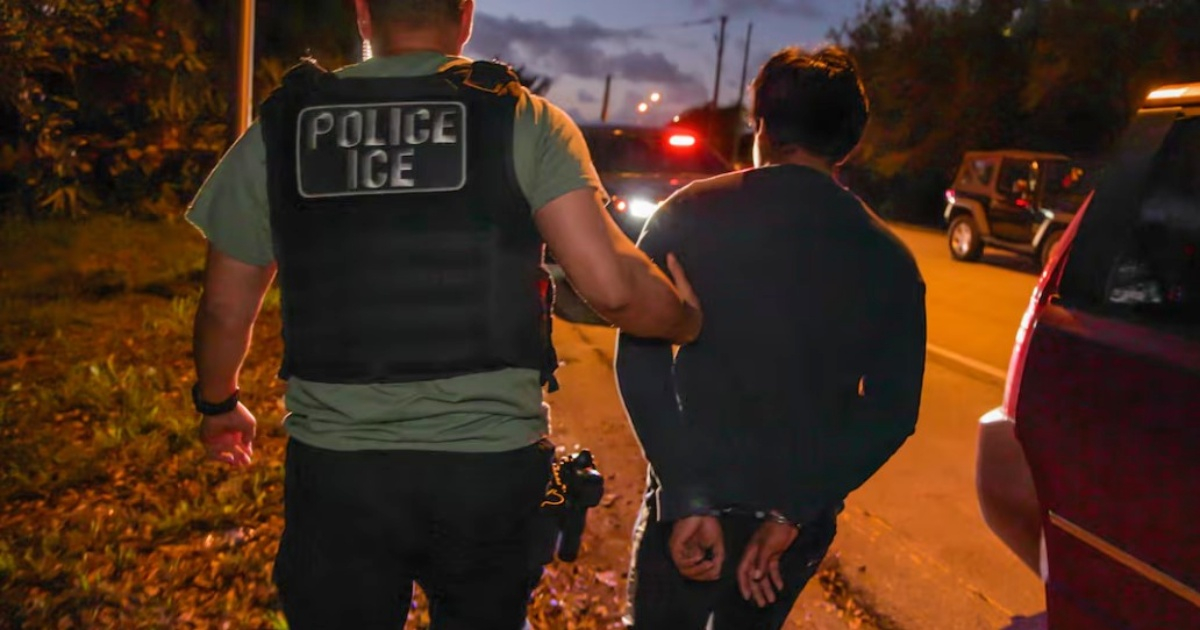
A investigation by ProPublica published on Tuesday documented 506 American citizens detained by immigration agents between January 2025 and September 2026, as part of the immigration crackdown of the second Trump administration.
The report—compiled from social media, court records, and local media—reveals a pattern of violations of constitutional rights that the federal government itself denies and which has direct implications for the Cuban community in South Florida.
The investigative journalism outlet warns that the actual number is likely higher, as federal authorities do not maintain a public record of how many times immigration agents detain U.S. citizens.
The figures that the government denies
The Department of Homeland Security (DHS) has publicly stated that "DHS does NOT mistakenly arrest American citizens", that there are no "indiscriminate" stops, and that "ICE does not use restraints or restrict children." The investigation contradicts each of those claims.
More than a hundred citizens were detained after agents questioned their citizenship; nearly all of them were people of color.
At least 70 minors and adolescents were detained, some handcuffed or restrained with plastic ties.
Another 63 citizens were detained while filming operations, and 36 remained for at least one day without being able to contact a lawyer or family member.
Approximately a dozen were deported, mostly children.
The DHS responded to ProPublica that its operations "are highly targeted," and that the agents "conduct due diligence," but it did not refute the individual documented cases.
Florida: cases that illustrate the risk
In April 2025, a 20-year-old was held for over 24 hours in a Florida jail despite presenting proof of his citizenship.
In Key Largo, a woman was arrested for the third time while driving a vehicle registered in her immigrant partner's name; the video, published by the Miami Herald, shows her telling the officers: “I am a U.S. citizen, please help me.”
This context overlaps with the expansion of the 287(g) program in Florida, which allows local police to act as immigration agents.
Doral —a city with a strong Cuban presence— formalized its agreement with ICE in January 2026 under pressure from Governor Ron DeSantis.
This Thursday, around 170 residents submitted a petition to cancel that agreement.
In addition, there is the detention center Baker Correctional Institution, known as “Deportation Depot”, in north Florida, which houses approximately 1,000 individuals—including Cubans—and operates without having been inspected by the ICE Detention Oversight Office.
Why does this matter to naturalized Cubans?
The ProPublica report does not specifically identify Cubans among the 506 cases. However, the documented pattern—arrests based on skin color, accent, or work environment—exposes the Cuban community in Miami to the same risks as other communities of color.
The detentions of Cubans by ICE increased by 463% between late 2024 and early 2026, and over 42,000 Cubans have pending final deportation orders in the United States.
The fiscal year 2026 ended with 37 deaths in ICE custody, a record high, including at least three Cubans.
What to do if ICE stops you and you are a citizen?
Federal law does not require citizens to carry proof of citizenship during an encounter with immigration agents.
Even so, experts recommend always carrying the U.S. passport, the passport card, or the certificate of naturalization, as they reduce verification time and can prevent prolonged detention.
If an agent stops you, you have the right to clearly and calmly declare your citizenship, to request an attorney before answering questions, and to not sign any documents without legal advice.
The cases documented by ProPublica show that 63 citizens were detained precisely while recording, underscoring that exercising that right also comes with risks in the current climate.
Former officials with decades of experience reacted with alarm to the findings. “I have never seen so many encounters with U.S. citizens in all my years,” stated Darius Reeves, former head of the ICE office in Baltimore.
Eric Balliet, with over two decades at Homeland Security Investigations and Border Patrol, was more straightforward: “This is just terrible.”
El caso de ciudadanos detenidos por ICE es parte de un panorama migratorio en constante cambio. Sigue toda la actualidad sobre arrestos, deportaciones y derechos en nuestra sección de
Related videos:
Filed under: