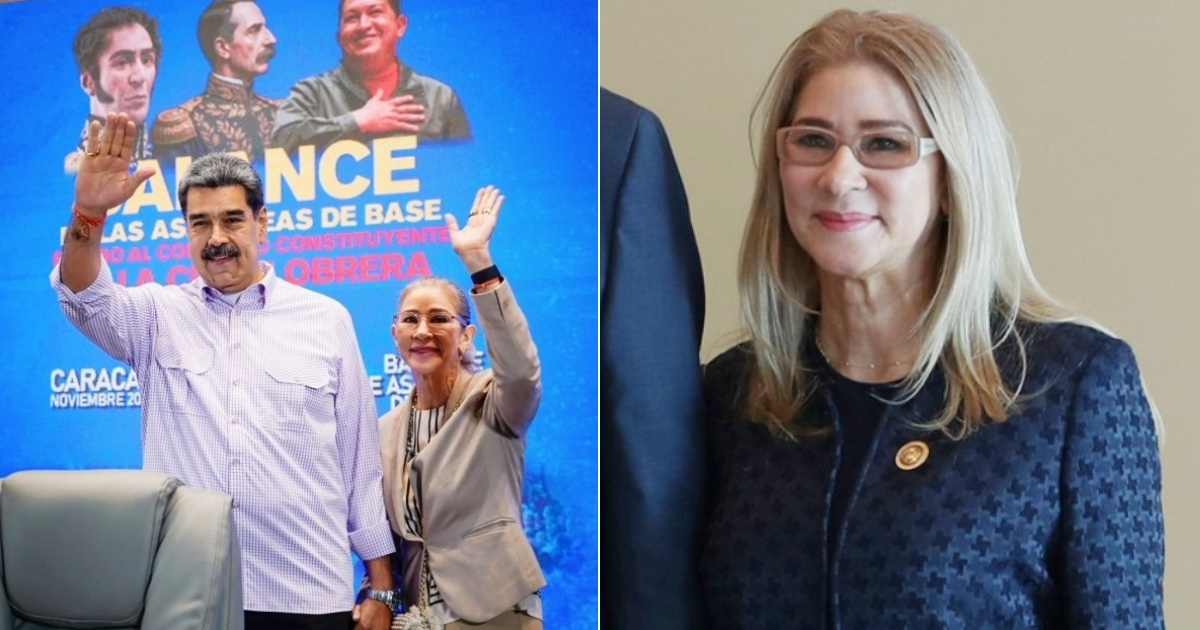
The federal judge Alvin Hellerstein, of the Southern District Court of New York, rejected this Thursday the request for bail and house arrest filed by the defense of Cilia Flores, the wife of ousted Venezuelan president Nicolás Maduro, as reported by the agency EFE.
The decision means that Flores, 69 years old, will remain detained at the Metropolitan Detention Center (MDC) in Brooklyn, where she has been since her capture and transfer to the United States alongside Maduro on January 3rd.
The defense had requested that Flores be allowed to await trial in a private residence, under strict surveillance measures, citing a progressive deterioration of his heart health and that the conditions in prison hamper his medical recovery.
The lawyers proposed 24-hour armed surveillance, GPS monitoring, restricted visits, and intercepted calls, with all costs to be borne by the accused.
The heart problems alleged by the defense
During the hearing held on Thursday, Flores' lawyers presented new medical arguments to justify his transfer to house arrest.
According to the agency AP, the defense claimed that Flores has lost 25 pounds since his incarceration and suffers from severe heart problems.
The attorneys pointed out that Flores suffers from a mitral valve prolapse, has experienced episodes of ventricular tachycardia and arrhythmias, and that he possibly suffered a mild heart attack on July 29, according to evaluations from external medical consultants.
A stress test conducted in April at the Brooklyn Hospital Center was interrupted due to chest pain, while three cardiologists recommended a catheterization that, according to the defense, has not yet been performed.
His lawyers also claimed that Flores suffers from "persistent dizziness, vertigo, and difficulty breathing" and that she was left with permanent scars after allegedly being "thrown against a wall or dresser" during the capture operation in January.
Regarding the risk of flight, the defense argued that Flores is “determined to support her husband with her constant presence”.
The Prosecutor's Office had warned of the risk of flight
The Southern District of New York's Attorney's Office formally opposed on September 23, labeling Flores as “an extreme flight risk and a danger to the public”.
The prosecutors argued that Flores faces a mandatory minimum sentence of 40 years in prison if convicted, which, given her age, would effectively equate to a life sentence and would provide a strong incentive to attempt to escape.
They also warned that, if released, Flores "could directly attempt to intimidate witnesses and victims" in Venezuela.
The Prosecutor's Office also noted that the accused has received medical attention at a local hospital when necessary.
New charges for torture on the horizon
Flores and Maduro were captured at their residence in Caracas during a nighttime operation carried out by U.S. military forces on January 3, 2026, which the Trump administration described as a "surgical law enforcement operation."
Both are facing charges related to narcoterrorism and cocaine importation and have pleaded not guilty.
In parallel, federal prosecutors are preparing new charges for the alleged torture of more than a dozen American citizens detained in Venezuela.
Among those affected are the former marine Matthew Heath, who spent 752 days in prison and reported mock drownings and electric shocks; and Osman Khan, who was detained for 259 days.
Both were detained in facilities of the General Directorate of Military Counterintelligence (DGCIM), an organization highlighted by the United Nations in investigations regarding torture and other human rights violations.
Maduro's son had raised concerns about Flores' health
Days before the court decision, Nicolás Maduro Guerra warned about Cilia Flores' health condition.
"It is a very delicate issue for her," stated the Venezuelan deputy, who also affirmed that Flores is asthmatic and suffered a respiratory episode after the use of tear gas at the detention center.
The situation contrasts with reports of human rights violations and a lack of judicial guarantees against political prisoners during the Chavista government of which Flores was a part.
With the rejection of her application, Flores will have to remain in detention while the judicial process proceeds in the United States.
The next milestone in the case is scheduled for November 17, when motions related to sovereign immunity will be addressed. The trial is set for June 1, 2027.
Related videos:
Filed under: