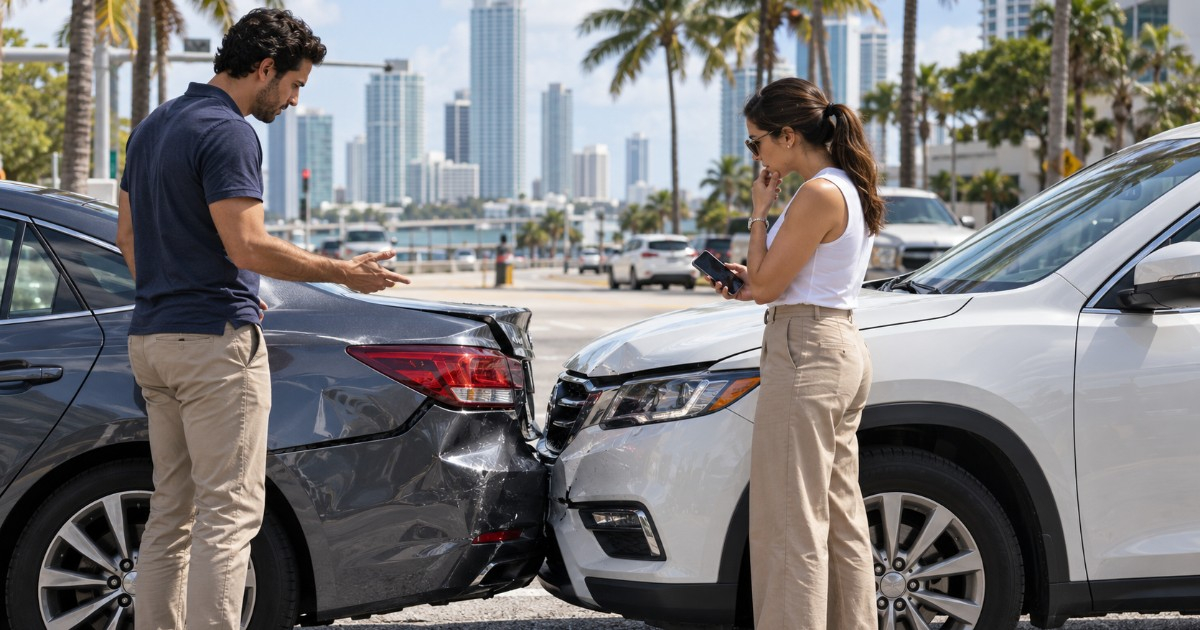
Florida drivers have new rules they need to be aware of after a traffic accident. As of October 1, 2026, the state has raised the threshold for property damage that requires immediate notification of a crash to the authorities from $500 to $2,000.
The modification is part of the SB 488 law, approved by the state Legislature and signed by Governor Ron DeSantis. The measure modifies section 316.065 of the Florida Statutes and affects thousands of drivers, including Cubans who drive daily through Miami-Dade, Broward, and other counties.
However, the change does not mean that all accidents with damages below 2,000 dollars can go unreported. There are other legal obligations, and not calling the Police does not eliminate the driver's responsibilities to their insurance company.
When is it mandatory to call the police after an accident in Florida?
According to section 316.065 of the Florida Statutes, a driver must immediately report the accident to the authorities when any of the following circumstances occur:
There are injured people: any injury requires notification of the accident, regardless of the cost to repair the vehicles.
A death occurs: notification is mandatory regardless of the amount of material damages.
The apparent material damages amount to at least 2,000 dollars: this is the new limit that replaces the previous one of 500 dollars.
The notification must be made by the fastest available means. If the accident occurs within a municipality, it is necessary to notify the local police. Outside of municipal boundaries, the law directs to the county sheriff's office or the nearest Florida Highway Patrol (FHP) station.
In case of injuries, immediate danger, or the need for emergency assistance, you should call 911.
There are also other situations that require special police attention, such as fleeing the scene of the accident, potential offenses related to alcohol or drugs, commercial vehicles involved, or cars that become inoperable and need a tow truck. These scenarios may require more detailed police reports in accordance with Article 316.066.
What happens if the damages are less than $2,000?
Let's imagine that a driver rear-ends another vehicle at a traffic light in Miami. There are no injuries, both cars are drivable, and the apparent damages amount to about $800.
In that case, and as long as no other circumstances require the authorities to intervene, the new threshold allows the accident not to be reported to the Police immediately due to the amount of damages.
But that doesn’t give you the right to leave just like that.
Drivers must stop, identify themselves, and exchange the relevant information. Article 316.062 requires providing name, address, and vehicle registration number, in addition to presenting the driver's license when applicable.
As a precautionary measure, it is also advisable to exchange insurance details and take photographs of the vehicles, the license plates, the damages, and the location where the collision occurred.
The reason is simple: a seemingly minor impact can hide mechanical or structural damage that is only discovered later at a workshop.
Attention: even if the Police are not involved, you may need to submit a report within 10 days
This is one of the most important differences that motorists should be aware of.
The article 316.066(1)(e) of Florida legislation states that drivers involved in accidents resulting in damage to vehicles or other property that do not require a police report must submit a written report to the Florida Department of Highway Safety and Motor Vehicles (FLHSMV) within 10 days thereafter.
Therefore, not needing a police investigation does not equate to being exempt from submitting an accident report.
The FLHSMV provides the official form Driver Report of Traffic Crash (HSMV 90011S), which allows for the documentation of these types of incidents.
According to the form instructions, it can be completed, signed, and emailed to SelfReportCrashes@flhsmv.gov, or mailed to the address provided by the department.
It is advisable to keep a copy of the report and any confirmation of its submission. If the police have already investigated the accident and prepared the corresponding report, this process should not be confused with the report that a driver submits directly when there is no police intervention.
What happens if you hit a parked car and can't find the owner?
There is another important exception that many drivers are unaware of.
Article 316.063 establishes specific obligations when a parked vehicle or unattended property is struck.
In that case, the driver must stop and locate the owner to provide their information or leave a visible and secure note with their name, address, and license plate number.
Additionally, you must promptly notify the relevant police authorities of the accident without unnecessary delay.
Therefore, leaving a note on the windshield does not alone substitute for all legal obligations. The new threshold of $2,000 does not eliminate this provision.
Does the new law change what your car insurance pays?
No. Changing the threshold for notifying the Police does not automatically increase or decrease the coverage contracted with an insurance company.
The Florida Department of Financial Services explains in its official guide to automobile insurance that there are different types of coverage, each with a specific purpose.
Property Damage Liability (PDL): covers damages to third-party property when the insured driver is legally responsible. Florida generally requires a minimum of $10,000 for this coverage.
Personal Injury Protection (PIP): provides coverage for certain injuries and medical expenses, regardless of who caused the accident, within the limits and conditions of the policy.
Collision: is an optional coverage that can pay for the repair of your own vehicle after a collision, subject to deductibles and other contracted conditions.
For example, if a driver has a policy without collision coverage, the fact that the damages are below $2,000 does not mean that their own insurance company has to pay for the repairs to their vehicle.
The responsibility of another driver and the available coverages can also determine which insurer is liable for the damages.
Can you file an insurance claim if you don't have a police report?
The absence of a report prepared by the Police does not automatically mean that a claim is invalid.
However, the insurer may need documentation to determine how the accident occurred, assess the damages, establish liability, and verify that the claim is covered by the policy.
For this reason, the Florida Department of Financial Services recommends contacting the authorities whenever possible, even in seemingly minor incidents, and to notify the insurance company as soon as possible.
The lack of timely notification to the insurer can complicate the claim and, depending on the policy conditions and circumstances, lead to disputes over coverage.
If there are injuries, there is another date that should not be overlooked: PIP protection rules generally require that initial medical attention be received within 14 days of the accident in order to access certain benefits.
This medical deadline is different from the 10 days allowed to submit an accident report when it needs to be done directly to the FLHSMV.
What to do after a crash in Florida
To avoid issues with authorities and insurance, drivers can follow these recommendations:
Stop immediately in a safe location, without leaving the accident scene before fulfilling your legal obligations.
Check for injuries and request emergency assistance when necessary.
Determine whether it is necessary to notify the Police, taking into account the injuries, the apparent damages, and the other circumstances of the collision.
Exchange information with other drivers, including license plates, licenses, and insurance company details.
Document the damages through photographs, videos, and information from potential witnesses, as long as it is safe to do so.
Notify the insurance company in a timely manner and follow their instructions to initiate the claim.
Submit the corresponding report within 10 days when the accident must be documented directly by the driver to the FLHSMV.
What penalties can be imposed for not reporting an accident?
Florida law classifies the failure to notify an accident in accordance with section 316.065 as a non-criminal traffic violation, punishable as a non-moving vehicle infraction.
However, illegally leaving the scene of an accident is a different and potentially much more serious situation. The consequences depend, among other factors, on whether there are material damages, injured persons, or fatalities.
Article 316.061 provides for criminal penalties for leaving the scene of certain accidents with material damage without fulfilling the obligations of identification and remaining at the scene.
Consequently, no driver should interpret the new limit of $2,000 as a permit to leave the scene of a collision without identification or without documenting what occurred.
A law that also introduces changes for registering vehicles in Florida
SB 488 is not limited to traffic accidents.
As CiberCuba previously reported, the same legislation changed the required documents to register vehicles in Florida, a provision that particularly impacts immigrants who use foreign passports as their identification.
The change was also among the 12 laws that came into effect in Florida on October 1.
For drivers, the main conclusion is that an accident may not require the presence of an officer due to the extent of the damages, but it can still generate legal obligations and financial responsibilities.
Documenting what happened, adhering to deadlines, and communicating promptly with the insurance company remain essential to protect your rights.
Related videos:
Filed under: