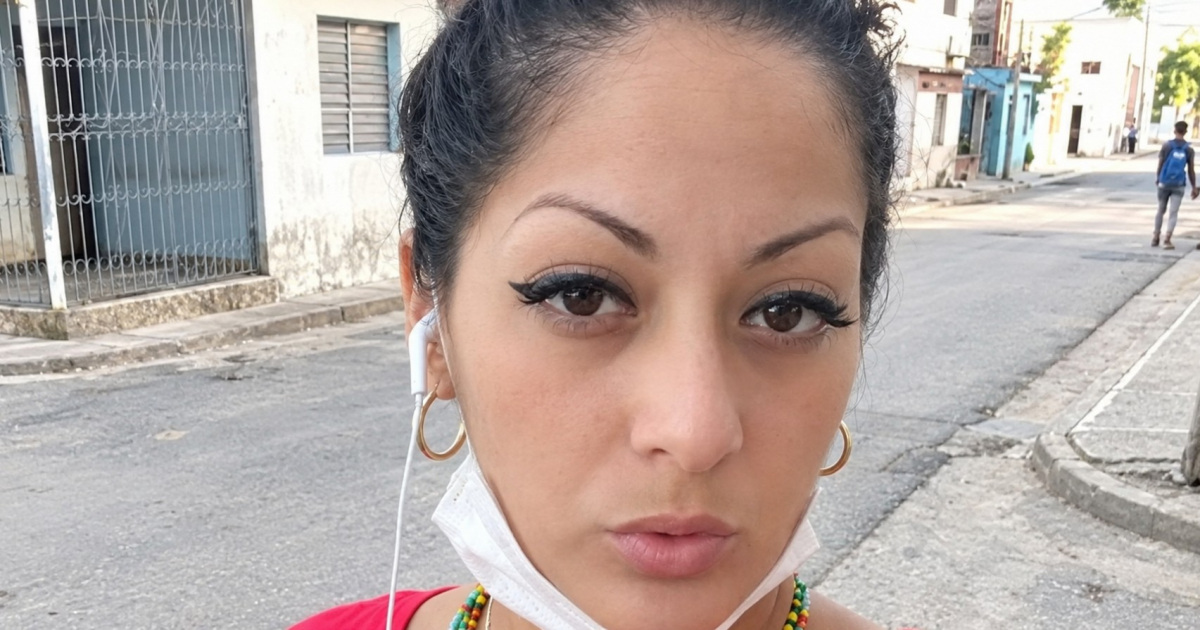
Political prisoner Ana Ibis Tristá Padilla raised concerns from the women's prison in Las Tunas about the serious deterioration of her health in a letter that the Cuban Observatory of Human Rights (OCDH) spread on Wednesday. The organization demanded urgent medical attention and her immediate release.
In her written testimony from the prison known as La Veguita, Tristá Padilla describes three ailments that keep her in a constant state of decompensation: anorexia, chronic asthma, and kidney failure.
"My illness, anorexia, I'm managing it thanks to the immense support from all of you. Chronic asthma and my kidney issues affect me quite a bit, and in general, I am always out of balance," wrote the 37-year-old activist.
To prevent kidney failure, you must take furosemide continuously, but the prolonged use of the diuretic has hardened her legs and damaged her tendons, as she herself reports.
"I can barely walk and I experience daily pain, but I must continue taking it because my kidneys are collapsing," he/she stated.
Cuban authorities have not issued any public response regarding the complaints about their condition or to the request for medical attention made by the OCDH.
This is not the first time that an alert has been raised about her situation. In April, the OCDH had already reported the critical state of health of Tristá Padilla: renal problems that prevented her from urinating normally, extreme weakness, fainting with minimal effort, and bone and joint pain attributed to malnutrition and lack of medical attention.
Ana Ibis's judicial history is equally revealing of how justice operates under the dictatorship. She was arrested in November 2023, accused of organizing a peaceful march that never took place, posting political placards, and planning the launch of Molotov cocktails.
In the first trial, held in November 2024, she was acquitted along with Jarol Varona Agüero due to insufficient evidence. However, the prosecutor appealed the acquittal, the Supreme Court overturned it, and ordered a new trial to be held in Santiago de Cuba, a province different from that of the defendants' residence.
In that second trial, Tristá Padilla received a 14-year sentence for "propaganda against the constitutional order" and "other acts against state security," while Varona Agüero was sentenced to 13 years. The Supreme Court upheld both sentences in August, exhausting the last avenue of appeal.
The OCDH described the process as "a political operation disguised as a judicial process" and noted that "everything is based on reports and interpretations from the Ministry of the Interior and Counterintelligence, institutions directly involved in repression."
The case of Ana Ibis cannot be separated from that of her husband, Damián de Jesús Hechavarría Labrada, also a political prisoner, sentenced to five years in 2021 for shouting “Down with the dictatorship! Homeland and Life!” at one of the first documented events featuring that slogan before July 11. It was then that Ana Ibis publicly took up the defense of political prisoners and became a target of the regime.
Their situation reflects a broader pattern of medical negligence in Cuban prisons. According to Prisoners Defenders, as of the end of August 2026, Cuba recorded a historic high of 1,339 political prisoners, of which 463 had serious medical conditions.
The general repressive context shows no mercy: the OCDH documented more than 3,000 repressive actions between January and September, with 344 occurring in September alone, a pace that already surpasses the total recorded for all of 2025.
"It has been a disastrous month for freedom of expression and independent journalism. The regime, amidst its unpopularity, seeks to impose the law of silence, and unfortunately, we believe things may get worse," warned Yaxys Cires, director of Strategies at OCDH.
Related videos:
Filed under: