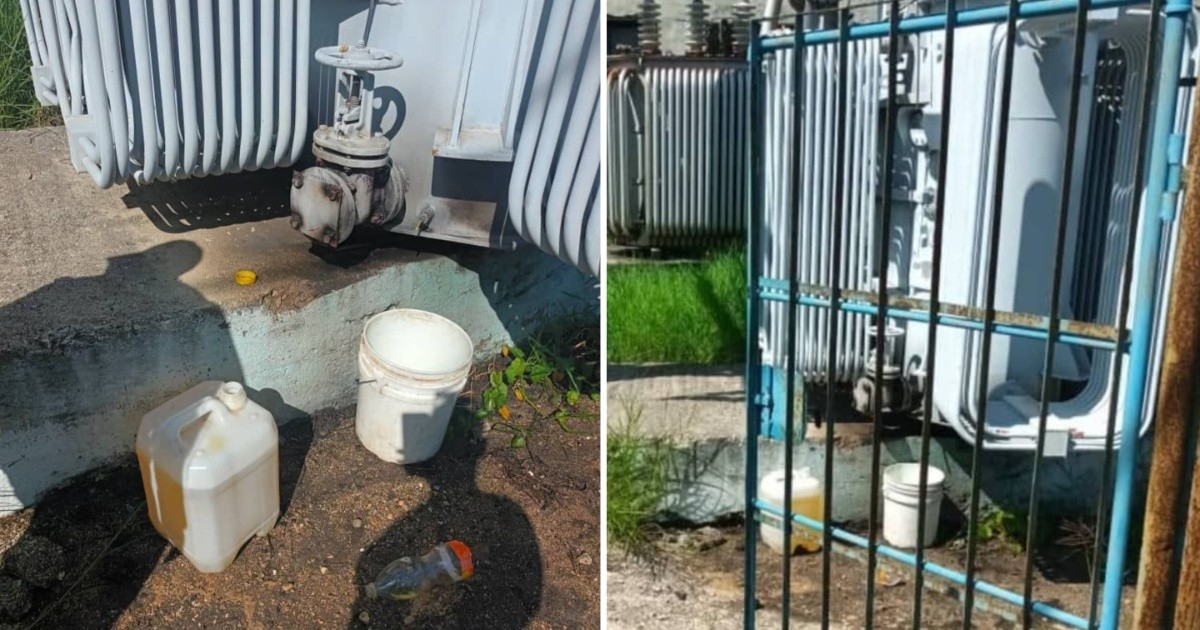
Cuban authorities detected and thwarted an attempt to steal dielectric oil this Friday at the Cubana de Bronce substation, located in the Havana municipality of Guanabacoa, according to the Electric Company of Havana (EELH).
The state entity confirmed on its social media that the transformer was not damaged and assured that those allegedly responsible for the attempt have been captured by the security forces. However, the brief statement did not specify how many people were arrested or their identities.
The note characterized the event as a demonstration of "the effectiveness of the organizational and technical measures adopted by the Electric Company of Havana in conjunction with the response agencies."
The positive result occurred just 10 days after the EELH announced the installation of chemical traps in its substations, a substance that is invisible but detectable under ultraviolet light, designed to identify those who steal the liquid. The case in Guanabacoa would be the first publicly known outcome of these measures in Havana.
The theft of dielectric oil has become one of the main threats to the Cuban electrical system. This product serves functions of cooling and insulation in transformers; its removal leads to overheating, short circuits, and irreversible damage to the equipment.
In the black market, it is sold as a substitute for fuel for tractors and agricultural machinery at prices of between 500 and more than 1,000 Cuban pesos per liter.
The magnitude of the problem was revealed last July when the Minister of Energy and Mines, Vicente de la O Levy, acknowledged before the National Assembly that the theft occurs "daily" and that "the amount of oil that has been stolen is almost equivalent to what we are producing in the same period."
Between 2025 and the first half of 2026, the authorities opened more than 460 criminal investigations for crimes against the National Electric System, more than 300 of which were for the theft of dielectric oil, recorded in all 15 provinces and 97 municipalities of the country.
The courts have responded with severe sentences. In early October, seven individuals received sentences ranging from 12 to 15 years in prison for stealing 1,248 liters of oil at the Moa Nueva substation in Holguín, an act that destroyed the transformer and left more than 6,000 homes without electricity.
On that same date, four men were sentenced to between 15 and 20 years for stealing oil from the Dairy Complex of Havana, causing losses of over 10 million pesos and disrupting the production of staple food items.
Despite the escalating punitive measures, thefts continue unabated. In Holguín, Fabián Vega Genicio, the distribution director for the provincial electric company, warned that by the end of September, 65 incidents threatening the electrical system were recorded, compared to 42 in the same period of 2025, with 36 of those cases related to the theft of dielectric oil, against only four in the same timeframe the previous year.
The Cuban Penal Code, following the approval of Opinion 475/2025 by the People's Supreme Court, allows these thefts to be classified as sabotage, with penalties ranging from seven to 30 years in prison, up to life imprisonment or the death penalty in more serious cases.
Related videos:
Filed under: