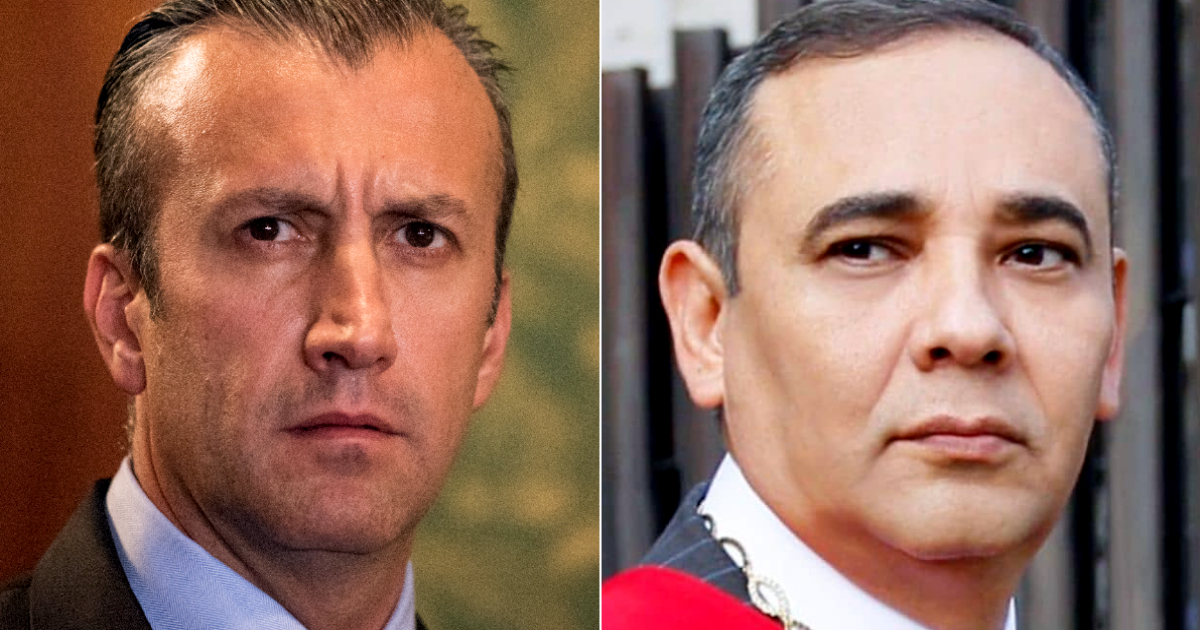
A report by Bloomberg published this Monday regarding the transfer of businessman Álvaro Pulido Vargas to U.S. justice includes a mention that has raised alarms within chavista circles: among those whose custody Washington seeks are former Oil Minister Tareck El Aissami and the former President of the Supreme Court of Justice Maikel Moreno.
The financial media does not claim that both are the next to be extradited, but explicitly identifies them as targets of U.S. authorities within the framework of judicial cooperation that has continued to grow since the capture of Nicolás Maduro on January 3, 2026.
Among the individuals sought by U.S. authorities are former Oil Minister Tareck El Aissami, detained in Venezuela since 2024, and former Supreme Court President Maikel Moreno, states the text from Bloomberg.
The context surrounding that mention is what makes it significant.
Pulido Vargas is at least the third person transferred from Venezuela to the U.S. so far in 2026, and the second one just in October. Before him, in May, Venezuela handed over Alex Saab —former financial advisor and former minister of Maduro— who pleaded guilty to money laundering in a federal court in Miami in July.
At the beginning of this month, Aníbal Alexander Canelón Aguirre was sent to face charges of bank fraud and material support to terrorists.
This pattern of sustained deliveries reflects the policy of the acting president Delcy Rodríguez, who, since replacing Maduro, has redirected Venezuela towards the priorities of Washington. Bloomberg describes this shift as “a growing police cooperation between Caracas and Washington.”
Trump met with Rodríguez in New York in September, and the U.S. removed her from its list of sanctioned individuals in April 2026, acknowledging her immunity as head of state.
The political framework of these deliveries is the three-phase plan articulated by Secretary of State Marco Rubio: stabilization, economic recovery, and transition with free and multiparty elections, which Washington uses as a roadmap to normalize relations with Caracas in exchange for judicial cooperation and economic openness.
In that scenario, El Aissami and Moreno meet all the conditions to be natural candidates.
The first, former vice president and former Minister of Oil, was formally accused by the U.S. in 2019 of ties to drug trafficking, with a reward of 10 million dollars for information regarding his whereabouts, and has been detained in Venezuela since April 2024.
The second, who presided over the Supreme Court from 2017 to 2022, was accused in 2020 of money laundering and bribery to influence judicial decisions, with a reward of five million dollars.
There is, however, a legal obstacle that Caracas has had to navigate with each extradition: the Venezuelan Constitution forbids the extradition of its citizens. Bloomberg points out that this hurdle "raises new questions about how Caracas is proceeding with the extraditions," without the government having publicly explained the legal mechanism it employs.
Meanwhile, Maduro and Cilia Flores remain detained in Brooklyn, where they face charges of narco-terrorism and, since October 8, a new accusation of conspiracy to commit torture, highlighting that judicial pressure from Washington on the chavista environment shows no signs of abating.
Related videos:
Filed under: