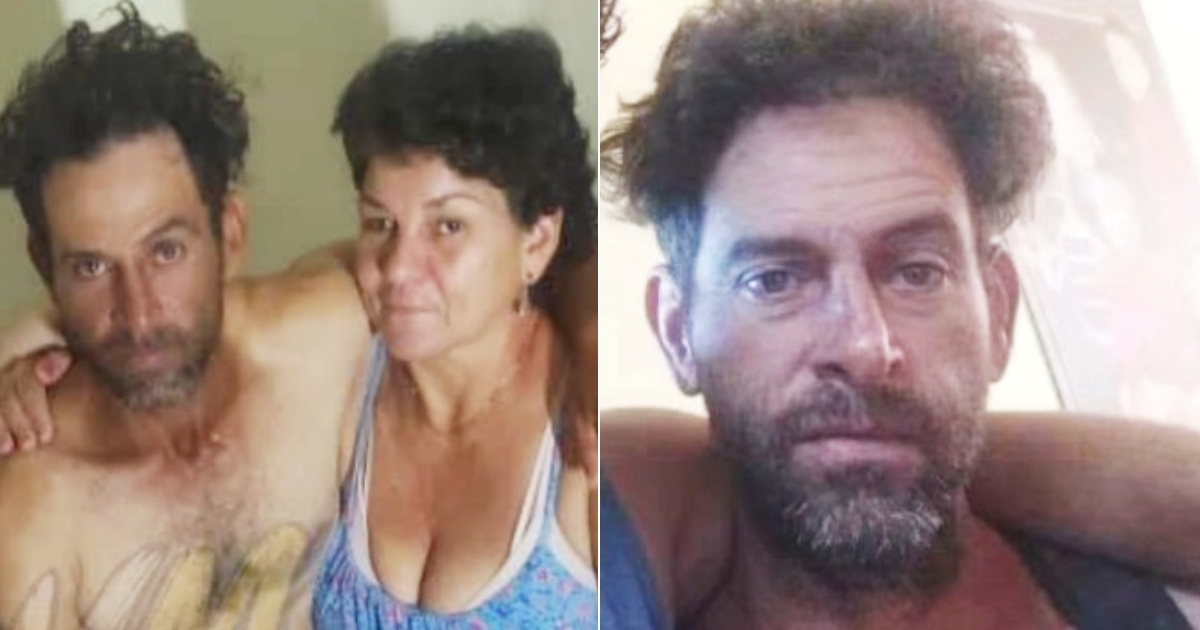
The first images on Cuban soil of Enrique René Reyes Martínez, who was rescued on Monday aboard an improvised raft about 16 miles east of Key Biscayne, Florida, and returned to the island in the last few hours, have been released this Thursday.
The images confirm that the 38-year-old Santiago raftsman is in Havana after being returned by U.S. authorities.
The photographs were published on social media by journalist Yosmany Mayeta Labrada, who also revealed exclusive details about the repatriation process based on testimonies from family sources.
According to Mayeta, the images were taken during the early hours of Thursday.
Contrary to the speculation that placed him in Cojímar, Enrique René is located in another municipality of the capital, the exact location of which has not been disclosed at the explicit request of his family to protect their privacy and safety.
"He's alive, he's in Cuba, and his family already knows his whereabouts!" Mayeta wrote when posting the photos.
The images showed the man in seemingly good health, although he was thin and very sunburned.
In one of the images, he was seen sitting next to two women.
Regarding the return, Mayeta revealed that Enrique René stated that he never set foot on U.S. soil, nor was he hospitalized; rather, he was transferred from one vessel to another until he was taken to the so-called mother ship.
He assured that he received good treatment throughout the entire process.
The journalist Javier Díaz, from Univision 23, also published a photograph of the repatriated balsero, and noted that Enrique René "thanks Our Lady of Charity" for being alive.
Four days adrift and a return without setting foot on land
Enrique René is originally from the Los Cangrejitos neighborhood in Santiago de Cuba, although he had been living in Havana for several years.
On Thursday, October 8, he set out from the beach of Cojímar on a makeshift raft made of foam blocks, wooden planks, and ropes, barely enough for one person.
Four days later, he was found adrift about 16 nautical miles east of Key Biscayne by a couple returning from the Bahamas to Miami.
"They saw a shape in the distance and decided to move a little closer, realizing it was a person on top of the raft," reported a source familiar to Univision.
The couple alerted the authorities via the VHF 16 emergency maritime channel, and units from CBP Air and Marine Operations, along with the Coast Guard, responded to the call.
The family, caught between relief and contradictory accounts
On Wednesday night, family members confirmed the deportation of Mayeta and to other media outlets, although none of his close relatives in Santiago de Cuba had been able to communicate with him personally.
The versions regarding his intentions when going out to sea were contradictory. His aunt, Yelsa Reyes Fabelo, stated: "He was eager to leave Cuba, but that was not intentional."
One cousin, on the other hand, maintained that the man did have plans to emigrate and chose to conceal them from the family so as not to cause worry.
Enrique René is the father of a young girl. His family in Santiago is still hoping to be able to embrace him.
A rescue that reflects a larger crisis
The case of Enrique arises as the legal channels for emigration for Cubans have gradually closed. The Cuban Family Reunification Program ceased accepting new applications in December 2025, and by the end of September, Washington announced additional restrictions on visa categories for Cubans.
Days before the rescue, the U.S. Embassy in Havana posted a discouraging message with the slogan "Don't risk your life, it's not worth it," which prompted an overwhelming number of critical responses from Cubans who pointed out that they also cannot emigrate through legal means.
That same week, the Coast Guard repatriated six Cubans following two separate operations in the Florida Straits. Between 2021 and 2026, over 1.79 million Cubans left the island in the largest exodus in its history.
CBP Air and Marine Operations summarized the seriousness of these journeys in their official statement: "The open sea is relentless, and these trips can quickly become fatal."
La historia de Enrique René refleja las complejas dinámicas de la política migratoria entre Cuba y EE.UU. Sigue todos los desarrollos en nuestra sección de
Related videos:
Filed under: