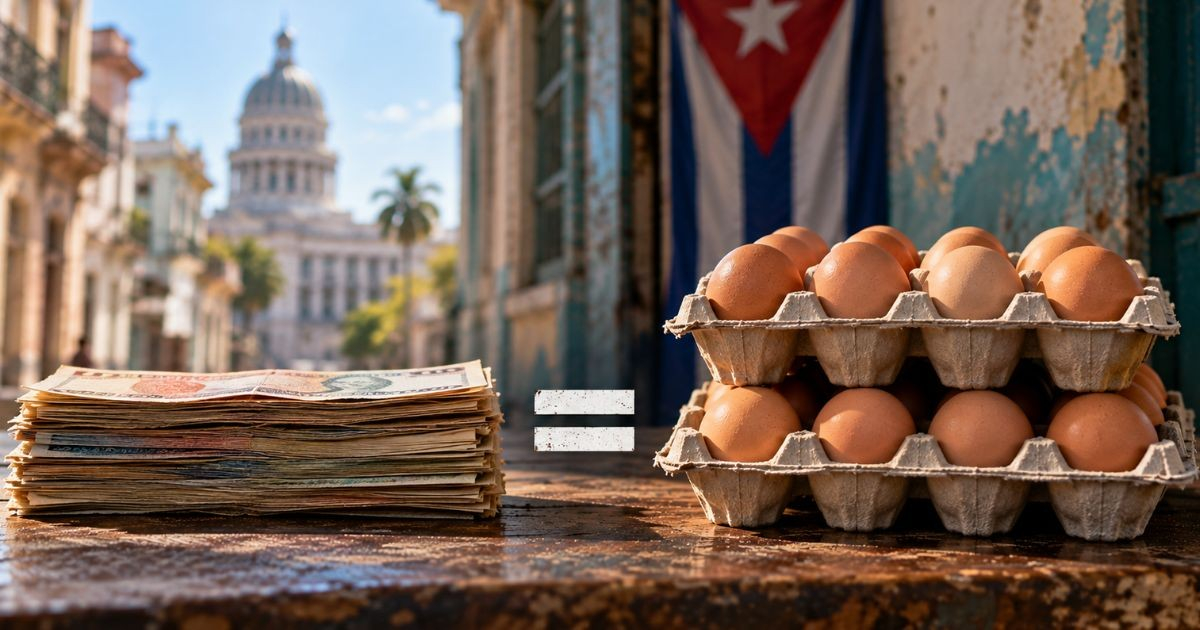
The average monthly salary in Cuba reached 7,354 Cuban pesos (CUP) in August, a figure that represents a nominal increase compared to previous measurements, but which equates to just about eight euros at the informal exchange rate.
In terms of purchasing power, that income doesn't even cover the cost of two cartons of 30 eggs in places where each carton costs around 3,800 pesos or even much more in some locations.
The data was released by the National Office of Statistics and Information (ONEI) in its report "Selected Indicators of the Business and Budgetary System for August 2026", concerning the remuneration of workers within that system.
The institution also published a breakdown by economic activity that shows significant differences between sectors.
According to official data cited by the EFE agency, the average salary increased by 6.12% compared to the figure published in April. However, this increase must be analyzed in light of the rising prices and the depreciation of the Cuban peso.
The year-on-year inflation of the formal market reached 25.19% in August, while the monthly variation was 4.92%.
The difference between the nominal value of the salary and its purchasing power becomes particularly evident when converting it to foreign currency. With the euro valued at over 800 pesos in the informal market, 7,354 CUP is roughly equivalent to eight or nine euros, depending on the exchange rate used.
The conversion at the official exchange rate offers a significantly higher figure, but it does not necessarily reflect the purchasing power of those who need to buy foreign currency or products sold at prices linked to the informal market.
Construction and electricity lead in salaries
The information from the ONEI reveals significant differences among economic activities. Construction topped the salaries in the business and budgeted system, with an average monthly income of 14,743 pesos, nearly double the overall average.
They were followed by the supply of electricity, gas, and water, at 13,376 pesos, and mining and quarrying, at 12,590 pesos.
Business services, real estate activities and rentals also exceeded 10,000 pesos, reaching 10,764 pesos, as did science and technological innovation, at 10,417 pesos. These were the only five activities that achieved average remuneration above that threshold.
Below were transportation, storage, and communications, with 9,408 pesos; manufacturing industries, excluding sugar production, with 8,426 pesos; and financial intermediation, with 7,731 pesos.
Public health and social assistance recorded 7,005 pesos; agriculture, livestock, hunting, and forestry, 6,903; fishing, 6,658; and public administration, defense, and social security, 6,321 pesos.
Sugar workers, commerce employees, and teachers are among the lowest paid
At the bottom of the rankings is the sugar industry, with only 4,724 pesos per month, the lowest average among the activities reported in the publication.
Hotel and restaurant workers received an average of 5,104 pesos, while those in trade and personal effects repair reported 5,217 pesos.
In culture and sports, the average was 5,609 pesos; in other communal services, associations, and personal activities, it was 5,795 pesos; and in education, 5,824 pesos.
This means that the average salary of an education worker represents approximately 39.5% of that recorded in construction. The difference between the two sectors amounts to 8,919 pesos per month.
Even the average salary in the highest-paying sector faces challenges due to the cost of living. The 14,743 pesos from construction, for instance, amount to less than four cartons of eggs if each carton costs 3,800 pesos.
A month's salary to buy less than two cartons of eggs
The most immediate contrast appears in food: a carton of 30 eggs can cost up to 3,800 pesos in private stores in Havana, or even more in the black market or informal sector.
At that price, two cartons amount to 7,600 pesos, which is 246 pesos more than the average monthly salary reported by the ONEI.
The worker who would dedicate their entire income to purchasing a single carton of eggs would spend approximately 51.7% of their salary, not accounting for rice, beans, oil, meat, transportation, electricity, or other essential expenses.
The comparison is not limited to Havana. In September, a report from Trinidad showed cartons of eggs priced at 4,500 pesos, while in August consumers from various provinces reported prices nearing 6,000 pesos per carton.
Another recent example was provided by a Cuban who calculated how much a newly graduated teacher could buy with their salary. A selection of eggs, beans, rice, potatoes, bananas, and cassava amounted to 7,150 pesos, exceeding the 7,035 pesos that, according to the testimony, that teacher received monthly.
An increase that does not meet basic needs
The insufficiency of income is not a concern exclusive to economists or consumers. In July, officials from the Ministry of Labor and Social Security acknowledged that the new minimum wage of 3,210 pesos does not cover the basic basket of goods and services.
This minimum wage, effective from July 2026, should be distinguished from the average salary of 7,354 pesos reported now by the ONEI: the former establishes a minimum wage for workers covered by the relevant regulations; the latter is a statistical average that encompasses very different remuneration.
The nominal increase in salary, therefore, does not automatically equate to a recovery of purchasing power. When the prices of food and services rise faster than wages, workers may earn more pesos but still be able to buy fewer products.
The August report presents an evident paradox: while official statistics record an average salary of 7,354 pesos, in certain Cuban markets that monthly income barely suffices to buy a carton of eggs and a few additional food items.
For millions of household decisions —what to buy, what to postpone, and what to stop consuming— the difference between the announced salary and its real value is much more important than the increase reflected in the numbers.
Related videos:
Filed under: