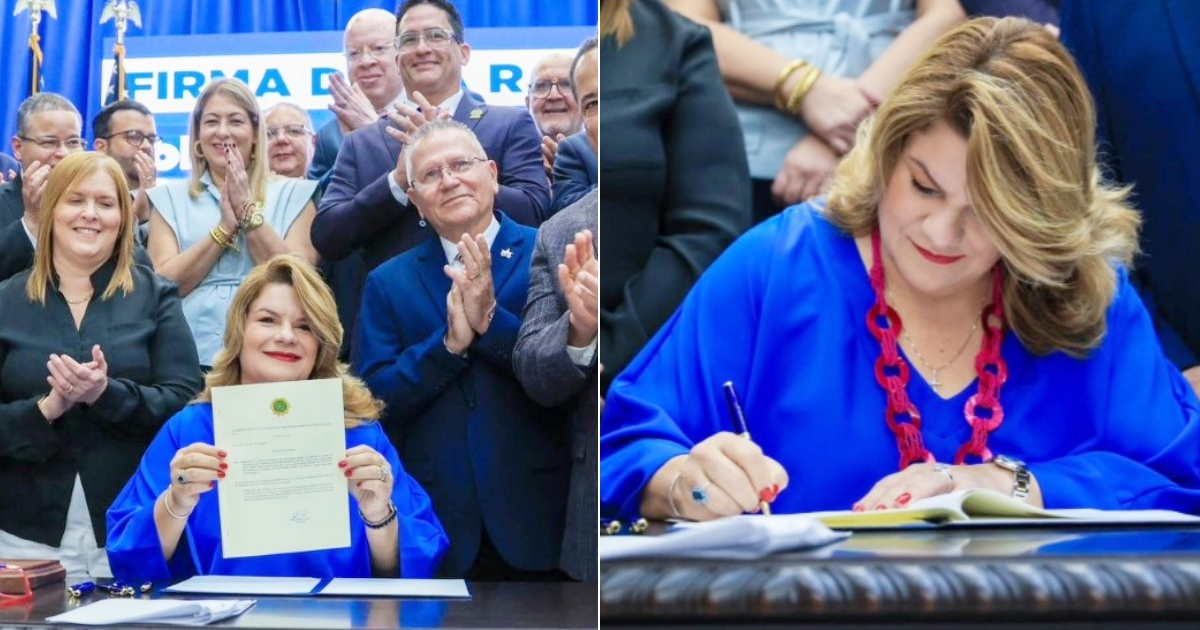
Jenniffer González Colón, governor of Puerto Rico, signed this Friday Resolution Joint 66-2026, through which she formally requests President Donald Trump and the United States Congress for the admission of the island as the 51st state of the Union, on equal terms with the other states.
The event took place at an official ceremony attended by lawmakers from the majorities in the House and Senate of Puerto Rico, cabinet secretaries, and representatives of civil society.
"I signed Joint Resolution 66-2026, which formally requests the President and the Congress of the United States to admit Puerto Rico as a State of the Union, on equal footing with the other states," the governor wrote on X.
He added that the measure honors an electoral commitment: “With this signature, we fulfill the commitment of our Government Program to prioritize statehood and honor the will of our people expressed at the polls.”
González also appealed to the historical contribution of Puerto Ricans to the United States.
"Puerto Ricans have contributed to the development of our Nation, defended its freedoms, and fulfilled the responsibilities of American citizenship. It is now the responsibility of Congress to address that will and exercise its constitutional authority to admit Puerto Rico as a state of the Union," he added.
What does the resolution establish?
The Joint Resolution 66-2026, also referred to as Concurrent Resolution of the House 391, goes beyond a symbolic statement.
According to the official material released by the governor herself, the document "strongly establishes the formal request for Puerto Rico's admission as a State of the Union as the public policy of the Government of Puerto Rico" and mandates the use of all governmental resources to promote it in any available forum.
The resolution was formally sent to Trump, to the presidents of the Senate and the House of Representatives, and to all members of Congress.
What comes next? The long constitutional road
The signing is a significant political step, but it does not automatically turn Puerto Rico into a state.
The constitutional process demands that the federal Congress approves an admission law under Article IV, Section 3, Clause 1 of the U.S. Constitution, which involves introducing a bill, reviewing it in committees, passing it in both chambers, and enacting it by the president.
The main obstacle is Trump's own position.
In May 2026, he described Puerto Rico's statehood as "a disaster," and in July he stated that he would "cry" if Puerto Rico and Washington D.C. become states.
In light of this situation, González indicated that he will wait for the 2026 midterm elections to promote a new congressional project.
It's not the first attempt.
Puerto Rico voted in favor of becoming the 51st state in November 2020, with 52.52% of the votes, but Congress did not approve any admission legislation.
In December 2022, the House approved the H.R. 8393 bill with 233 votes in favor, but the Senate did not ratify it.
Divided reactions
Pablo José Hernández, resident commissioner in Washington and president of the Popular Democratic Party (PPD), stated that the resolution will not change the political status of the island, and questioned the Government's prioritization of statehood over urgent issues like electricity and drinking water.
Juan Dalmau, from the Puerto Rican Independence Party (PIP), described the measure as a political act and stated that it does not represent a serious effort to address the status of Puerto Rico.
The debate historically features three positions: statehood—advocated by the New Progressive Party (PNP) of González—maintaining the current status as a Commonwealth, and independence.
Those who oppose warn of the risk of losing cultural identity and fiscal sovereignty.
A territory in limbo since 1898
Puerto Rico has remained under the authority of Washington since 1898, when Spain ceded the island after the Spanish-American War.
In 1917, Puerto Ricans were granted U.S. citizenship, although they did not have the right to vote in presidential elections or full representation in the federal Congress.
The island is exempt from federal income taxes but contributes to Social Security and Medicare, and receives less federal funding than the states in the Union.
The resolution signed by González is the most recent formal action in a history of at least seven consultations on the status since 1967, none of which have produced any real change.
The next decisive step now depends on a Congress and a White House that, so far, have shown little enthusiasm for the cause.
Related videos:
Filed under: