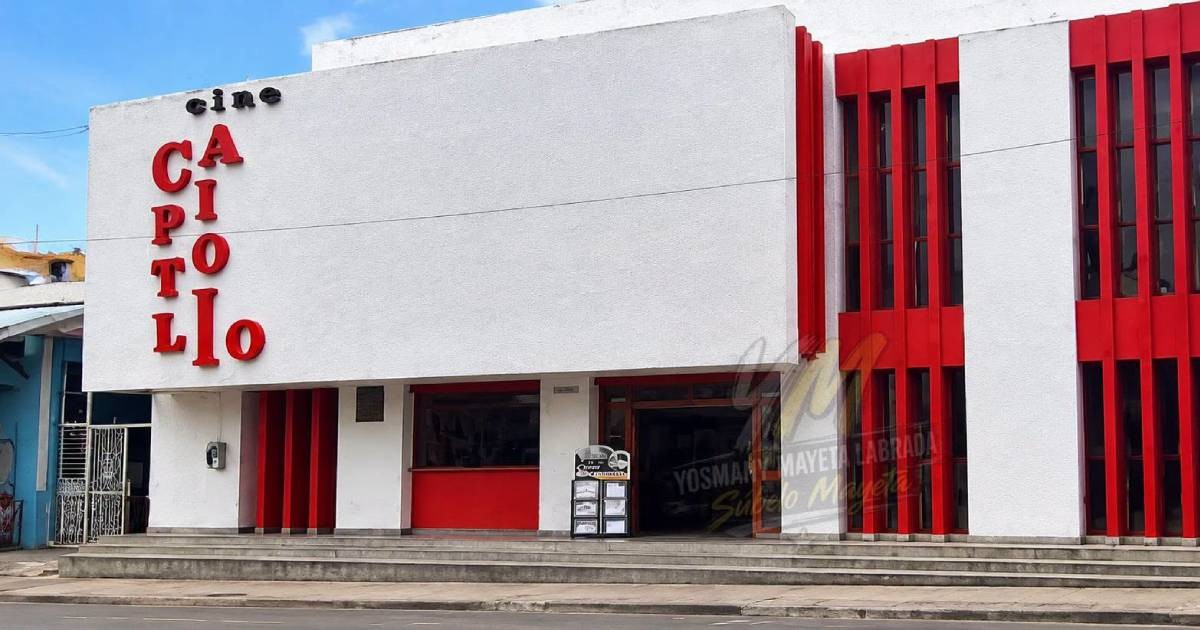
The Cine Capitolio in Santiago de Cuba, one of the most iconic cultural venues in the city, was reportedly the victim of a robbery early Saturday morning: unknown individuals took the building's front door, according to a report filed by independent journalist Yosmany Mayeta Labrada.
The testimony came from a Santiago resident who contacted the journalist. According to the account, this is not the first time the property has experienced this kind of theft: previously, sheets of zinc that covered part of the roof had gone missing.
The photographs released this Saturday show one of the entrances of the Cine Capitolio completely open, with no authority having publicly explained the circumstances of the incident or who is responsible for the security of the building.
The Capitol was inaugurated in 1939 on Victoriano Garzón Avenue, specifically built as a movie theater on a lot that previously housed a garage.
Its modernist architecture —white walls, red details, and elongated vertical windows— made it part of the second major expansion phase of movie theaters in the city, alongside venues such as the Cuba, Rialto, Maceo, and Fausto theaters.
After the Revolution, the property was nationalized and incorporated into the public exhibition network. Over time, it ceased to operate as a movie theater and was converted into a Cultural Center of Artex, the Cuban state company for artistic promotion, according to an academic research published in the Alcance magazine of the University of Havana.
The case is not an isolated incident. Just days earlier, the repeated theft of wooden boards from the benches in Plaza de Marte in the same city shocked the people of Santiago, allegedly to be used as firewood during the prolonged blackouts.
In August, thefts of heritage items were also reported in Matanzas, Holguín, and Las Tunas: metal railings, a bronze star from the mausoleum of Calixto García, and a bust of Antonio Maceo.
The decline of Cuban cinemas reflects a national pattern. About 80% of the approximately 398 cinemas that existed in Cuba have closed in recent decades, according to data collected by photographer Carolina Sandretto in a study published in 2018.
The XI Festival cinema in Alamar was documented in April 2026 in a state of complete ruin, and the historic Payret cinema-theater in Havana has remained closed since 2008 amid controversy over its potential conversion into a luxury hotel.
Mayeta Labrada summarized the frustration of many Santiago residents with a direct question: "Who protects the historical buildings in a city where even the doors disappear?"
"A city does not only lose its buildings when they disappear," Mayeta wrote. "It also loses part of its history when it allows them to be dismantled piece by piece."
Related videos:
Filed under: