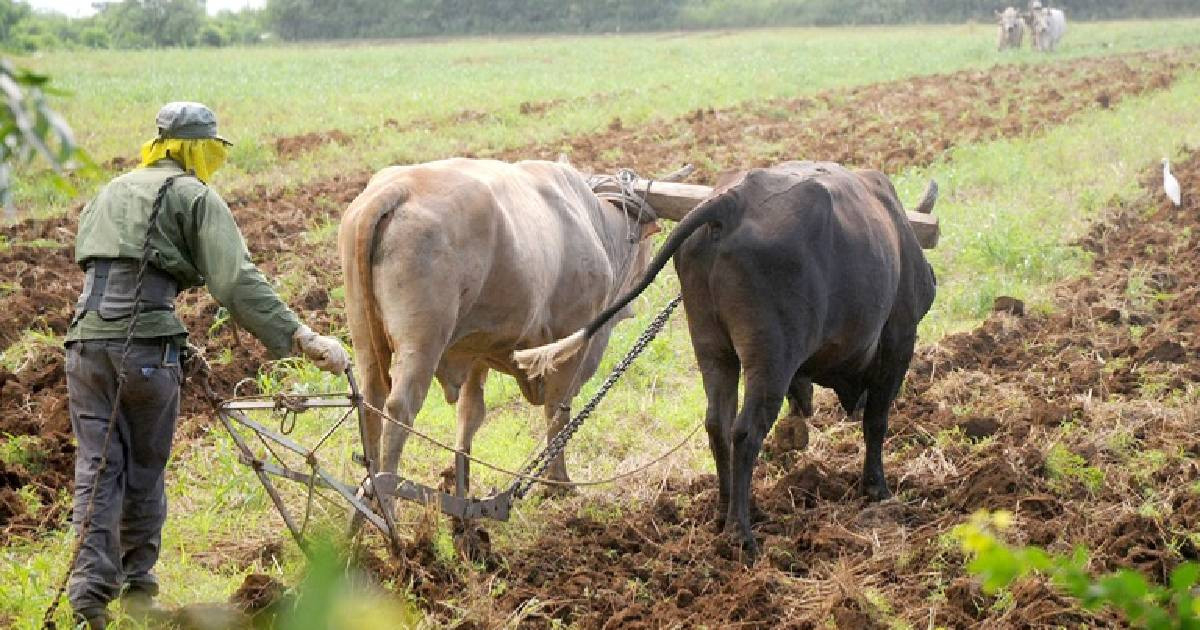
The provincial delegation of Agriculture in Guantánamo has made available over 8,400 hectares of land across the 10 municipalities of the province, suitable for coffee, cocoa, rice, sugarcane, various crops, and livestock. However, the official information acknowledged that only 20 hectares of this total area have irrigation facilities.
The announcement, published this Thursday by the provincial newspaper Venceremos, was made by Alvernis Veranes Favier, the top agricultural director of the eastern territory. It is part of the seventh thematic axis of the economic and social transformations promoted by the government, which states in section 58 to "modify the management and use of land for all economic actors."
Within that framework, the state-owned enterprises that manage socialist-owned lands can grant them in usufruct through contracts to state, private, mixed, or individual legal entities for an indefinite period and according to the submitted project.
The 8,451.58 hectares offered are distributed among multiple companies and cooperatives. The largest individual offer comes from Azcuba with 2,200 hectares, followed by the La Tagua subsidiary in Manuel Tames, with 1,597.84 hectares primarily designated for coffee, various crops, and livestock.
The Yateras Agroforestry Company contributes an additional 1,020 hectares for coffee and cocoa, while the Agricultural Production Cooperatives (CPA) provide a total of 734 hectares.
However, the most revealing limitation of the announcement is one that the official text acknowledges without emphasis: "there are only 20 hectares of irrigable land in the Agroindustrial Company of Guantánamo," which offers a total of 380.48 hectares, of which 353.48 are designated for livestock and 27 for various crops.
This figure illustrates one of the most serious structural problems in Cuban agriculture. Nationwide, the irrigated cropland does not exceed 10% of the total, according to specialists from the Ministry of Agriculture, which severely limits the productive potential of any land transfer.
The provincial offer comes weeks after Cuba opened idle state lands to small and medium-sized enterprises (mipymes) through Law 185 on Agricultural and Forestry Land, approved on July 29 and published in the Official Gazette in September.
The regulation extends usufruct rights to small and medium-sized enterprises, foreigners, and contracts of up to 25 years that can be renewed, and it will come into effect around December 8.
Bureaucracy remains another recognized obstacle. Earlier this month, the Deputy Minister of Agriculture, Telce Abdel González Morera, publicly admitted a "mismanagement" in the processing of land allocation applications, attributed to staff changes and lack of follow-up.
Cuba imports between 70% and 80% of the food it consumes, at an estimated cost exceeding $2 billion annually, amid a decline in production that reached 95% for pork, 87% for rice, and 70% for beans from 2018 to 2023, according to data from the World Food Program.
Law 185, which the regime portrays as the most comprehensive agrarian reform in decades, will have to prove in practice whether it can reverse decades of deterioration in a country where the usufruct system has existed since 2008 without resolving the structural food dependency.
Related videos:
Filed under: