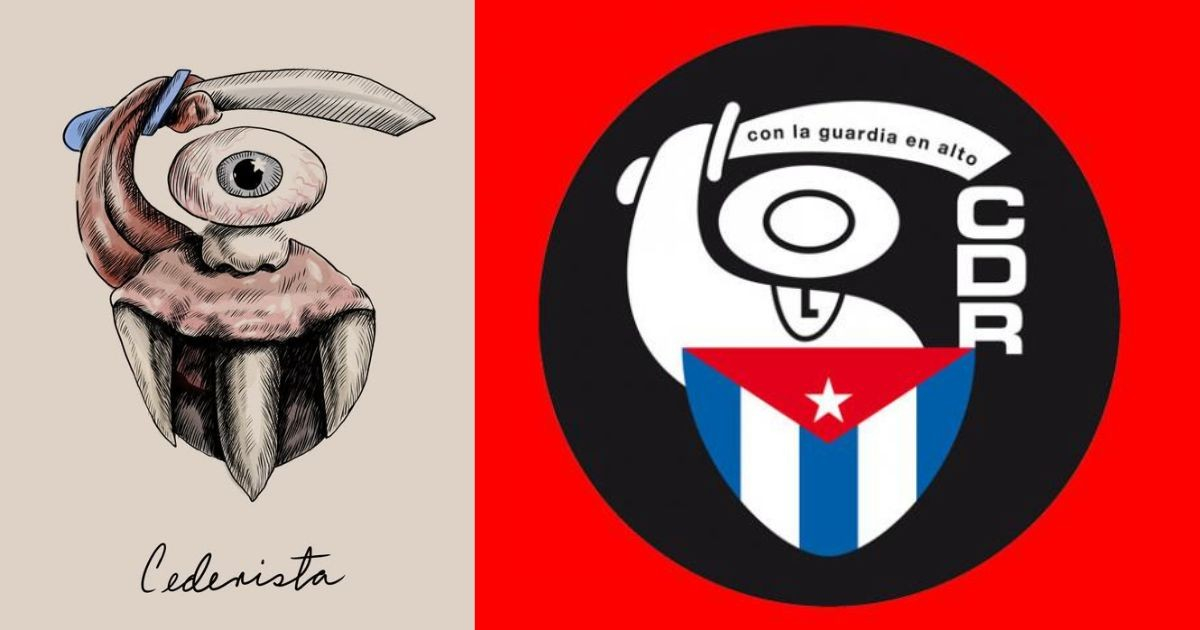
The Cuban artist Camila Lobón transformed the cederista into an illustration monster—although, to be honest, the creative work had already been done by Fidel Castro in 1960—with the 32nd installment of her satirical series "Miserable Bestiary", published in the digital magazine Rialta on Tuesday, October 13, and shared on her social media this Thursday.
The piece, titled "Cederista", seems to represent an anthropomorphized claw with an inquisitive eye and a machete held by a tongue-arm: an image in a surreal-gothic style whose design, as explained by Lobón herself, "derives from the original logo of El Cederista," that emblem created by Cándido Justiz Pileta —the first national head of Surveillance for the organization— with the motto "With the guard up."
The artist, who admits to feeling "a dark satisfaction" while creating this piece, accompanies the illustration with a text that serves as both political analysis, personal reflection, and a statement of accusation.
"It was only 1960 when one of the most lethal institutions that freedom has ever known was born in Cuba," writes Lobón, before quoting the founding words of the late dictator: the system was to be "a system of revolutionary collective surveillance" so that everyone would know who lived on the block, "what they were doing; who they were associating with; what activities they were involved in."
The result of such a patriotic initiative was captured with surgical precision: "With reporting institutionalized as a patriotic duty, meanness found the perfect civic disguise. The neighbor became the enemy, and camaraderie turned into a collective syndrome of suspicion."
Lobón, born in Camagüey in 1995, educated at the Higher Institute of Art of Havana and exiled in the United States since October 2021 after years of harassment by State Security, writes from the vivid memory of someone who grew up under that surveillance: “The elders threatened us with the lurking Cederista, as if it were the Boogeyman or the Sack Man, every time we expressed any semblance of political concern.”
The illustration comes just two weeks after the 66th anniversary of the CDR, celebrated on September 28, at a time when even the regime itself acknowledges that the organization is facing significant challenges. Díaz-Canel acknowledged to CDR members that "many people believe that this is an outdated organization, that it makes no sense under current conditions, that it contributes nothing" — which did not prevent him from subsequently requesting an expansion of its neighborhood surveillance role, as coherence has never been a strong suit of the regime.
The activist Alina Bárbara López described the CDR, an organization currently led by the former Cuban spy Gerardo Hernández Nordelo, as a “gigantic and unproductive bureaucratic structure without social basis” in September; while the regime, true to form, honored 134 outstanding CDR members through a presidential decree that same month.
In the comments on the post, netizens did not hold back: one pointed out that the CDR "turned a vice into a revolutionary virtue" and that "the revolution is nothing more than a vast work of corruption"; another noted that from this "the true New Man was born: a snitch, meddling in his neighbor's life, and envious"; a third warned that the beast is still very much alive: "they are denouncing today's protesters, that's how many have ended up in prison."
That last observation is statistically supported: Cuba recorded 1,372 political prisoners as of October 1, 2026, a historic record according to Prisoners Defenders, in a country that also suffers power outages of between 18 and more than 20 hours daily and an electricity generation deficit that frequently exceeds 2,000 MW.
Lobón concludes his text with a reflection that transcends the Cuban geography: “This creature, unfortunately, is not endemic to Cuba or to any particular ideology or political system. A combination of two disastrous human weaknesses—cowardice and selfishness—can be found just as easily dining beside Christ as denouncing a Jew to the Nazi authorities [...]. It only requires, to manifest itself, that power places it in the dilemma of either pushing others or receiving the blows.”
Related videos:
Filed under: